
Klaviyo Split Testing: 12 Proven A/B Tests to Boost Conversions, Clicks & Sign-Ups
Most brands stick to what’s “safe” — but safe doesn’t scale. Without testing, you’re likely leaving conversions, clicks, and subscribers on the table. Klaviyo’s split testing tools go far beyond subject lines — they cover flows, forms, SMS, and holdout groups that measure true revenue lift. This guide gives you 12 proven A/B tests used by high-growth ecommerce brands to make smarter, data-backed decisions.
- The foundations of Klaviyo split testing — where, how, and when to test
- 5 campaign email A/B tests to maximise clicks and revenue
- 4 flow A/B tests to boost conversions across key lifecycle stages
- 3 sign-up form A/B tests to grow your list faster
- How to use holdout groups to measure true automation lift
- A testing roadmap by funnel stage — and how to analyse results
The Foundations of Klaviyo Split Testing
Klaviyo split testing helps brands optimise retention across email, flows, forms, and SMS by validating what drives performance — using real data instead of assumptions. Here’s where you can run tests and how Klaviyo handles them.
Test subject lines, content, design, and CTA placement within the campaign builder. Klaviyo automatically sends the winning variant to the remaining list after your test window ends.
Use the Random Sample split block to test different branches, timing strategies, or messaging approaches within automated sequences like Welcome, Abandoned Cart, and Post-Purchase.
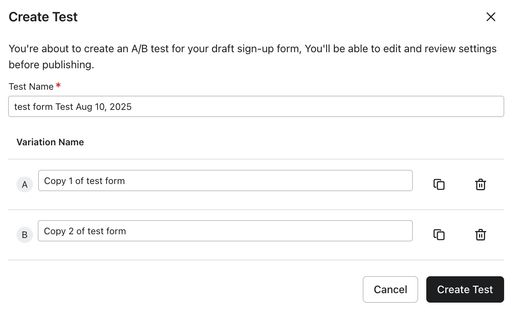
A/B test copy, visuals, offers, incentive types, and trigger timing directly in the Klaviyo form builder to find what drives the highest submission rate.
Native SMS A/B testing isn’t available. Instead, clone messages and segment your audience, then compare performance metrics (click rate) in Klaviyo analytics.
Key Rules for Clean Split Tests
- Test one variable at a time — prevents false positives and reveals exactly what’s driving results
- Minimum 5,000 recipients for campaign tests to reach statistical significance
- Default split is 50/50 — flow tests allow custom splits like 70/30 for lower-risk experiments
- Define your winning metric in advance — CTR, revenue per recipient, or conversion rate depending on test type
- Set a test window — Klaviyo’s campaign builder lets you customise test duration before auto-sending the winner
Klaviyo campaign A/B tests go far beyond subject lines. You can test creative, layout, tone, and CTAs to find what drives higher clicks and revenue across your full subscriber list.
Curiosity-led subject lines drive intrigue — clarity-led lines set expectations. Which wins depends on your audience’s trust level and where they are in their journey. Personalised variants like “{{ first_name }}, here’s something better” are worth testing separately.
Preview text is often ignored but reads alongside the subject line in most inboxes. Urgency signals scarcity; value signals benefit. The winning combination depends on your offer type and audience segment.
High-intent subscribers click the top CTA without needing persuasion. Lower-intent or new subscribers often need more context before they’ll click. Test both placements to find the right balance for each flow or campaign type.
Lifestyle imagery builds aspiration and brand feel. Product close-ups drive clarity and reduce purchase hesitation. The right choice depends on your campaign goal — brand-building vs. conversion-first.
Long-form storytelling works well for brand-scaffolding emails (welcome, about, founder). Short punchy layouts drive urgency in promotional or re-engagement sends. Test both on the same audience to find the format that converts best for each campaign type.
Klaviyo’s Random Sample split block lets you A/B test automated journeys across key lifecycle stages — comparing timing, tone, incentives, and channels in real flows with real customers.
Some brands see stronger first-purchase conversion without a discount offer when the brand story is compelling enough to close the sale on its own. An incentive-first welcome can also train subscribers to wait for a discount on future purchases.
Plain text SMS can feel more personal and conversational — like a message from a friend. Branded image SMS may improve visual urgency. The winner often depends on your brand’s overall tone and the AOV of the abandoned cart.
Personalised product blocks using Klaviyo’s dynamic product recommendations — based on purchase history, category, or price tier — typically outperform static blocks for repeat order rate. But the lift depends on catalogue size and data quality.
Immediate sends maximise urgency — but can spike unsubscribes from customers who recently browsed without strong intent. A short delay can improve subscriber experience without meaningfully reducing conversions, especially for high-demand products.
How to Set Up a Klaviyo Flow Split Test
Sign-up forms are your frontline for list growth. Even small tweaks in copy, offer type, or trigger timing can dramatically change submission rates — and the quality of subscribers you acquire.
Benefit-led headlines are clear and direct — they convert well on desktop for high-traffic brands. Curiosity-led headlines drive intrigue and tend to perform better on mobile. Run by device segment if you suspect platform-level differences.
Price-sensitive customers respond to percentage discounts; convenience-focused customers respond to free shipping. Free shipping typically outperforms for lower-AOV products where shipping costs feel proportionally large. Percentage discounts tend to win for higher-ticket items.
Scroll-based triggers engage actively browsing users who are already interested. Exit-intent captures visitors about to bounce — a last-chance moment. For returning visitors, scroll tends to convert better; for first-timers, exit-intent captures more leads before they leave.
Use Holdout Groups to Measure True Automation Lift
Holdout groups let you measure whether your flow actually drives incremental revenue — or whether customers would have converted anyway without the email. This is the most rigorous way to prove ROI from Klaviyo automations.
Measure the impact of nurturing on first-time purchases. Compare first-purchase rate between recipients and the holdout group.
Track whether cross-sell or educational emails genuinely lift reorder rates — or if customers reorder regardless.
Test if emails boost loyalty programme participation versus a control group that receives no prompts.
Compare reactivation rates between the win-back flow recipients and a passive holdout group with no communication.
How to Set Up a Holdout Group in Klaviyo
Metrics to Track After Every Klaviyo Split Test
Interpreting results correctly is where the real value lies. Focus on these metrics — not just open rate — to make decisions that drive actual revenue.
What to Do After a Test Ends
- Promote the winning variant to 100% of traffic and set it as the new default
- Launch a follow-up test on the next variable in your testing roadmap
- Document results — hypothesis, winner, lift percentage — in a shared testing log
- Share wins with design, copy, and product teams to embed learnings across channels
Common Klaviyo Split Testing Mistakes to Avoid
| Mistake | Consequence | Fix |
|---|---|---|
| Testing with under 2,000 recipients | Statistically insignificant results — any winner is likely noise | Wait until you have 5,000+ eligible recipients before running campaign tests |
| Testing multiple variables simultaneously | Can’t attribute results to a single change — wasted data | Change only one element per test: subject line OR layout OR CTA — never two at once |
| Calling a winner too early | False positive — result reverses with more data | Set a minimum test window (4–24 hours for campaigns; 30+ days for flows) |
| Optimising for open rate alone | Subject line winner may underperform on revenue | Always check RPR and conversion rate alongside open rate before declaring a winner |
| Running tests during flash sales or peak periods | Promotional uplift contaminates your test data | Test during normal trading periods — isolate promotional sends from learning tests |
| Never documenting results | Repeat the same tests; lose learnings when team members change | Keep a shared testing log with hypothesis, variable tested, winner, and lift percentage |
Frequently Asked Questions About Klaviyo Split Testing
Key Takeaways
- Go beyond subject lines: Most brands underuse Klaviyo’s testing tools — flows and forms offer bigger, more consistent revenue impact than campaign open rate tests.
- Use Random Sample splits for flows: Test timing, tone, incentives, and product block types to improve LTV and post-purchase engagement systematically.
- Form tests compound over time: Pop-up copy, offer type, and trigger timing improvements stack — a 2% lift in submission rate has a long-term impact on your entire list and revenue.
- Track the right metrics: Focus on RPR and conversion rate — not just open rate. Open rate wins don’t always translate to revenue wins.
- Use holdout groups for automation: The only way to know if a flow drives incremental revenue is to measure against a control group that receives nothing.
- Document and repeat: Keep a testing log. The brands that compound results are the ones who build on past learnings — not the ones who start from scratch every quarter.