



An ecommerce customer journey email program sends each shopper the message that fits where they are: new subscriber, browser, buyer, repeat customer or lapsed customer. In Klaviyo, that means one automated flow per stage, each triggered by what the person just did. Most stores cover the steps before the first order well and leave the stages after it nearly empty.
Short answer: Map seven stages (awareness, consideration, conversion, onboarding, retention, win-back and loyalty) to one Klaviyo flow each, then check how much revenue each stage brings in. In Sendora Lab’s client data, the stages before the first order earned over 90% of flow revenue, which tells you where the next build should go: after the first purchase.
The seven stages of the ecommerce customer journey
The customer journey is the path from first hearing about a brand to buying again and again. For email, it helps to split it into seven stages, each with one question the shopper is asking.
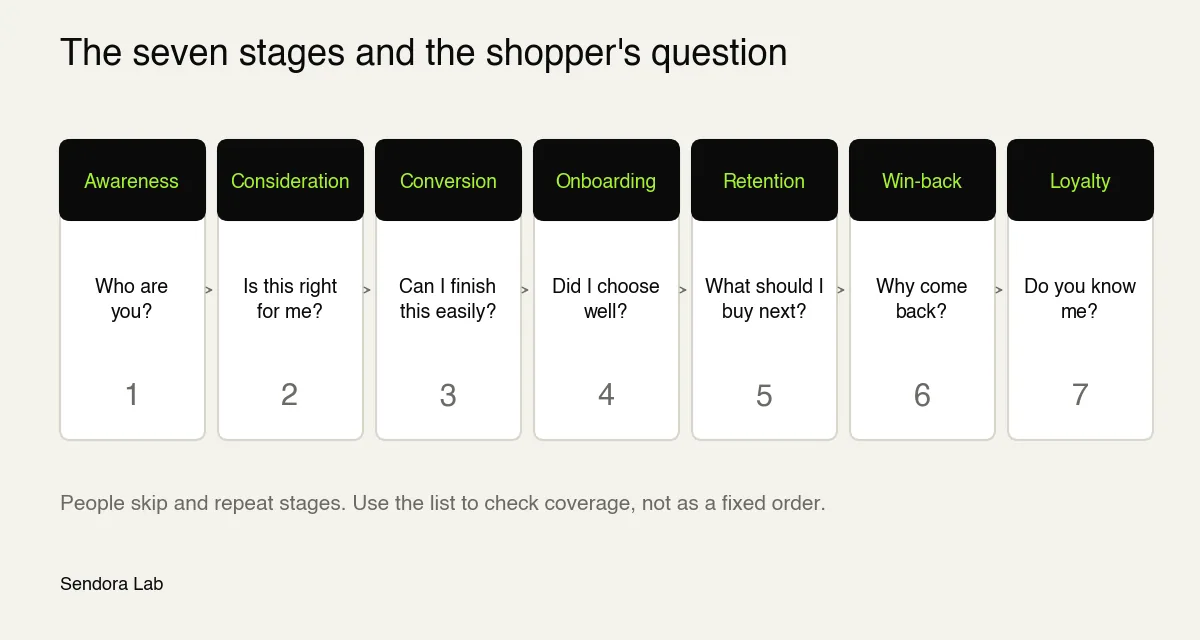
| Stage | The shopper’s question | What email should do |
|---|---|---|
| Awareness | Who are you? | Explain the brand and why it exists |
| Consideration | Is this right for me? | Help them compare, show reviews and sizing |
| Conversion | Can I finish this order easily? | Remove friction from cart and checkout |
| Onboarding | Did I make a good choice? | Confirm, ship, explain use and care |
| Retention | What should I buy next? | Suggest the next product at the right time |
| Win-back | Is there a reason to come back? | Give a relevant reason, not just a code |
| Loyalty | Do you recognise me? | Treat best customers differently |
People don’t move through these in a straight line. A shopper can subscribe, buy within an hour and skip consideration entirely. The stages are a checklist for coverage, not a fixed order of emails.
Which Klaviyo flow covers each customer journey stage
Each stage maps to a flow, and each flow starts from a trigger. A flow is a sequence of automated messages that Klaviyo sends when a set event happens, such as someone joining a list or placing an order (Klaviyo: getting started with flows).
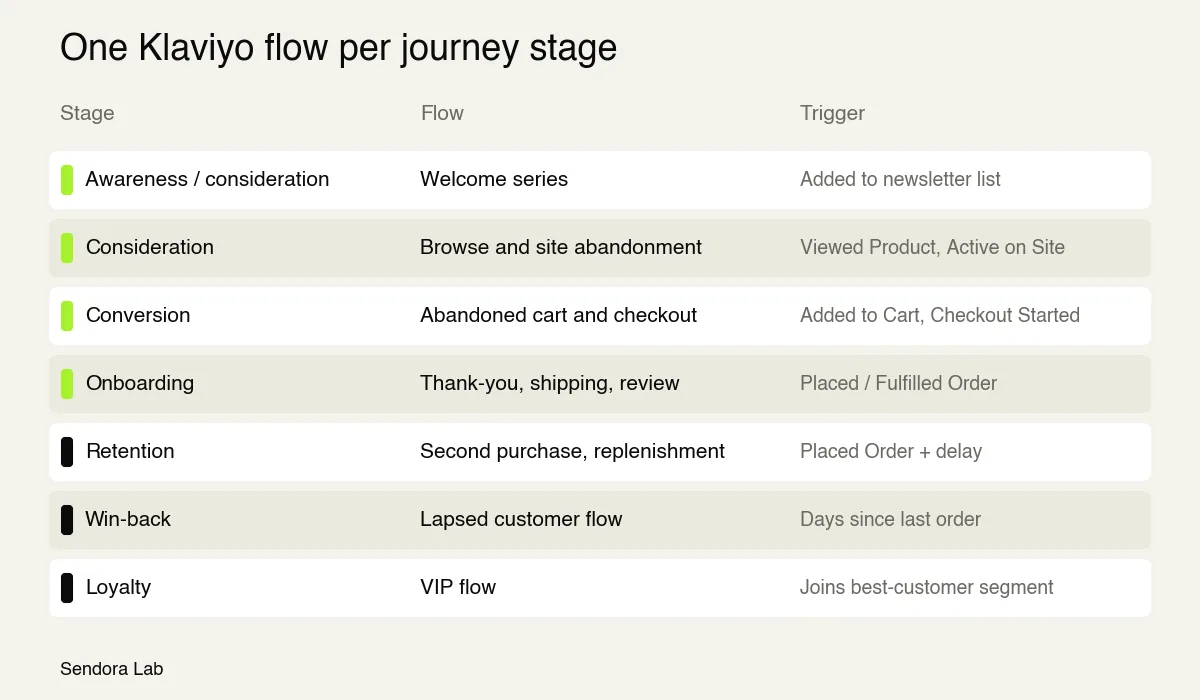
Before the first order
- Awareness to consideration: a welcome series, triggered when someone joins your newsletter list.
- Consideration: browse abandonment (triggered by Viewed Product) and site abandonment (triggered by Active on Site).
- Conversion: abandoned cart (Added to Cart) and abandoned checkout (Checkout Started).
After the first order
- Onboarding: order thank-you, shipping updates and a review request, triggered by Placed Order, Fulfilled Order or a delivery event.
- Retention: a second-purchase or cross-sell flow, and a replenishment flow for products that run out.
- Win-back: a flow for buyers who have gone quiet longer than their normal gap between orders.
- Loyalty: a VIP flow triggered when someone joins a best-customer segment.
A sunset flow sits outside the journey. It asks unengaged subscribers if they still want emails and removes them if not, which protects the inbox placement of every other flow.
What real data shows: where flow revenue sits by stage
In a real account, most flow revenue comes from the stages before the first order. That’s normal, but it also shows where the program is thin.
In Sendora Lab’s anonymised Klaviyo data from a Dutch fashion and home store on Shopify (1 April–14 November 2026, email only), twelve flows sent emails. We grouped them by stage. Attributed revenue is the value of orders Klaviyo credits to an email because the shopper opened or clicked it within the attribution window; by default Klaviyo gives each order to the most recent eligible email (Klaviyo: how conversion tracking works).
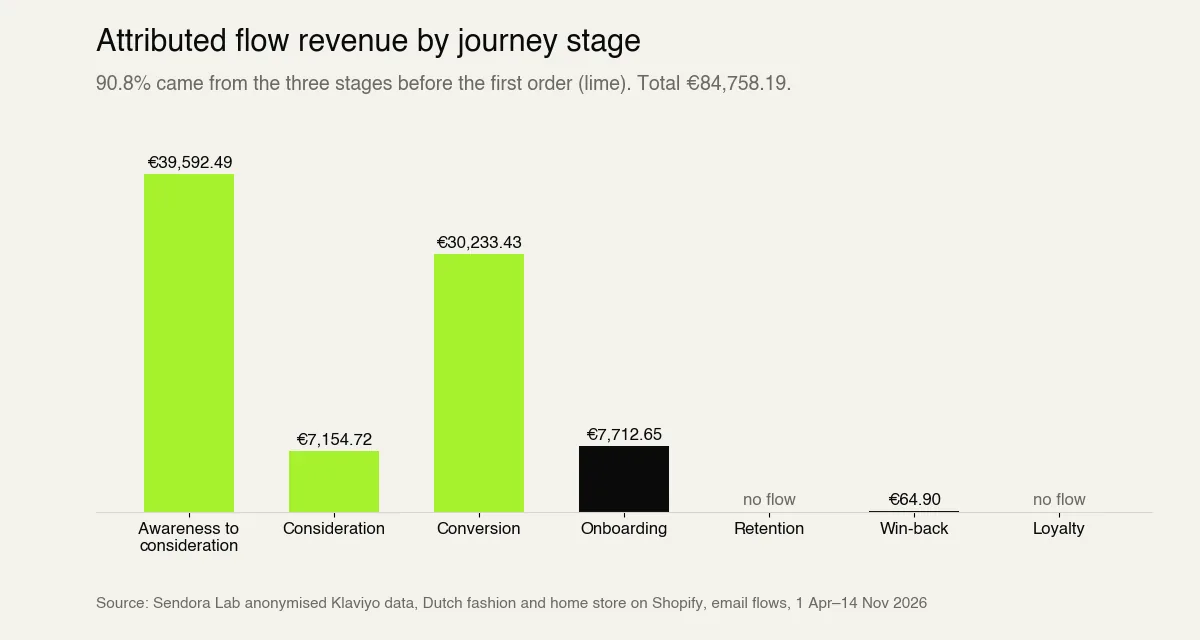
| Stage | Flows in the account | Attributed revenue | Share |
|---|---|---|---|
| Awareness to consideration | Welcome series | €39,592.49 | 46.7% |
| Consideration | Browse abandonment, site abandonment | €7,154.72 | 8.4% |
| Conversion | Abandoned cart, two abandoned checkout flows (one later paused), an old checkout draft | €30,233.43 | 35.7% |
| Onboarding | Thank-you, shipping confirmation, review request | €7,712.65 | 9.1% |
| Retention | None | – | – |
| Win-back | Customer win-back | €64.90 | 0.1% |
| Loyalty | None | – | – |
Across all flows, Klaviyo attributed €84,758.19, and 90.8% of it came from the three stages before the first order. The welcome series alone brought €1.45 per recipient from 27,320 recipients and 628 orders. Here a recipient counts each email delivered, so one person who gets three emails counts three times.
Onboarding emails earned far less per email (the thank-you flow made €0.09 per recipient), and that is fine. Their job is confidence and fewer support tickets, not sales. Judge each stage by its own job, not by revenue alone. The sunset flow sent 34,378 emails and earned nothing, which is exactly what it should do.
The gaps most journeys have after the first order
The weak spot is almost always retention, win-back and loyalty. In the store above, two of seven stages had no flow at all, and the one that existed barely sold.
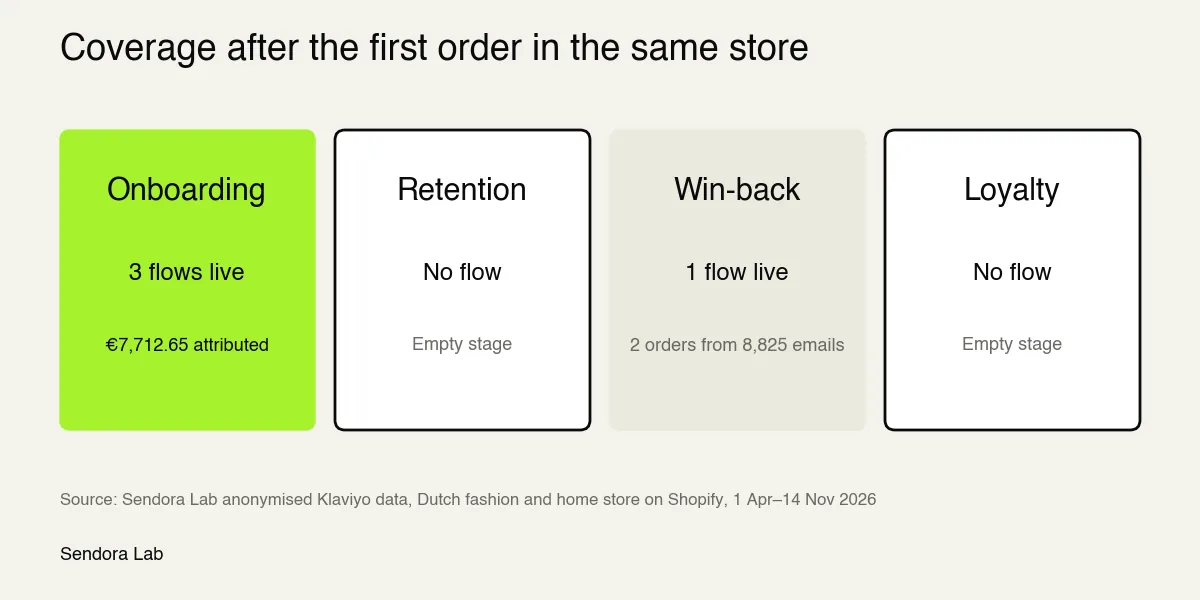
The win-back flow sent 8,825 emails in the period and Klaviyo attributed 2 orders (€64.90) to it. That doesn’t prove win-back fails. It suggests this flow fires at the wrong time or says the wrong thing. Most win-back flows trigger a fixed number of days after the last order; if that number isn’t based on how often your customers really reorder, the email arrives either too early to matter or too late to save anyone. Our guide to the Klaviyo win-back segment shows how to set that gap from your own order data.
Klaviyo can help with timing. Its predictive analytics show each customer’s expected date of next order, worked out from their own order pattern or, for one-time buyers, from other customers (Klaviyo: understanding predictive analytics). Note that it doesn’t consider which products someone bought, so it suits stores where products are reordered on a similar cycle.
The missing retention stage is usually the cheapest fix. A second purchase flow that starts after delivery, suggests a related product and waits for the normal reorder gap fills the space between onboarding and win-back.
How to audit your ecommerce customer journey email coverage
You can audit coverage in about two hours with only the Klaviyo flow list and a flow report. Write the seven stages down, then fill in what you already have.
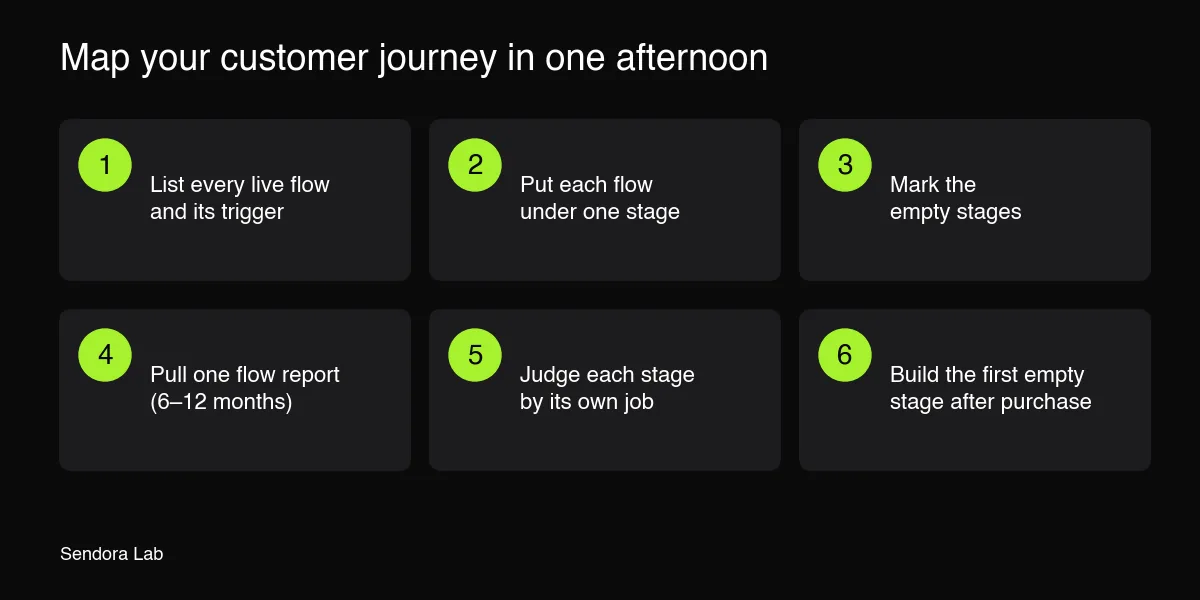
- List every live flow and write its trigger next to it.
- Put each flow under one stage. If two flows do the same job, merge them or exclude one audience from the other.
- Mark empty stages. These are your build list.
- Pull one flow report for the last six to twelve months, grouped by flow, with recipients, orders and attributed revenue.
- Judge each stage by its job. Conversion flows should sell; onboarding flows should reduce questions and returns; sunset flows should clean the list.
- Build the first empty stage after purchase before you fine-tune flows that already work.
Most stores find the same thing: strong welcome and checkout flows, and very little after the order. If you want the order to build things in, our Klaviyo retention strategy guide lays it out.
Conclusion
A good ecommerce customer journey email program has one flow per stage and judges each by its own job. Real data from a Shopify store showed over 90% of flow revenue sitting before the first order, with retention and loyalty empty. Fill the stages after purchase first. If you’d like a second pair of eyes on your journey map, Sendora Lab builds and audits these flows for Shopify brands: see our Klaviyo email marketing service.
FAQ
What are the stages of the ecommerce customer journey?
Awareness, consideration, conversion, onboarding, retention, win-back and loyalty. Each one maps to at least one automated email flow in Klaviyo.
Which email flows should a Shopify store build first?
Welcome series and abandoned checkout first, since they cover the stages that earn most flow revenue. Then post-purchase, browse abandonment, a second-purchase flow and win-back.
Why do most flow sales come before the first order?
Welcome and checkout flows reach people at the moment of highest intent. In one Dutch fashion and home store on Shopify, those stages earned 90.8% of flow revenue between April and November 2026.
How do I know when to send a win-back email?
Base the delay on how long your customers normally wait between orders, not a default number of days. Klaviyo’s expected date of next order can help when products are reordered on a similar cycle.
Want this set up in your Klaviyo account?
A free 30-minute audit, your account open on screen.
Book a free audit