



A Klaviyo retention strategy is a set of flows, segments and campaign rules that turns first-time buyers into repeat customers without wearing out your list. Build the flows that catch buying intent first (checkout, welcome, browse), then a post-purchase flow aimed at the second order, then win-back and sunset flows that keep the list healthy. Campaigns sit on top of that system, sent to engaged segments rather than everyone.
Below is the order we build it in, with real numbers from two Sendora Lab client accounts, both on Shopify. Brand A is a footwear store selling in Canada (flows live April to September 2026, figures in Canadian dollars). Brand B is a Dutch online fashion store (March to October 2026, figures in euros). Brand A and Brand B are pseudonyms. Every figure comes straight from each account’s Klaviyo flow and campaign reports.
What a Klaviyo retention strategy is made of
A retention program has five layers: identity and consent, events, decisions, messages and learning. Most accounts we audit have a problem in one of the first three layers that no amount of copywriting will fix.
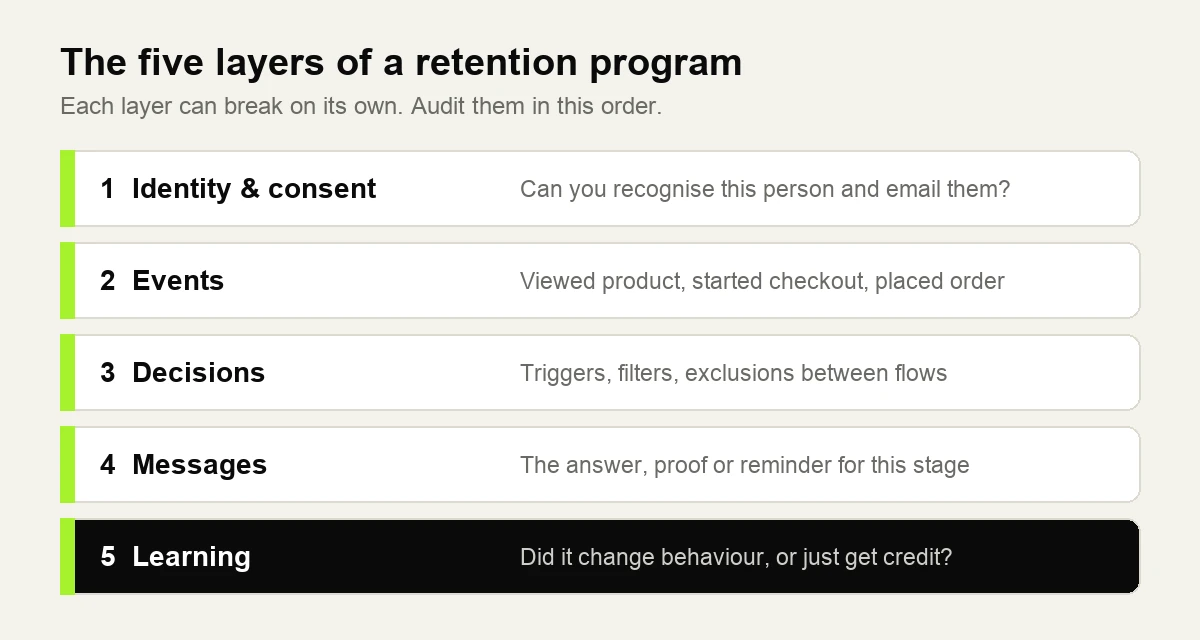
- Identity and consent. Can Klaviyo recognise this person, and are you allowed to email them?
- Events. Is Shopify sending Viewed Product, Checkout Started and Placed Order reliably?
- Decisions. Which flow should this person be in, and which should they be removed from?
- Messages. What does the customer need to hear at this stage: an answer, proof, or a reminder?
- Learning. Did the message change behaviour, or did it just collect attribution for an order that was coming anyway?
Audit in that order. A beautiful browse abandonment email does nothing if Viewed Product isn’t firing, and a clever segment doesn’t help if half of it has no email consent. If you want a quick way to check your own account, our 20-minute Klaviyo audit walks through each layer.
Build the intent flows first
Start with the flows triggered by a shopper doing something: starting checkout, signing up, viewing a product. These earn the most per email because the person has just shown what they want.
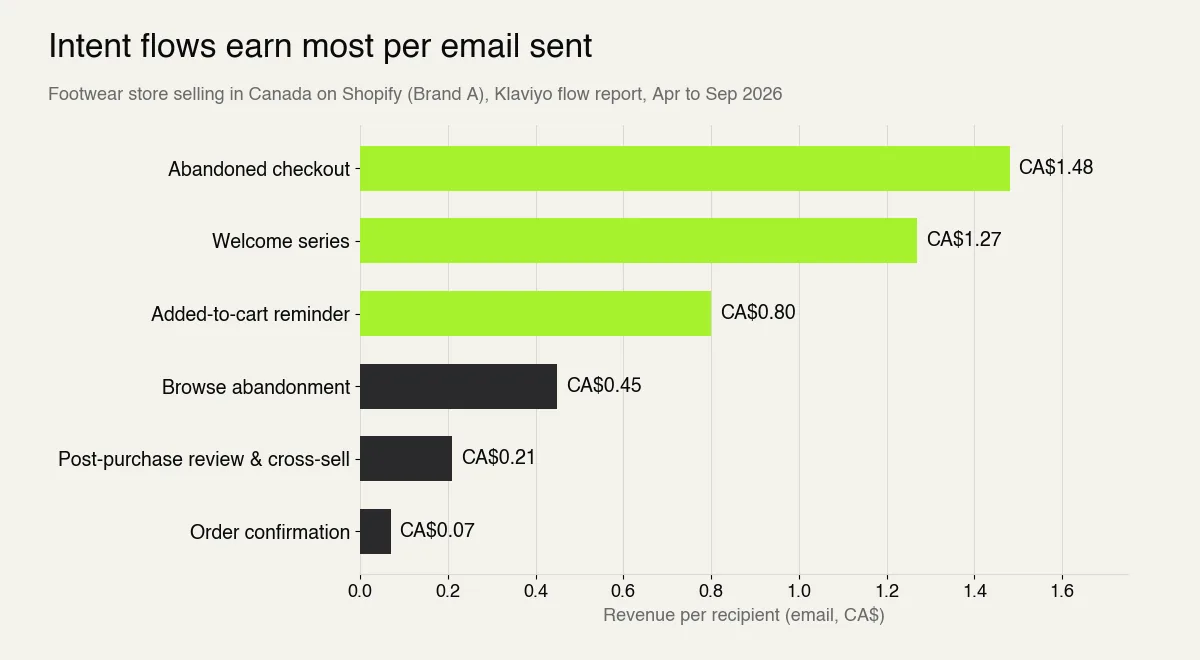
In Brand A’s account (April to September 2026), the abandoned checkout flow earned CA$1.48 per recipient, with 55 attributed orders from 2,712 delivered emails. The welcome series earned CA$1.27 per recipient, even though it only went live in September. The added-to-cart reminder earned CA$0.80 and the browse abandonment flow CA$0.45, which is normal: viewing a product is a weaker signal than entering a checkout.
Rebuild old flows instead of stacking new ones
When an account already has a tired flow, replace it rather than add a second one beside it. Two checkout flows running together send duplicate reminders to the same people. When we checked the core flows in seven client accounts in October 2026, one store had two checkout flows and two browse flows live at the same time, each fed by a different tracking source.
A rebuild usually changes the content, the timing and the exclusions together, so don’t credit any single change. Turn the old flow off, let the new one run for a full buying cycle, and judge it on its own revenue per recipient.
The build order we use
- Check that Shopify events and consent are recorded correctly.
- Welcome series for new subscribers.
- Checkout abandonment, with a purchase exclusion.
- Post-purchase, split by first-time and returning customers (see also purchase behavior segmentation).
- Browse abandonment, once Viewed Product is reliable.
- Win-back and sunset, once you know your normal reorder interval.
Treat campaigns as the exception, not the engine
Campaigns should go to people who have engaged recently, with a reason to send that day. Sending to everyone on a fixed weekly rhythm is the quickest way to train a list to ignore you.
Brand B shows the cost clearly. Between 6 April and 30 September 2026 it sent 52 email campaigns, and 16 of them recorded no attributed order. The 14 campaigns sent to everyone not suppressed earned €0.0052 per recipient, with a 0.50% click rate. The 16 sent only to people who had shopped or clicked in the previous 30 days earned €0.0506 per recipient, with a 1.69% click rate. Hold to the same rule in peak season, including your Black Friday email sequence.
That doesn’t mean campaigns are useless. It means a retention strategy shouldn’t depend on them. Brand A’s three campaigns in late September 2026 all recorded orders, but they earned between CA$0.14 and CA$0.59 per recipient, against CA$1.48 for its checkout flow.
A simple audience rule
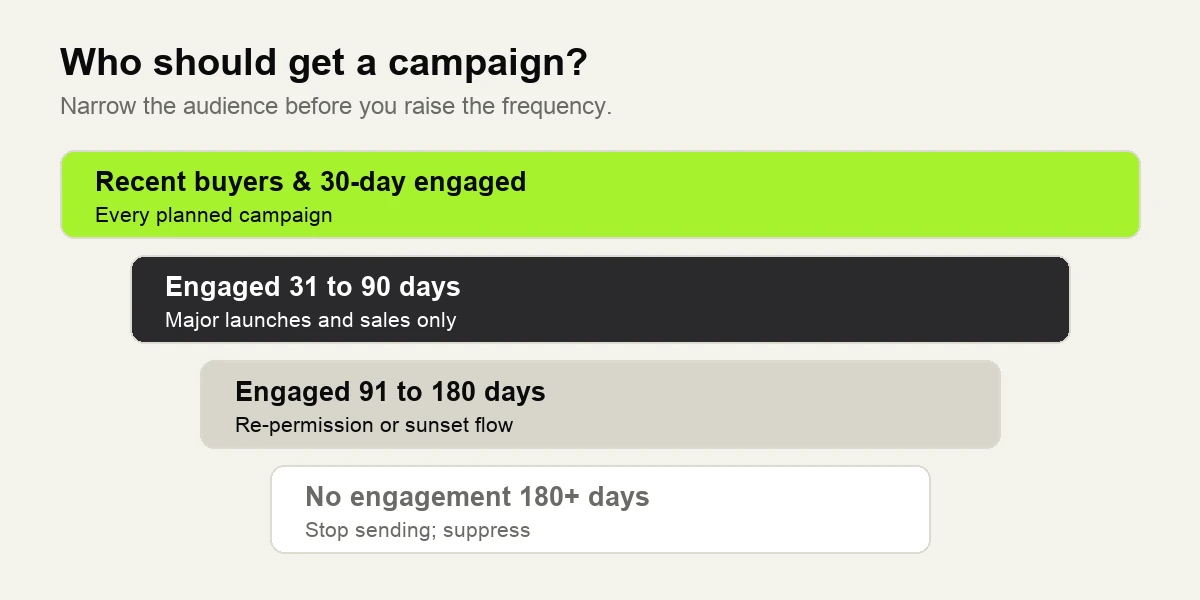
- Recent buyers and anyone engaged in the last 30 days: every planned campaign, with early access first for your VIP segment.
- Engaged 31 to 90 days: major launches and sales only.
- Engaged 91 to 180 days: a re-permission message or the sunset flow.
- No engagement for 180+ days: stop sending and suppress.
Adjust the windows to your buying cycle. A store selling seasonal clothing can tolerate a longer quiet period than one selling daily consumables, which is where a replenishment flow earns its place.
Post-purchase is where retention starts
The post-purchase flow is the first real retention message, and it should be judged on whether customers come back, not on the revenue Klaviyo attributes to it. Someone who has just paid is unlikely to buy again within days.
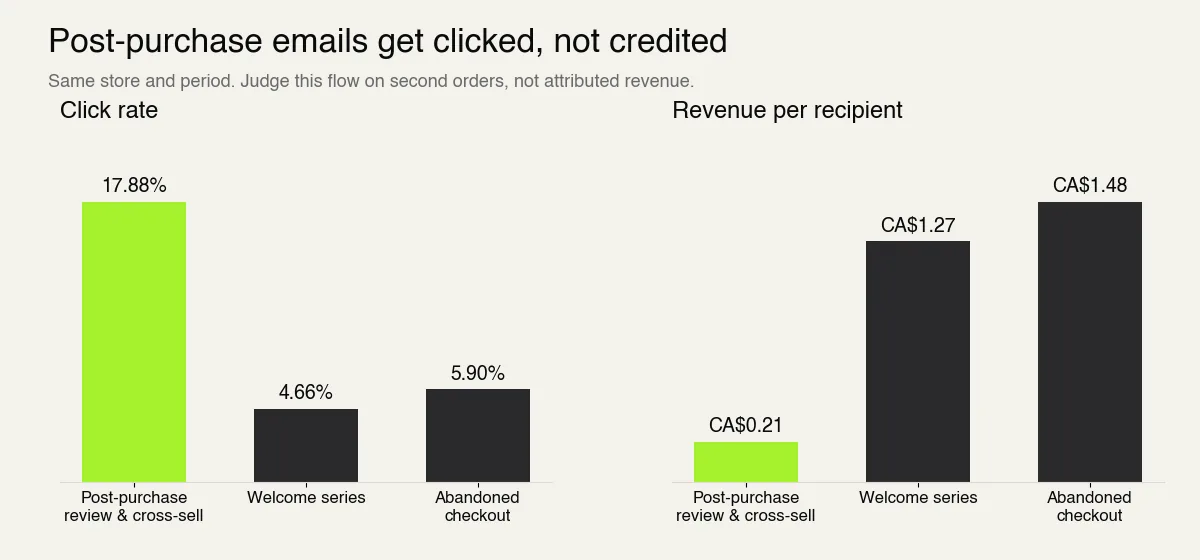
In Brand A’s account, the post-purchase review and cross-sell flow had a 17.88% click rate, far above the welcome series (4.66%) and the abandoned checkout flow (5.90%). Its revenue per recipient was only CA$0.21. Read on attributed revenue alone, it looks like the weakest flow in the account. Read on engagement, it is the one customers pay most attention to.
What to put in it
Klaviyo’s own setup guide recommends a Placed Order trigger with a split on whether the person has ordered once over all time, so first-time and returning buyers get different paths. We use the first-time path to confirm the purchase was a good choice: care or sizing information, delivery expectations, and how to reach a person if something is wrong. Product recommendations come later, timed to when a second order makes sense for that category.
The returning-customer path can be shorter and more direct. These people already trust the store, so they need less reassurance and more relevance. There is more on this in our post on post-purchase flows that earn the second order.
Win-back and sunset flows keep the list honest
Win-back and sunset flows rarely make much money. Their job is to separate customers who might return from profiles that are hurting your deliverability.
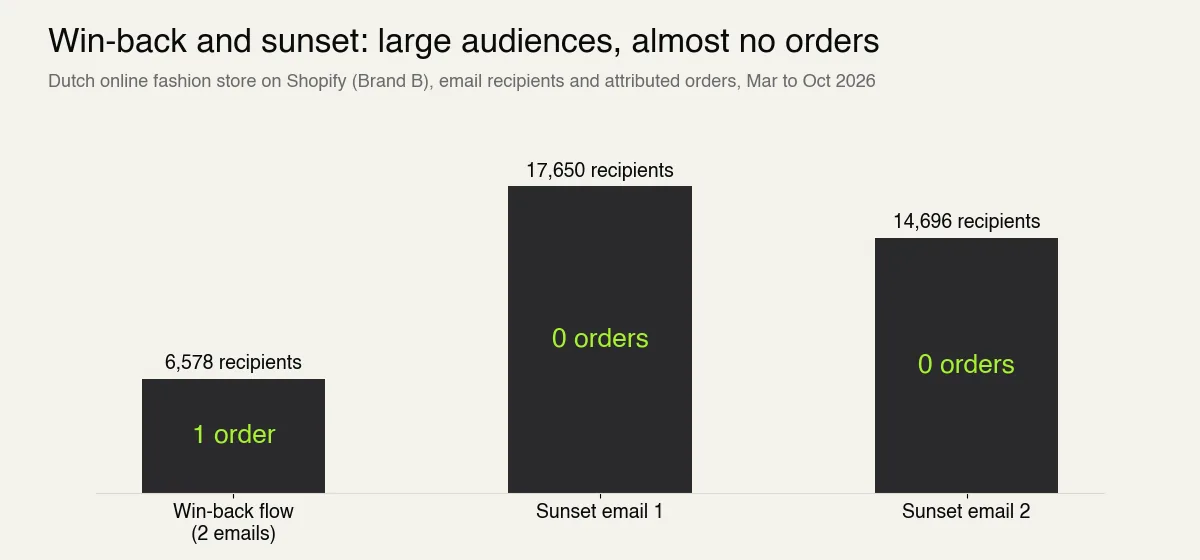
In Brand B’s account (March to October 2026), the win-back flow’s two emails had 6,578 recipients in total and produced one attributed order, with a 0.70% click rate. The sunset flow’s first email went to 17,650 people and its second to 14,696; neither produced an order, and 2.28% of first-email recipients unsubscribed. On revenue those flows look like failures. On list health they did exactly what they should: they identified thousands of profiles that no longer wanted to hear from the brand, so campaigns could stop paying for them.
Time the win-back to the reorder interval
A win-back sent long after a customer has drifted away is too late. Measure your median time between first and second orders, then trigger the win-back shortly after a customer passes it. If your win-back also earns almost nothing, test the timing before you test a bigger discount. Our post on finding lapsed customers early shows how to build that segment.
Stop your flows from colliding
Every flow needs filters that remove people once they move to the next stage. Without them, one shopper can receive a browse email, a checkout email and an order confirmation in the same afternoon.
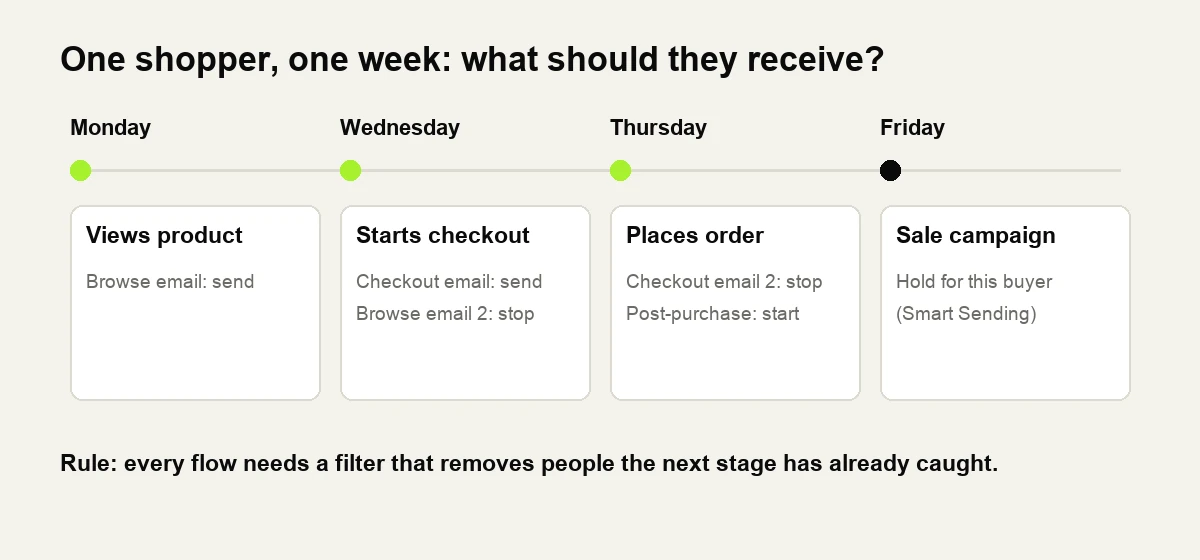
Klaviyo gives you two tools for this, and they behave differently. According to Klaviyo’s guide to flow triggers and filters, a metric trigger filter is checked only when someone enters the flow. A profile filter is checked on entry and again before each email or SMS, so it is the one that catches a shopper who buys halfway through a sequence.
Filters we set by default
- Browse abandonment: has not started checkout since starting this flow, and has not placed an order since starting this flow.
- Checkout abandonment: has not placed an order since starting this flow.
- Win-back: has not placed an order since starting this flow, and is not in an active post-purchase path.
Smart Sending adds a second layer. Klaviyo’s Smart Sending documentation gives a 16-hour default window for email, and it applies to marketing flow messages as well as campaigns. Transactional messages are never skipped. Leave it on for most marketing flows, but turn it off for checkout reminders, where a skipped email costs a sale.
How to measure whether retention is working
Report a short list of behaviour metrics every month, not just attributed revenue; our guide to email campaign metrics lists which ones. Attribution tells you which email was opened before an order; it doesn’t tell you whether the email caused it.
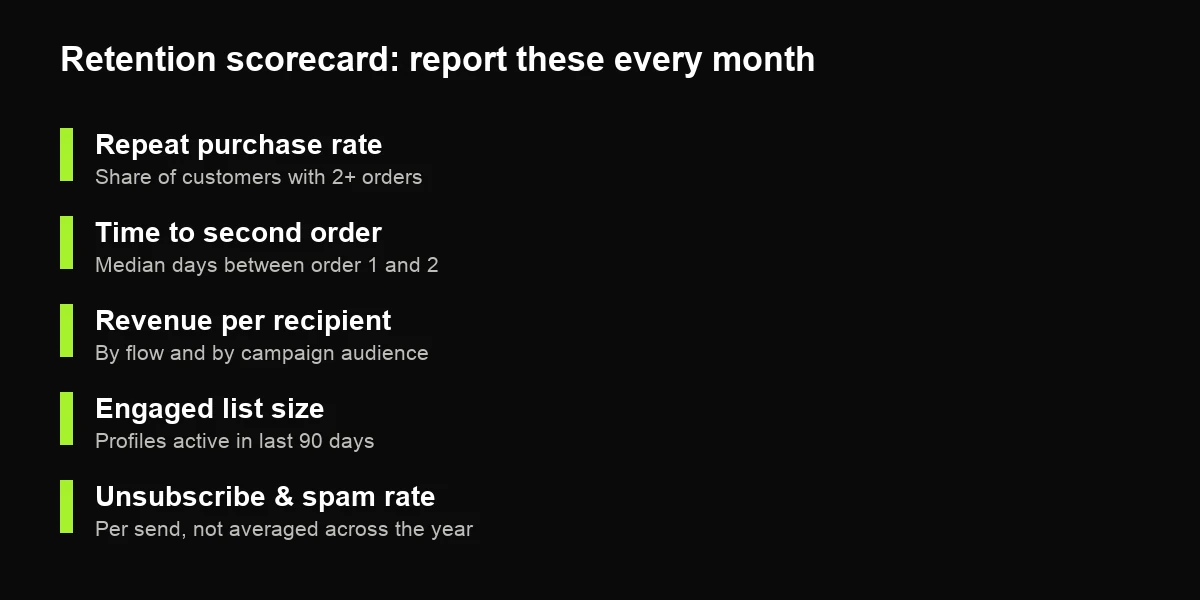
| Metric | What it tells you |
|---|---|
| Repeat purchase rate | Whether first-time buyers are coming back at all |
| Time to second order | When your post-purchase and win-back flows should act |
| Revenue per recipient | Which flows and audiences earn their sends |
| Engaged list size | Whether the list is growing or just getting longer |
| Unsubscribe and spam rate per send | Whether frequency or targeting is costing you trust |
Revenue per recipient is the most useful single number for comparing flows and audiences, because it adjusts for how many people each one reaches. Our explainer on revenue per recipient as a core email metric covers how to read it and where it misleads.
Putting your Klaviyo retention strategy together
A working Klaviyo retention strategy is mostly an order of operations: fix tracking and consent, build the intent flows, write a post-purchase flow aimed at the second order, then add win-back and sunset flows timed to your real reorder interval. Campaigns go to engaged segments, and every flow has filters that let shoppers leave when they move on.
The numbers from these two stores show why. Brand A’s checkout flow earned CA$1.48 per recipient while its campaigns earned at most CA$0.59, and Brand B’s campaigns to the whole list earned €0.0052 per recipient against €0.0506 for recent shoppers. If you’d like a second pair of eyes on your own setup, see how we handle email and retention for Shopify brands, or book a free 30-minute audit. Setting up a new account? Start with which Klaviyo flows to build first.
Want this set up in your Klaviyo account?
A free 30-minute audit, your account open on screen.
Book a free audit