



Email copywriting is the craft of writing the words in an email, from the subject line to the button, so the right reader opens, reads and clicks. For an ecommerce brand, the hard part is not grammar but sounding like yourself instead of a template. This guide shows how we write subject lines, preview text and body copy for Shopify brands in Klaviyo, with real campaign data on what generic copy costs.
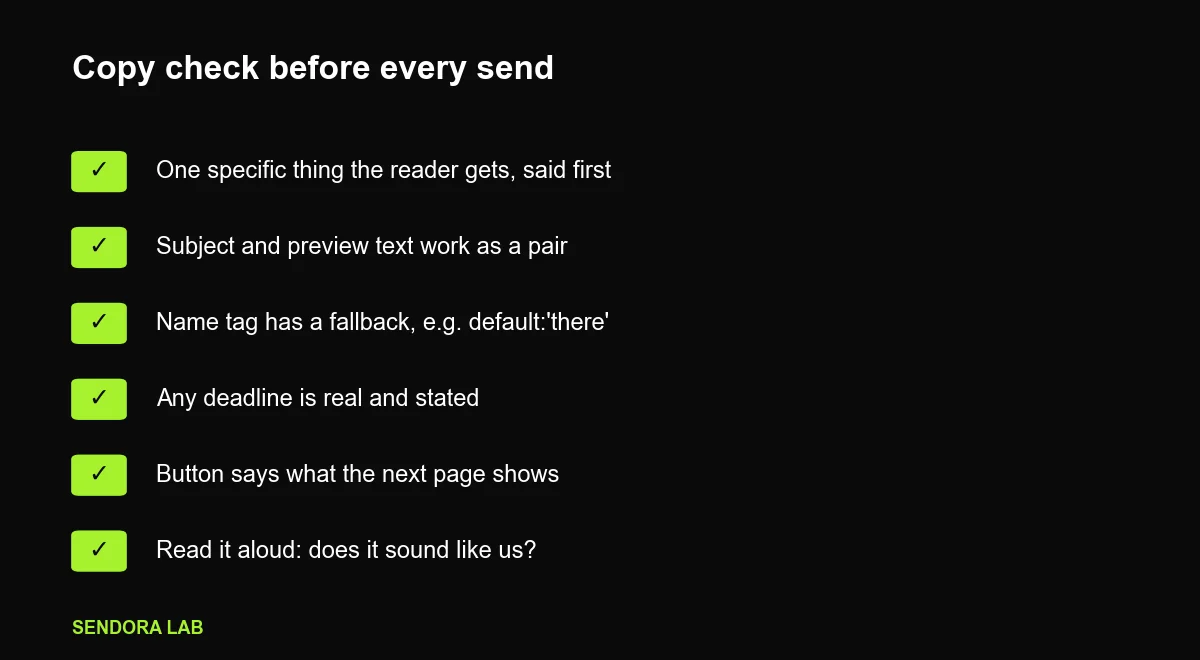
Short answer: write every email around one specific thing the reader gets, say it in the subject line and preview text as a pair, and use the words your customers use. Drop interchangeable lines like “Don’t miss out!” that any store could send. In Sendora Lab’s anonymised Klaviyo data from a Dutch online fashion store on Shopify (April to September 2026), 42 of 52 campaigns written in that generic style lost more subscribers to unsubscribes than they gained clickers.
What template-sounding copy costs
Generic copy doesn’t fail loudly; it slowly teaches people that your emails are not worth opening. You see it first in unsubscribes running ahead of clicks.
A Dutch online fashion store on Shopify sent 52 email campaigns between 6 April and 30 September 2026. Its subject lines followed a pattern we see in many accounts. Translated from Dutch, typical ones read “Don’t miss this 10% discount!”, “Place your order before it’s too late! ⏰” and “Check out our offer 👀”. Of the 52 subject lines, 16 mentioned a discount, 10 used generic urgency such as “don’t miss it” or “order today”, and 34 carried an emoji.
- 512,328 emails were delivered, and 3,356 people clicked.
- 6,074 people unsubscribed from those same campaigns.
- 42 of the 52 campaigns had more unsubscribes than unique clickers. The median click rate was 0.87%; the median unsubscribe rate was 1.38%.
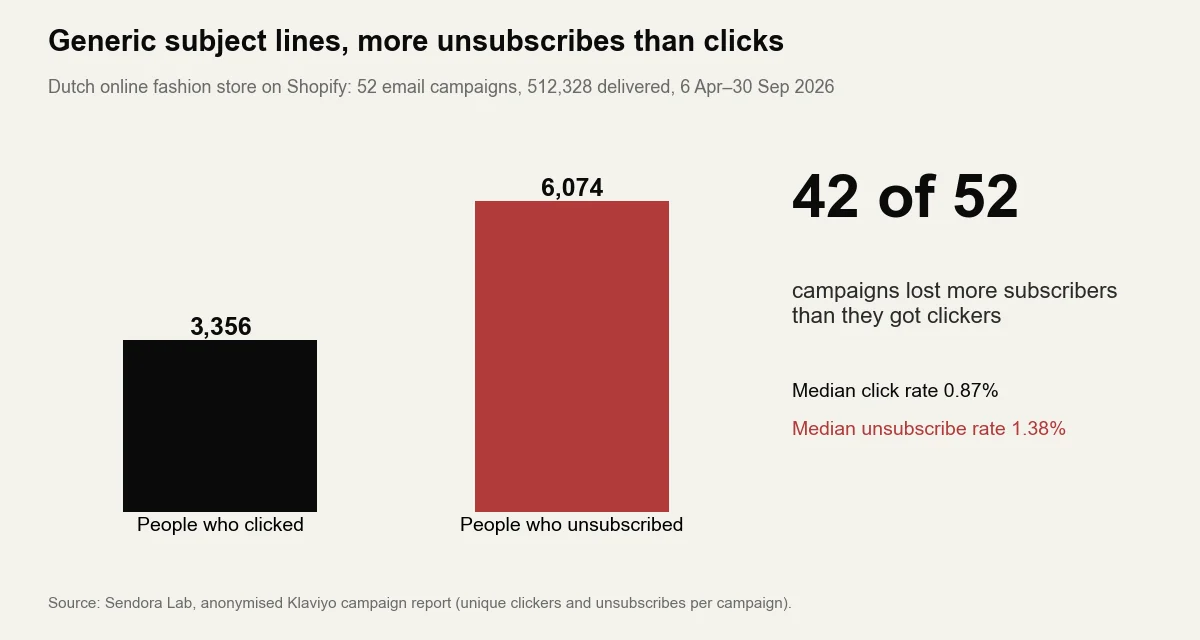
Copy is not the only cause. The store sent about twice a week, often to small segments, and our guide to email marketing frequency shows how sending more raises unsubscribes. But the copy gave readers no reason to stay: nothing in “Don’t miss it!” tells them what they would miss. A click rate here means unique clickers divided by delivered emails.
Discounts in the subject line didn’t help
Putting the discount up front did not lift clicks in this store. Among the 14 campaigns sent to its recently active shoppers, the five with a discount in the subject line had a median click rate of 1.54%, against 2.14% for the nine without. Five and nine campaigns are small samples, so read this as “no sign of a lift”, not as proof that discounts hurt.
Write the subject line and preview text as a pair
The subject line and preview text are read together in the inbox, so write them as one message: the subject names the thing, the preview text adds the detail that earns the open.
Preview text is the short line an inbox shows next to or under the subject line. In Klaviyo you set it in the campaign’s content step. If you leave it empty, the inbox usually shows the first text it finds in the email instead, which is often a menu or a “View in browser” link. In the Dutch store, 46 of the 52 campaigns had no preview text at all and two more had only an emoji.
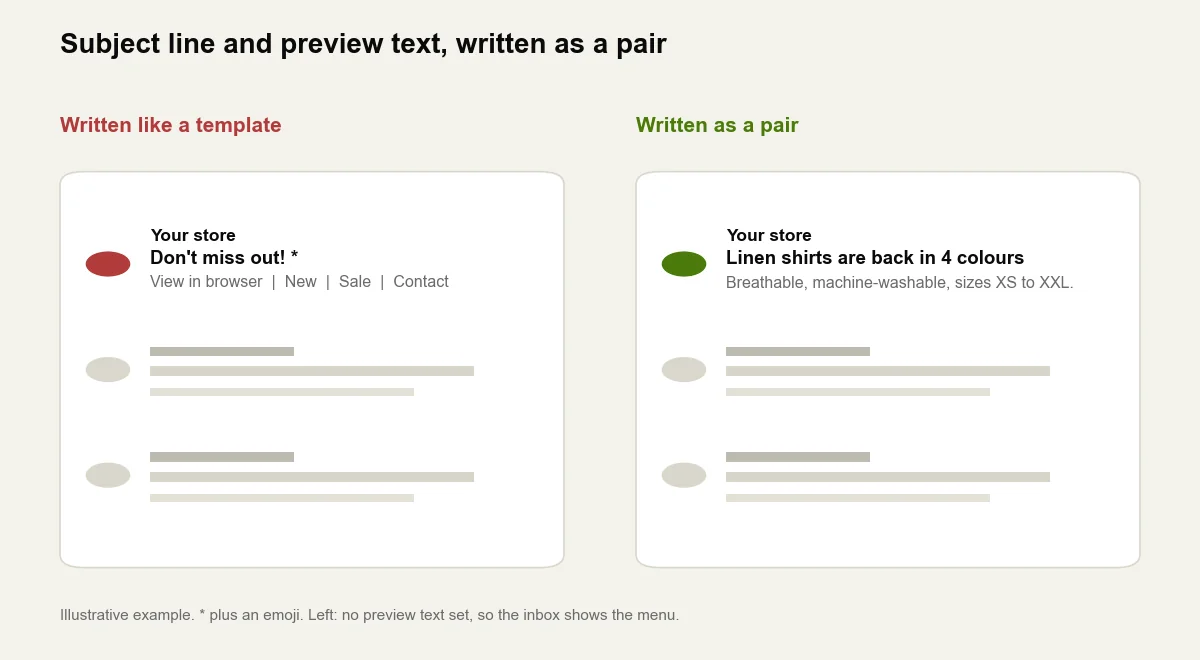
- Front-load the specific part. Phones cut long subject lines, so put the product, the problem or the number first. Our guide to mobile email design covers how little space a phone gives you.
- Don’t repeat yourself. If the subject says “New linen shirts”, the preview text should add something: colours, price, or why now.
- Use names carefully. Klaviyo’s guide to personalising emails with names and fallback values shows the tag
{{ first_name | default:'there' }}, which prints “there” when a profile has no name. One of the Dutch store’s campaigns used the first-name tag with no fallback, so anyone without a saved name got a subject line starting with a comma. - Keep it true. The FTC’s CAN-SPAM compliance guide says the subject line must accurately reflect the content of the message. “Last chance” on a sale that runs all month breaks trust, and in the US it can break the law.
Say something specific, not something urgent
Specific copy gives the reader a reason to click; urgency without a reason gives them a reason to leave. Use urgency only when there is a real deadline, and say what it is.
A US health-accessories brand on Shopify sent four campaigns to the same segment of recently engaged prospects who hadn’t bought yet, between 26 August and 7 September 2026. The emails differed in subject, preview and body, so this compares whole emails, not subject lines alone:
| Email (subject paraphrased) | Delivered | Click rate | Unsubscribe rate |
|---|---|---|---|
| Practical guide: three medication mistakes travellers make | 898 | 1.23% | 0.78% |
| Plain-text tips email from a named team member | 1,656 | 1.03% | 0.79% |
| Holiday sale: 20% off everything | 990 | 0.20% | 0.81% |
| Holiday sale: last few hours | 1,277 | 0.47% | 1.49% |
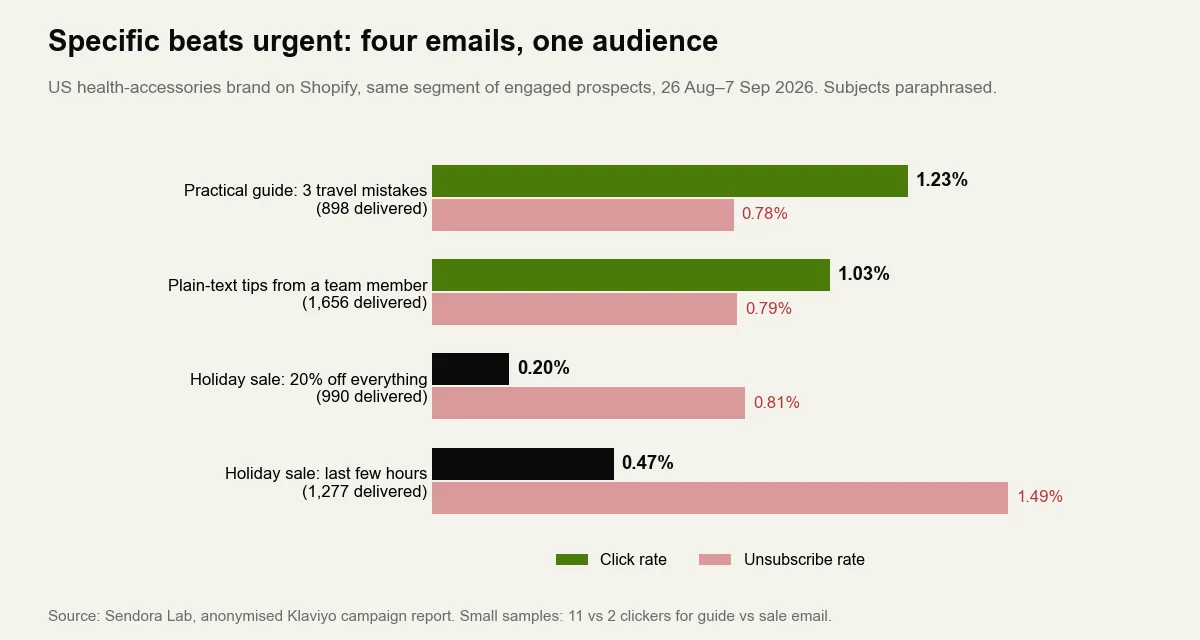
The helpful emails earned several times the click rate of the generic sale email, and the “last few hours” email lost the most subscribers. The numbers are small: 11 clickers against 2. When the guide and both sale emails went to a larger segment of engaged non-buyers, the gap shrank (0.39% for the guide, 0.31% for both sale emails) and every email produced three orders, but unsubscribes still rose from 0.26% for the guide to 0.53% for “last few hours”. The pattern points one way: specific and useful beats loud.
Find your brand voice and write it down
A brand voice is a short set of rules for how your emails sound, written down so every writer, freelancer or AI draft sounds the same. Without it, copy drifts towards the template phrases every store uses.
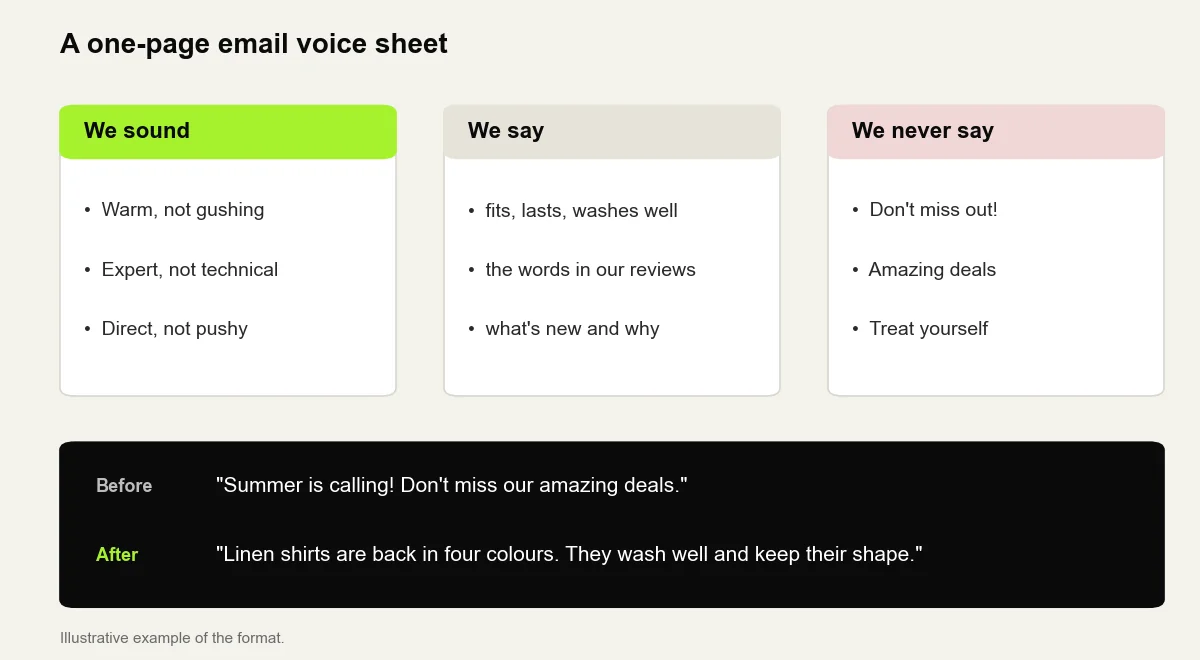
- Pick three words for how you sound, each with a limit: “warm, not gushing”, “expert, not technical”, “direct, not pushy”.
- Collect your customers’ words. Read reviews, support emails and returns notes. If customers say “it finally fits my hips”, that beats “flattering silhouette”.
- List words you use and words you avoid. Ban the ones any store could send: “amazing deals”, “don’t miss out”, “treat yourself”.
- Write one before-and-after for each email type: campaign, welcome, cart reminder. New writers copy examples faster than rules.
- Read it out loud. If it sounds like an advert, rewrite it as you would say it to a customer in the shop.
If you sell in more than one language, write the voice sheet per language and have a native speaker write or review the copy. Machine translation flattens voice first. Our guide to multilingual email marketing covers how to set that up in Klaviyo.
Body copy that earns the click
Most readers scan an email rather than read it, so put the point first, keep each paragraph to one idea and make the button say exactly what happens next.
Nielsen Norman Group’s study of how users read on the web found that 79% of test users always scanned new pages and only 16% read word by word. Concise, scannable and objective writing together improved measured usability by 124%. Email is read the same way, usually on a phone.
- Headline first, in live text. It should make sense on its own: “Linen shirts are back in four colours”, not “Summer is calling”.
- One or two short lines of body. Say why it matters to the reader now. Cut adjectives that any brand could use.
- Specific buttons. “See the linen shirts” beats “Shop now”, because it promises what the next page shows.
- Plain words, no marketese. The same study found neutral, objective wording more credible than promotional language.
Layout carries copy: a clear headline and button only work if they are placed well. Our guide to ecommerce email design covers that side.
Test copy on clicks, not opens
Test one copy change at a time, on the same audience, and pick the winner on clicks or orders. Open rates are inflated by automatic opens, so they can crown the wrong subject line.
Klaviyo’s campaign A/B test sends two versions to a sample and the winner to the rest. That works when the list is large enough for a difference of a few clicks to mean something. On small lists, keep a simple log instead: subject, preview text, audience, click rate and unsubscribe rate for every send, and look for patterns over a few months. Our guides on open rates after Apple Mail Privacy Protection and email campaign metrics explain which numbers to trust.
Conclusion
Good email copywriting is specific: one thing the reader gets, said in your customers’ words, with a subject line and preview text that work as a pair. Generic urgency and discount-first subject lines look safe, but in the data above they went with more unsubscribes than clicks. Write a voice sheet, fill every preview text, set a name fallback and test on clicks.
Sendora Lab writes and builds Klaviyo campaigns and flows for Shopify brands in several languages. See examples on our work page, read about our email marketing service, or book a free audit and we’ll review your last ten subject lines with you.
FAQ
What is email copywriting?
It is writing the words of an email, including the subject line, preview text, headline, body and button, so the reader opens, reads and clicks. In ecommerce its job is usually to get one click to a product or collection.
Should I put the discount in the subject line?
Not by default. In a Dutch fashion store’s campaigns to recently active shoppers (April to September 2026), subject lines with a discount had a median click rate of 1.54% against 2.14% without. Say what the reader gets first; mention the discount if it is the news.
What should preview text say?
It should add to the subject line, not repeat it: the detail, price, colours or deadline. Always set it in Klaviyo; an empty preview text lets the inbox show whatever text comes first in the email.
How do I use a first name safely in a subject line?
Use a fallback, for example {{ first_name | default:'there' }} as shown in Klaviyo’s help centre. Without one, profiles with no name get a subject line that starts with a comma.
Does urgency work in email copy?
Only when the deadline is real and stated. In a US health-accessories brand’s campaigns, a “last few hours” email had a 1.49% unsubscribe rate, the highest of four sends to the same audience.
Want this set up in your Klaviyo account?
A free 30-minute audit, your account open on screen.
Book a free audit