



Apple Mail Privacy Protection open rates look healthy, but a large share of those opens were never made by a person. Apple’s mail app can load your email in the background, and Klaviyo counts that as an open. This guide explains what an open still tells you, how big the gap is in real Klaviyo accounts, and what to measure and change in your setup instead.
Short answer: since Apple Mail Privacy Protection (MPP), an open no longer proves someone read your email, so open rates run high and say little about content. In Sendora Lab’s anonymised Klaviyo data from a US health-accessories brand on Shopify (28 campaigns, June to September 2026), the reported open rate was 36.5%, but only 12.5% of delivered emails had an open not flagged as a machine open, and 0.76% got a click. Judge emails on clicks, orders and revenue per recipient, and use opens only as a rough trend.
What Apple Mail Privacy Protection does to an open
An open in Klaviyo is recorded when a tiny invisible image in the email, the tracking pixel, loads from Klaviyo’s servers. Before MPP, that image loaded only when a person opened the email with images on, so an open was a decent sign of a human reader.
Apple changed that. According to Apple’s Mail Privacy Protection privacy page, Protect Mail Activity downloads remote content in the background by default, whether or not you open the email, and routes it through two separate relays so senders can’t see your IP address. Users can switch it off, but it is on by default in Apple Mail on iPhone, iPad and Mac.
So when an Apple Mail user with MPP on receives your campaign, the pixel can load within minutes, and Klaviyo logs an open. Klaviyo’s help article on identifying Mail Privacy Protection opens says it has no way to tell a true human open from an automated one when MPP is enabled.
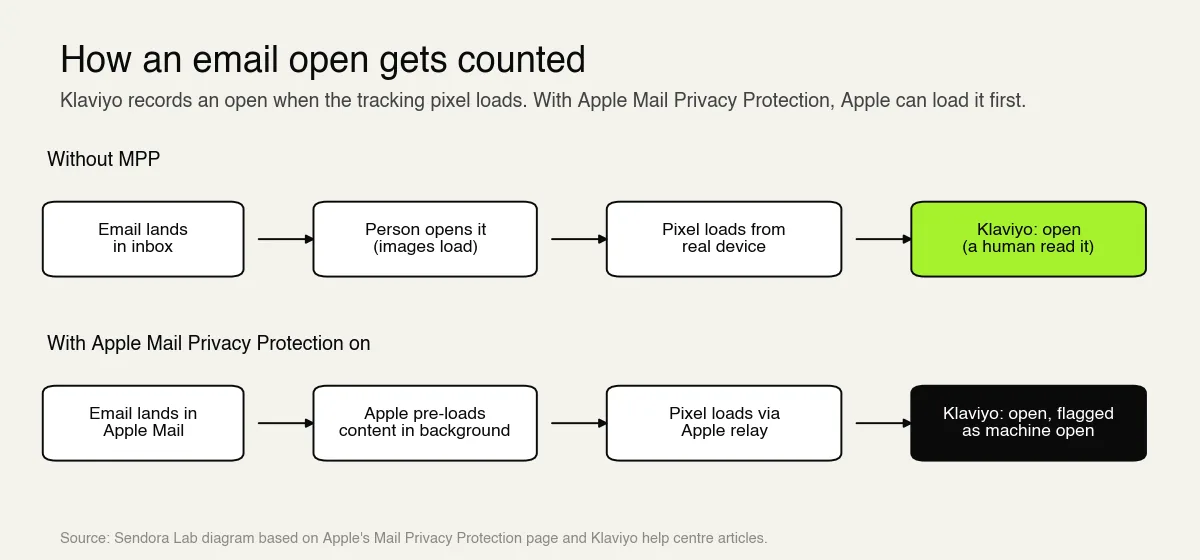
Apple Privacy opens and machine opens
Klaviyo marks these opens in two ways. Every Opened Email event since 20 November 2021 carries an Apple Privacy Open property, true or false. Klaviyo also flags machine opens, which a Klaviyo community manager describes in a community answer on machine vs MPP opens as opens triggered by a bot, such as an inbox provider, network or firewall. Every Apple Privacy open is a machine open, but not every machine open comes from Apple. The figures in this guide use the machine-open flag in the raw event data, so they include MPP and any other automated opens.
How much of your open rate is machine opens?
In the three accounts we checked, between 57% and 70% of campaign opens were machine opens. Flow emails had a lower share in all three, and a much lower one in the two European stores, because more flow opens come from people who just did something on the site.
In Sendora Lab’s anonymised Klaviyo event data:
- A US health-accessories brand on Shopify (May to September 2026): 69.7% of 19,993 campaign open events were machine opens, and 62.9% of 22,090 other opens, which are mostly flow emails.
- A Dutch-language fashion store on Shopify (October 2025 to September 2026): 64.9% of 776,763 campaign opens and 36.3% of 614,248 flow opens.
- A small Polish online store on Shopify (October 2025 to September 2026): 56.8% of 26,486 campaign opens and 40.5% of 1,617 flow opens.
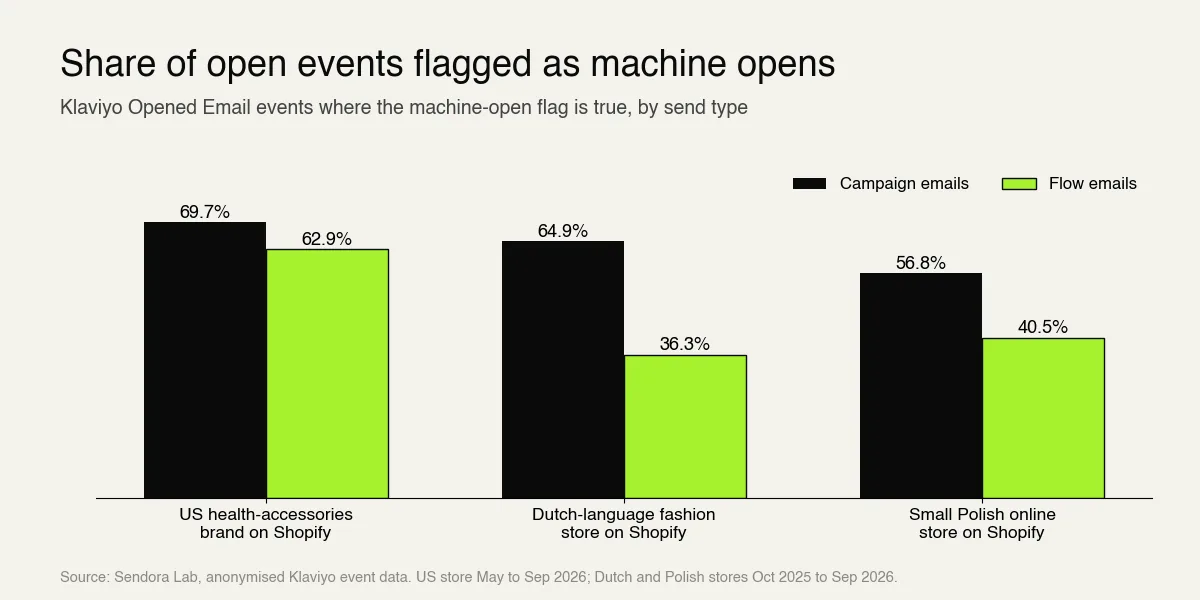
The share depends on how many of your subscribers read email in Apple Mail, which varies by country and audience. That is why one store’s open rate can’t be compared with another’s, and why a benchmark open rate from a report says little about your own list.
Per email, most openers are machines. Per person, many are customers
Look at a single campaign and machine opens dominate. Look at a person over months and the picture changes. You need both views before you decide anything.
The campaign view
Across the US brand’s 28 campaigns with 500 or more recipients (24 June to 30 September 2026), 14,431 of 39,533 delivered emails were opened, a 36.5% reported open rate. But 9,491 of those openers, 65.8%, had only machine opens for that email. Only 4,931 people had an open not flagged as a machine open, 12.5% of delivered emails, and 300 clicked.
The subscriber view
Over five months (1 May to 1 October 2026), the same store had 6,242 people who opened at least one email. 2,574 of them, 41.2%, never had a single open that wasn’t a machine open. You might call them fake openers. They aren’t: 1,091 of those 2,574 placed an order in the same period, while only 188 clicked an email.
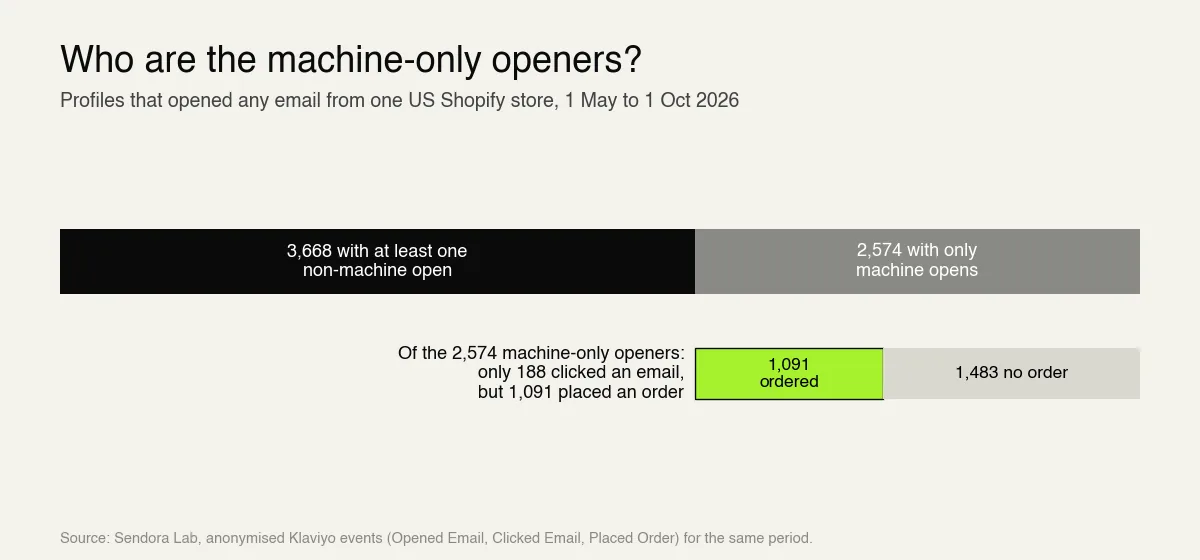
A machine-only opener is usually a real person using Apple Mail. You just can’t see whether they read anything. Over a full year the share drops further: 14.6% of 72,818 openers at the Dutch store and 16.3% of 2,891 at the Polish store had only machine opens. Most people produce a real open at some point.
The engaged segment trap
If your engaged segment is built on “opened email in the last 30 days”, MPP keeps Apple Mail users in it whether they read or not. Those people then receive your campaigns, generate more machine opens and stay in the segment. Your best-looking audience can be your least responsive one.
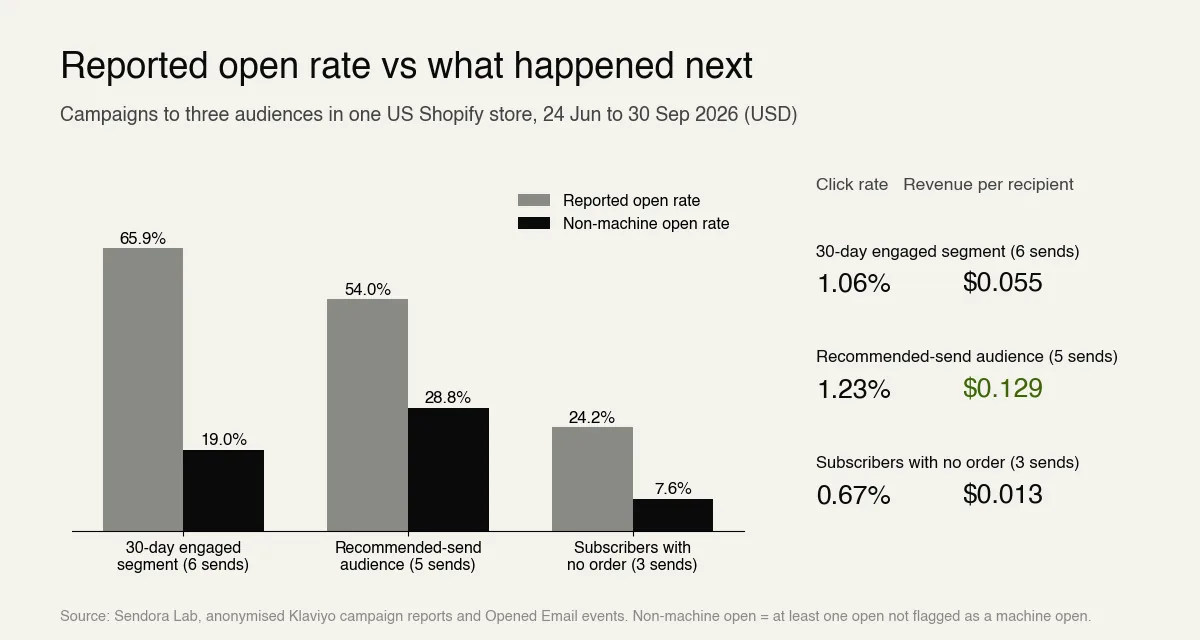
The US brand’s data shows how far a reported open rate can mislead. It sent campaigns to three kinds of audience between 24 June and 30 September 2026:
| Audience | Delivered | Reported open rate | Non-machine open rate | Click rate | Revenue per recipient |
|---|---|---|---|---|---|
| 30-day engaged segment, 6 sends | 6,875 | 65.9% | 19.0% | 1.06% | $0.055 |
| Recommended-send audience, 5 sends | 3,668 | 54.0% | 28.8% | 1.23% | $0.129 |
| Subscribers with no order, 3 sends | 7,043 | 24.2% | 7.6% | 0.67% | $0.013 |
By reported open rate, the engaged segment wins. Remove machine opens and the recommended-send audience comes out ahead, and its revenue per recipient was more than twice as high: 22 attributed orders worth $472.69 against 14 orders worth $377.34 from almost twice as many emails. 71.1% of the engaged segment’s openers had only machine opens, against 46.6% for the recommended-send audience.
The single campaign with the highest open rate in the account shows the same thing: 75.0% reported opens, 22.7% non-machine opens, 0.96% clicks. Our guide to the Klaviyo engaged segment covers how to build one on clicks, orders and site activity instead.
What to measure instead of opens
Use metrics that need a person to act. Clicks, orders and revenue can’t be triggered by Apple’s background download.
- Click rate: unique clickers divided by delivered emails. It is the cleanest sign that someone read the email. Some scanners click links too, so watch for odd spikes.
- Placed orders and revenue per recipient: attributed revenue divided by delivered emails, which lets you compare sends of different sizes. See our guide to Klaviyo revenue per recipient.
- Unsubscribe and spam complaint rates: the cost of each send, which opens never showed.
- Opens as a trend only: a sudden drop in opens across all mailbox providers can still warn you of an inbox placement problem.
One more catch: by default Klaviyo can credit an order to an email that was only opened, and its message attribution article notes that conversions are tracked when MPP opens an email automatically. You can change this in your account’s email conversion settings. Our guide to Klaviyo attributed revenue explains why that matters, and email campaign metrics covers how to read the full report.
How to handle Apple MPP opens in Klaviyo
You don’t need to stop tracking opens. You need to stop letting them drive decisions on their own. These are the changes we make in client accounts.
- Fix engaged segments. Add the filter “where Apple Privacy Open equals False” to any “Opened Email” condition, as Klaviyo’s MPP article shows, and add “Clicked Email”, “Placed Order” or “Active on Site” as alternative conditions.
- Report MPP opens separately. In Analytics, Custom Reports, add Total or Unique Apple Privacy Opens to a campaign or flow performance report. Klaviyo’s guide to tracking MPP opens in custom reports lists the steps.
- Pick A/B test winners on clicks or orders. A subject line test won on open rate may simply have reached more Apple Mail users.
- Check flows that branch on opens. A conditional split on “has opened email” sends Apple Mail users down the “engaged” path whether they read or not. Split on clicks or site activity.
- Don’t sunset on opens alone. A machine-only opener may still buy, as 1,091 people did in the data above. Use clicks, orders and site visits too, as in our email sunset policy guide.
Conclusion
Apple Mail Privacy Protection open rates are inflated by design, and in the stores we checked most campaign opens were machine opens. Treat the open rate as a rough trend line, take machine opens out of engaged segments and A/B tests, and judge each email on clicks, orders and revenue per recipient. The people behind machine opens are often still customers, so measure them by what they do, not by what their mail app loads.
Sendora Lab sets up segments, flows and reporting like this for Shopify brands as part of our email marketing service. If you want to know how much of your open rate is real, book a free audit.
FAQ
Are email open rates still accurate after Apple Mail Privacy Protection?
Not as a measure of reading. In a US Shopify brand’s 28 campaigns from June to September 2026, the reported open rate was 36.5%, but only 12.5% of delivered emails had an open not flagged as a machine open.
What is a machine open in Klaviyo?
An open triggered by software rather than a person, such as Apple’s background download, an inbox provider or a firewall. Klaviyo staff describe Apple Privacy opens as a subset of machine opens.
How do I exclude Apple MPP opens from a Klaviyo segment?
On an “Opened Email” condition, add the filter “where Apple Privacy Open equals False”. Combine it with click, order or site activity conditions so real Apple Mail readers who click or buy still count as engaged.
Should I remove subscribers who only have machine opens?
Not on that basis alone. In one store, 1,091 of 2,574 people with only machine opens over five months placed an order, so check clicks, orders and site visits before suppressing anyone.
Want this set up in your Klaviyo account?
A free 30-minute audit, your account open on screen.
Book a free audit