



An email sunset policy is the rule that decides when you stop sending marketing email to subscribers who no longer open or click, and what you send them before you stop. It protects the inbox placement of every other email you send. Below is how to define “unengaged”, how to build the sunset flow in Klaviyo, what two real sunset flows returned, and the final step that one of them never took.
Short answer: call a subscriber unengaged when they have received a fair number of emails but have not opened, clicked, bought or visited your site within a window that fits how often you send, usually 90 to 180 days. Send one to three last-chance emails in a sunset flow, then suppress anyone who stays silent. Sendora Lab sees the last step skipped often: in one store’s anonymised Klaviyo data, 5,180 of 6,248 people who had received the sunset flow’s final email went on receiving marketing email afterwards.
What an email sunset policy is, and why sending less helps
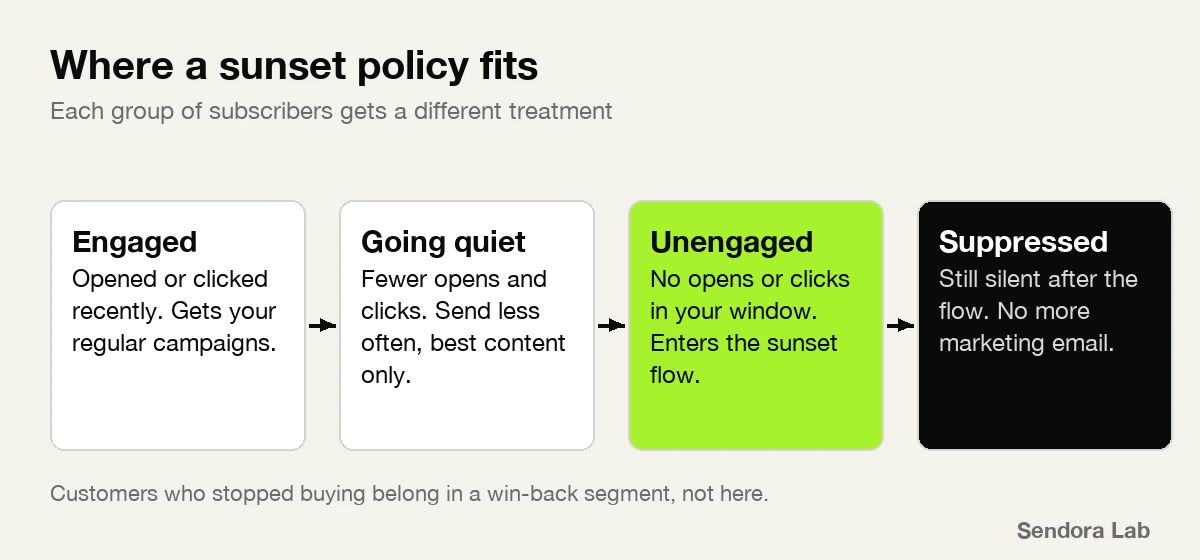
A sunset policy removes long-term non-readers from your regular sends so that the people you do email are people who react. Mailbox providers watch those reactions, and silence from a large part of your list works against you.
Two Klaviyo terms come up throughout. A sunset flow is an automated series that sends a final “do you still want these?” message to unengaged subscribers. Suppression stops Klaviyo sending marketing email to a profile while keeping the profile and its history in your account.
Google is direct about this. Its email sender guidelines say: “Consider unsubscribing recipients who don’t open or read your messages.” The same page asks bulk senders to keep the spam rate in Postmaster Tools below 0.10% and never reach 0.30%. People who ignore you for months are also the ones most likely to hit “report spam” when you finally catch their eye. Our email deliverability guide covers the other habits that keep a store in the inbox.
A sunset policy is not a win-back. Customers who used to buy and have stopped belong in a win-back segment first. It is also not the same as choosing who gets each campaign; that is the job of your engaged segment. The sunset rule sits at the far end: it decides when someone leaves your sending altogether.
Decide who counts as unengaged
Base the rule on opens, clicks and buying signals over a window that matches how often you send. Someone who has had three emails in six months has not had a fair chance to ignore you; someone who has had forty has.
Klaviyo’s sunset flow help article suggests a broad starting segment: can receive email marketing, created at least 180 days ago, received at least 5 emails in the last 72 weeks, and zero opens, clicks, site activity, product views, started checkouts and orders over all time. That is cautious, which suits a store that sends rarely.
Both stores in our data used a tighter rule: a profile at least 90 days old that had received at least 10 emails and had zero opens and zero clicks in the last 90 days. Neither rule looked at orders or site visits. For a store that sends several times a week, this is the version we would build:
- Can receive email marketing.
- AND created at least 90 days ago, so new subscribers get time to settle in.
- AND Received Email at least 10 times in the last 90 days.
- AND Opened Email zero times and Clicked Email zero times in the last 90 days.
- AND Placed Order, Active on Site and Viewed Product zero times in the last 90 days.
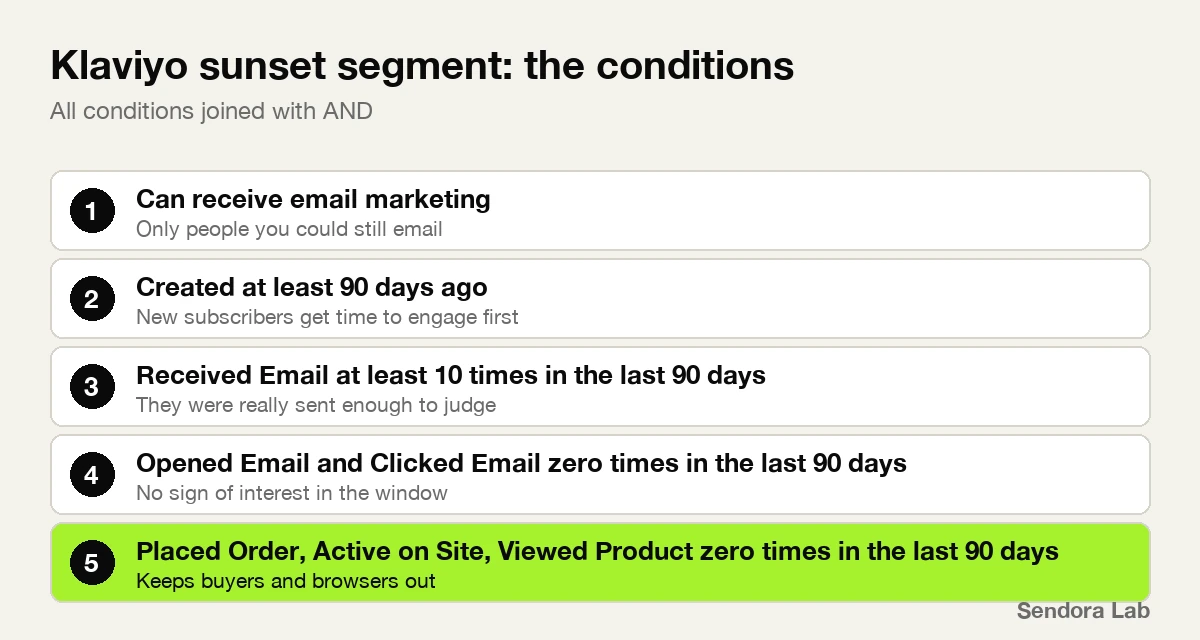
Condition 5 is the one most setups miss, and the data further down shows why it matters. If you send once a week, stretch the window to 180 days. Our guide to email marketing frequency helps you judge how many sends a subscriber should have had before you decide they are not reading. One caution on opens: Apple Mail Privacy Protection can record opens that no person made, so a click-based rule is stricter than an open-based one.
How to build the sunset flow in Klaviyo
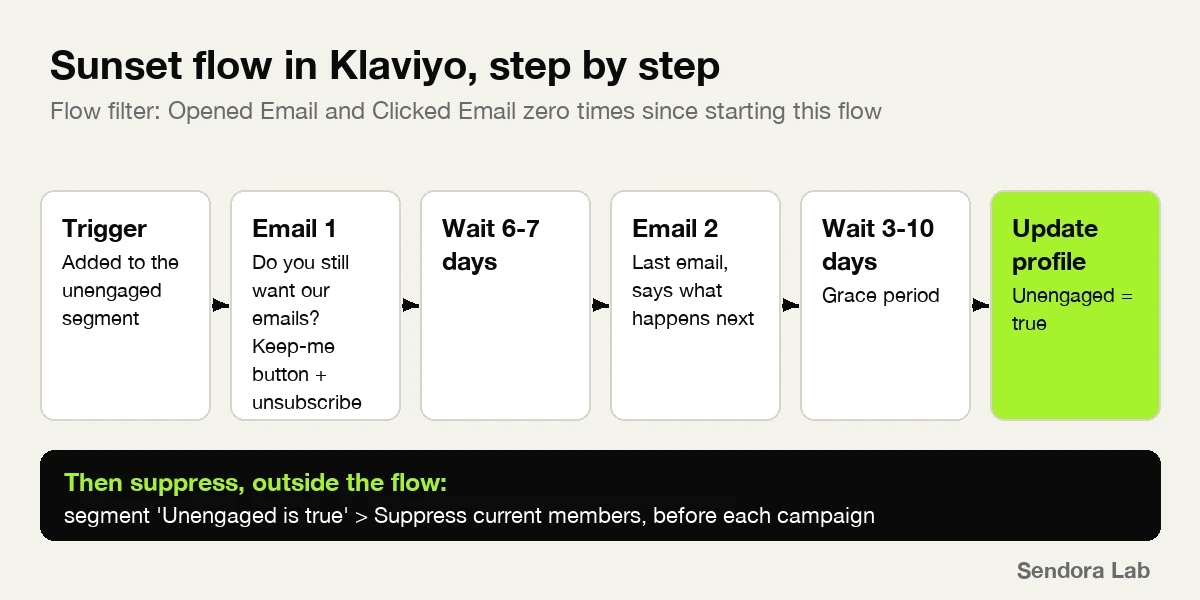
Trigger the flow on the unengaged segment, send one or two plain “do you still want our emails?” messages, and tag anyone who stays silent. Both stores in our data used this structure.
- Trigger: “Added to segment”, using the segment above.
- Flow filter: Opened Email zero times since starting this flow AND Clicked Email zero times since starting this flow. Anyone who reacts leaves the flow untagged.
- Email 1, one day after entry: ask if they want to stay, with one clear “keep me on the list” button and an easy unsubscribe link.
- Email 2, six or seven days later: a short last notice that says what happens next.
- Grace period: Klaviyo suggests three days if you send daily, or 7 to 10 days if you send less often. Our two stores waited five days.
- Final step: “Update profile property”, setting Unengaged to true.
Klaviyo’s article warns against more than three emails, because repeated mail to people who ignore you can itself hurt deliverability. A list of new products is the wrong content here; the only job of these emails is to get a clear yes or no.
What two real sunset flows returned
A sunset flow earns almost nothing in sales, and that is fine. Its value is the people who leave cleanly and the ones who raise a hand. These are per-email results from two Dutch-language fashion stores on Shopify, called Brand A and Brand B here (both names are pseudonyms), from Klaviyo flow reports in Sendora Lab’s anonymised data.
| Sunset email | Recipients | Open rate | Click rate | Unsubscribe rate | Spam complaints | Orders |
|---|---|---|---|---|---|---|
| Brand A, email 1 (Oct 2025 – Sep 2026) | 9,649 | 10.80% | 0.41% | 2.29% | 5 | 0 |
| Brand A, email 2 | 7,944 | 6.03% | 0.38% | 0.43% | 0 | 2 |
| Brand B, email 1 (Mar – 20 Oct 2026) | 17,650 | 12.82% | 0.20% | 2.28% | 4 | 0 |
| Brand B, email 2 | 14,696 | 5.42% | 0.32% | 0.58% | 1 | 0 |
The first email did most of the work in both stores: about 2.3% of recipients unsubscribed, which is a good result here because those people now leave on their own terms instead of staying silent. Clicks stayed between 0.20% and 0.41%. Brand A’s flow brought in 2 orders worth €99.90 from 17,593 recipients; Brand B’s brought none. Brand B’s flow went live in March 2026, so its figures cover a shorter period.
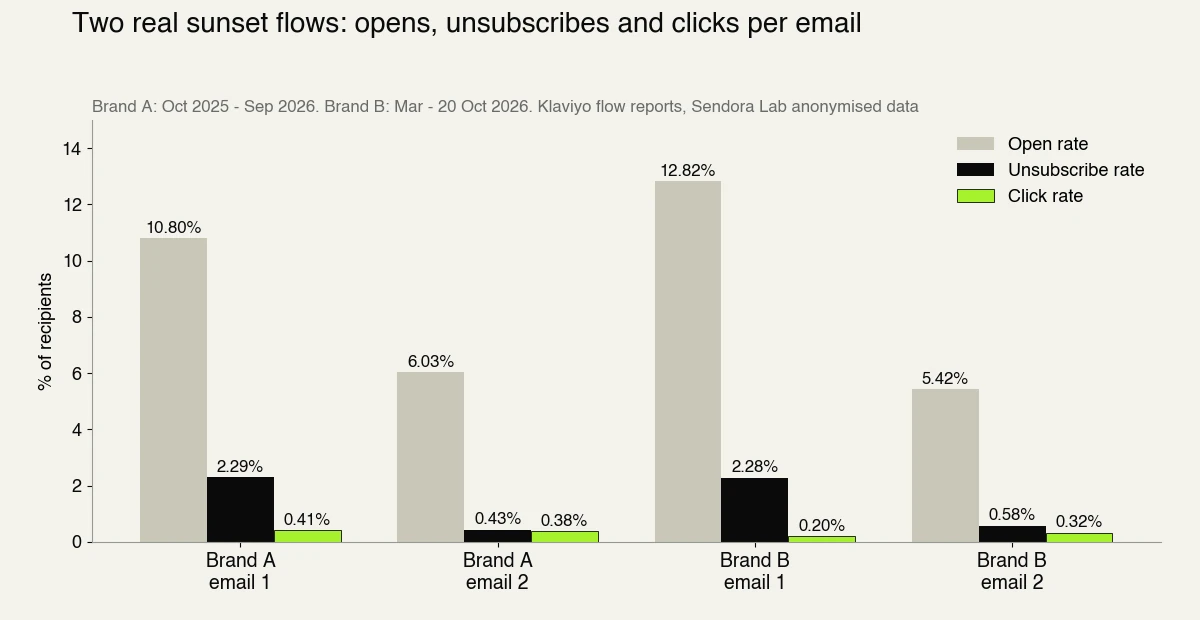
Read the open rates with care. Profiles in this flow had zero opens for 90 days, so a sudden 10% to 13% open rate is likely to include automatic opens from privacy features. Clicks are the cleaner signal of a real person.
The step most stores miss: actually suppressing
A sunset flow only tags profiles. Unless you then suppress the tagged profiles, or exclude them from every send, they keep getting email. Klaviyo’s help article is explicit: suppression cannot be a flow action, so you build a segment where Unengaged is true and use “Suppress current members”, repeating it before each campaign.
Brand A’s flow ended by setting two profile properties, Unengaged and “suppressed”, to true. A property named “suppressed” is just a label; it does not suppress anything. We followed the 6,248 profiles who received that flow’s final email between October 2025 and June 2026, up to 30 September 2026:
- 5,180 received at least one more email more than a week after the “last email we’ll ever send”, 40,079 emails between them;
- 1,154 opened or clicked an email later on;
- 39 placed an order after receiving the final sunset email.
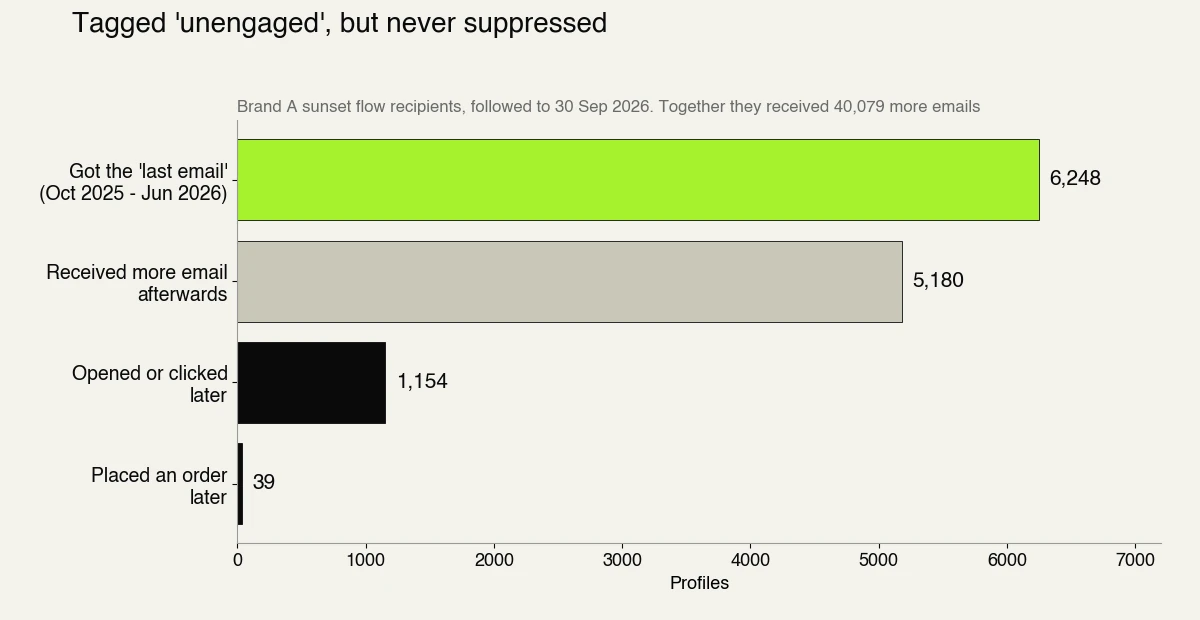
Two lessons come out of this. First, close the loop: suppress the “Unengaged is true” segment on a fixed day each week, or at least exclude it from every campaign. Second, the 39 later buyers show why condition 5 belongs in the segment. Someone who still visits and buys is a customer, not dead weight, even if they never open your newsletter.
Suppress or exclude?
Suppression stops all marketing email to the profile and, according to Klaviyo, keeps inactive profiles from counting towards your billing plan. Excluding the segment from campaigns is softer and easy to undo, but it relies on everyone remembering it on every send. With the buying signals in the segment, suppression is the safer default.
Conclusion
A working email sunset policy has three parts: a fair definition of unengaged that leaves buyers and site visitors out, a short sunset flow that asks one clear question, and a suppression step that actually happens. The first two take an afternoon in Klaviyo; the third is where our data shows stores slip. If you want help setting the window and checking your list, see our Klaviyo email marketing service or book a free audit. Warming a new Klaviyo branded sending domain? Keep unengaged subscribers out of the first month. Our Klaviyo domain warming guide has the full schedule.
FAQ
How long before a subscriber counts as unengaged?
Usually 90 to 180 days without opens or clicks, depending on how often you send. Klaviyo’s suggested sunset segment uses profiles at least 180 days old that received at least 5 emails in 72 weeks and never engaged.
Does a Klaviyo sunset flow suppress profiles automatically?
No. The flow can only update a profile property such as Unengaged. You then suppress the members of an “Unengaged is true” segment yourself, before each campaign.
How many emails should a sunset flow send?
One to three. Klaviyo warns that more than three can hurt deliverability, and in our data the first email produced most of the unsubscribes.
Does a sunset flow make money?
Rarely. In our data one sunset flow earned 2 orders from 17,593 recipients and the other earned none. Its value is a cleaner list, not sales.
Want this set up in your Klaviyo account?
A free 30-minute audit, your account open on screen.
Book a free audit