



Purchase behavior segmentation means grouping customers by what they bought, how they bought it, how often and how recently, instead of by age, gender or location. In Klaviyo it turns your order data into segments that update themselves, so each customer gets the message that fits what they actually did. Below is which signals are worth using, what two real stores’ orders say about them, and how to build the segments step by step.
Short answer: segment on purchase behavior because it tells you what someone is likely to buy next, which demographics rarely do. Start with what people bought (product or category) and whether they are first-time or repeat customers, then test basket size, order value and discount use on your own data before you build on them. In Sendora Lab’s anonymised data from a supplements brand, 1,795 of 1,953 repeat customers bought at least one product from their first order again.
What purchase behavior segmentation is
It is segmentation built on order events. A segment in Klaviyo is a group of profiles that updates itself from conditions; a purchase behavior segment uses conditions on events such as Placed Order (one per order) and Ordered Product (one per product in an order).
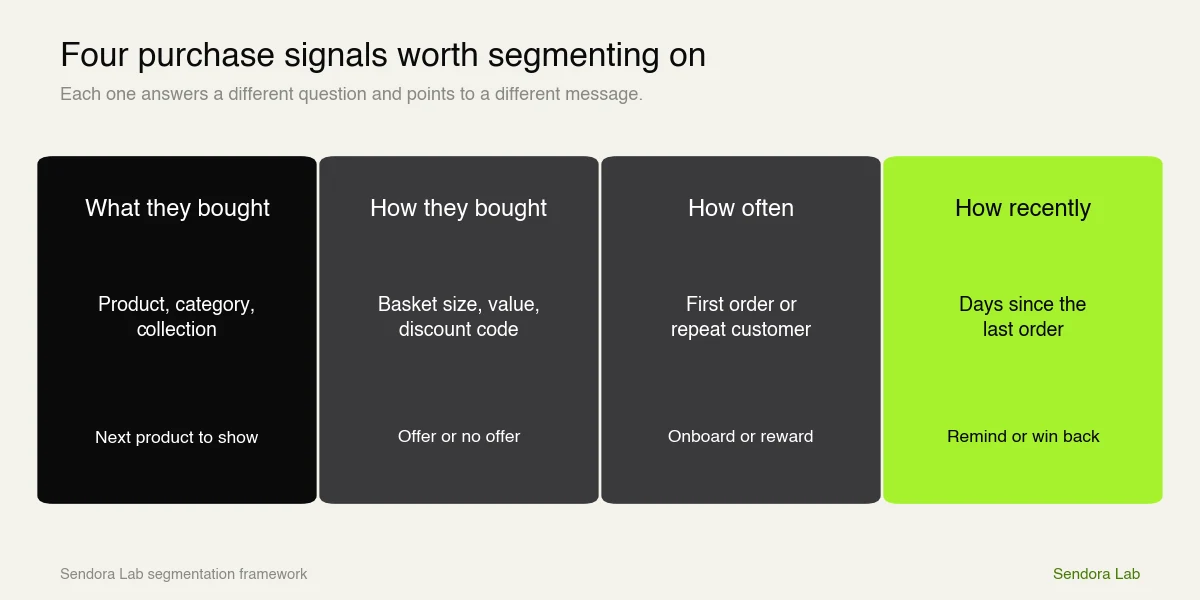
Klaviyo’s own guide to behavioral segmentation lists purchase behavior next to website behavior, lifecycle stage, interests and satisfaction. In practice we use four purchase signals, each pointing to a different message:
- What they bought: product, category or collection. This decides which products to show next.
- How they bought: basket size, order value and whether they used a discount code. This decides whether an offer is needed at all.
- How often: first-time or repeat customer. This decides whether you onboard or reward.
- How recently: days since the last order. This decides whether you remind or try to win back lapsed customers.
Demographics still have a place, for sizing or language. But two customers of the same age who bought different things want different emails; two customers of different ages who bought the same thing usually want the same one.
What someone bought first predicts what they buy next
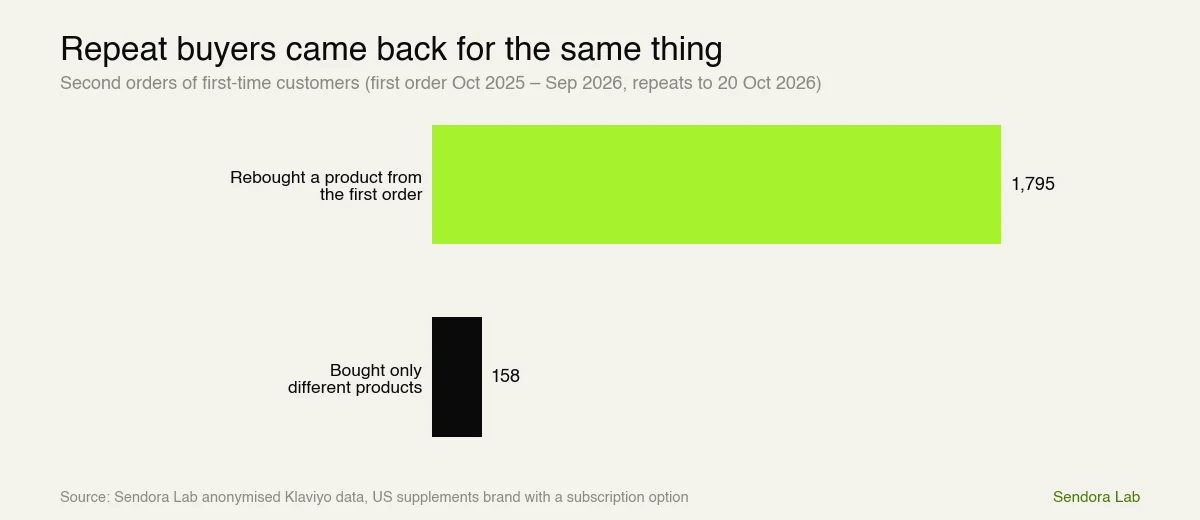
The product in the first order is the strongest signal we see in stores with consumable products. Repeat customers mostly come back for the same thing, so a segment built on the first product tells you what to send them.
In Sendora Lab’s anonymised Klaviyo data from a US supplements brand with a subscription option, 5,597 customers placed their first order between October 2025 and September 2026. By 20 October 2026, 1,953 of them had ordered again (34.9%). Of those 1,953, 1,795 had at least one product from their first order in their second order, and 158 bought only different products.
One caveat: subscription renewals count as orders, so part of that rebuying is automatic. It still means the first product is the right anchor for this store’s segments and for its replenishment flow.
For fashion, home or gift stores, where the same product is rarely bought twice, use the category or collection instead. Someone who bought a winter coat is a better target for knitwear than for another coat.
Basket size, order value and discounts: test before you trust
These signals sound useful, but whether they predict anything depends on the store. Run the numbers on your own orders before you build segments and flows around them.
In the supplements brand, first orders with two different products repeated far more often than single-product orders: 1,481 of 3,492 customers (42.4%) against 434 of 1,980 (21.9%). Three or more products: 38 of 125 (30.4%). There, a two-product first basket is a real signal.
In a Dutch-language fashion outlet store on Shopify, the same split showed almost nothing. Of 12,392 first-time customers from October 2025 to September 2026, 372 ordered again by 20 October 2026 (3.00%). By items in the first order, the repeat rate was 2.92% for one item, 3.14% for two and 3.07% for three or more.
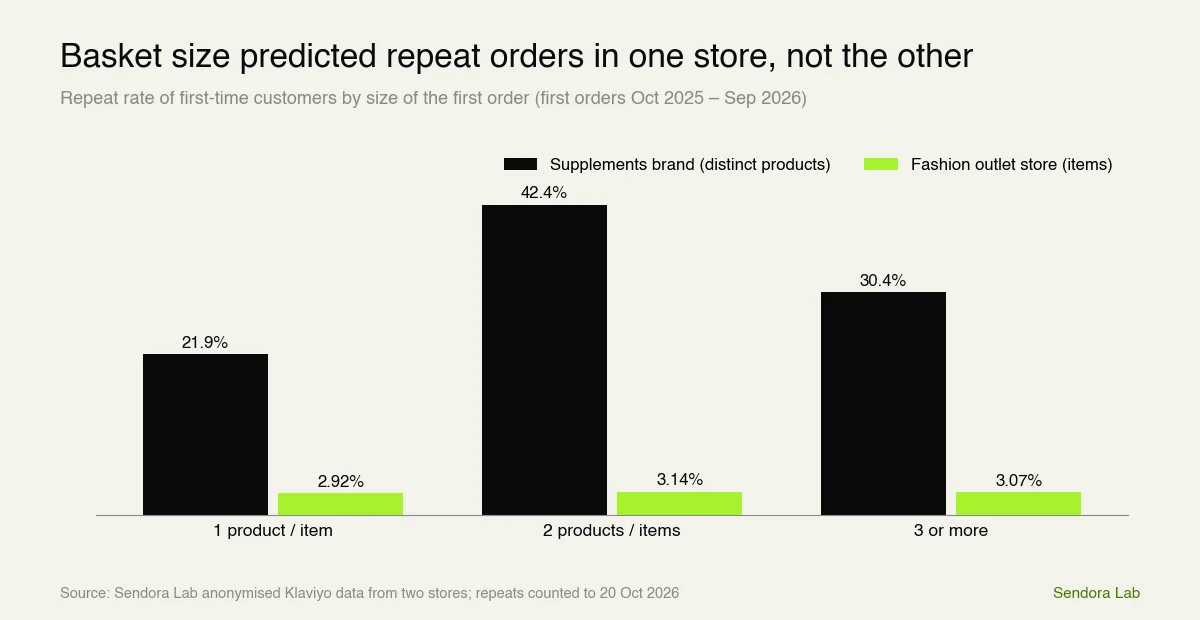
Order value moved a little in the outlet store: first orders of €120 or more repeated at 4.03% (36 of 894 customers), against 2.17% under €40 (16 of 738). Discount codes were too rare to segment on: of 12,494 customers whose first order in that year we checked, only 112 used a code.
The lesson: a segment is only worth building if it changes what you send and the group is big enough to matter. Check both before you add it to your plan.
How to build purchase behavior segments in Klaviyo
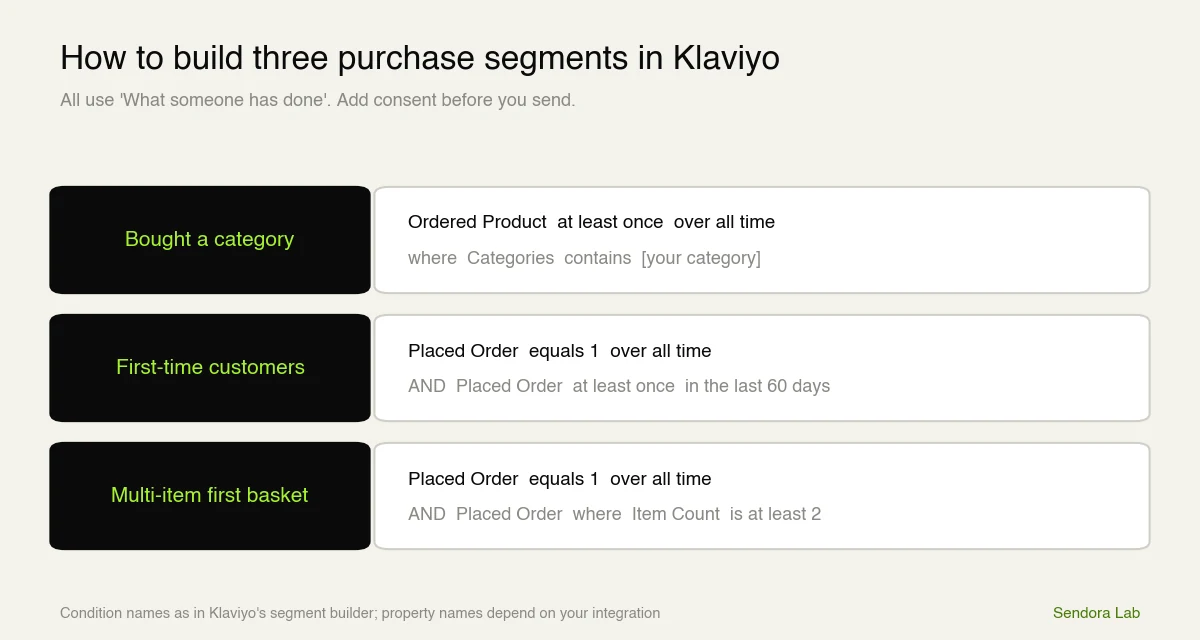
Use the “What someone has done” condition with Placed Order or Ordered Product, then narrow it with an event property filter. Klaviyo’s segment conditions reference explains the options; the points that trip people up are below.
Segment by product or category
- Go to Lists & Segments and create a segment.
- Choose “What someone has done”, then Ordered Product, “at least once”, “over all time” (or “in the last” 180 days for recent buyers).
- Click the filter icon and pick the property: product name, SKU, or Categories (your Shopify collections).
- For a list property such as Categories, “includes any of” matches exact items, while “contains the text” matches part of a value. Values are case sensitive.
- Add “Can receive email marketing” so the count shows people you can actually email.
Segment by order count and basket
- First-time customers: Placed Order equals 1 over all time. Add “at least once in the last 60 days” if you only want recent ones.
- Repeat customers: Placed Order at least 2 over all time. For your highest-value group, use spend instead; our VIP segment guide shows how to set that threshold.
- Multi-item baskets: Placed Order where Item Count is at least 2.
Only top-level event properties can be used in segments, and property names depend on your integration, so open a recent Placed Order event in a profile to check what yours carries. If refunds are common, add Refunded Order zero times so returned purchases do not keep people in a product segment.
What to send each purchase segment
Each segment should change one thing: the products shown, the offer, or the timing. If it changes nothing, you do not need it.
| Segment | What to send | Where it lives |
|---|---|---|
| Bought product or category X | Related products, care tips, new arrivals in that category | Campaigns, plus a category split in the post-purchase flow |
| Rebuys the same product | A reminder timed to their reorder gap | Replenishment flow |
| First-time customer, one product | The product most often bought second, no discount by default | Post-purchase flow |
| Repeat or high-spend customer | Early access and thank-yous instead of extra discounts | VIP campaigns |
| No order for longer than usual | A reason to come back, then a check-in | Win-back flow |
Purchase segments also work as exclusions. Leave recent buyers of a product out of the campaign that promotes it, and keep repeat customers out of first-order welcome offers. Pair them with an engaged segment when a send should go only to people who still read your emails.
Conclusion
Purchase behavior segmentation works because it follows what customers did, not who you assume they are. Start with what people bought and whether they have bought before, check every other signal against your own orders, and give each segment one clear message. If you want help deciding which purchase segments your store needs and wiring them into your flows, see our Klaviyo email marketing service or book a free audit. To combine what people buy with how recently and how often, read Klaviyo RFM segmentation. To put the first-time buyer split into a flow, read our second purchase email strategy guide.
FAQ
What is purchase behavior segmentation?
It is grouping customers by their buying actions: what they bought, how they bought it, how often and how recently. In Klaviyo you build it with conditions on Placed Order and Ordered Product events.
How do I segment by product purchased in Klaviyo?
Create a segment with “What someone has done”, choose Ordered Product at least once, then use the filter icon to pick a product name, SKU or Categories value. Values are case sensitive.
Is order value or basket size a good segment?
It depends on the store. In our data, two-product first orders repeated at 42.4% against 21.9% for one product in a supplements brand, but basket size made almost no difference in a fashion outlet store.
Do repeat customers buy the same product again?
In consumable categories they often do. In one supplements brand, 1,795 of 1,953 repeat customers bought at least one product from their first order again, partly through subscription renewals.
Want this set up in your Klaviyo account?
A free 30-minute audit, your account open on screen.
Book a free audit