



SMS vs email marketing is not a contest one channel wins. Texts reach fewer people but get far more clicks per message; email reaches almost everyone on your list, costs less per send and carries far more content. The useful question is which moments deserve a text, and which belong in the inbox.
Short answer: Use email for the calendar: launches, education, product range and most flows. Add SMS only to the few moments where speed matters, such as checkout reminders and last-hours offers, and only for people who gave SMS consent. In Sendora Lab’s client data, SMS earned more per recipient but email earned more in total, and texts lost subscribers faster.
Below are real numbers from two stores we work with, how Klaviyo counts SMS revenue (it is not the same as email), and how to split the work in practice.
SMS vs email marketing at a glance
The two channels differ in reach, cost and how results are counted. This table sums up the differences that matter for an online store using Klaviyo.
| SMS | ||
|---|---|---|
| Who you can reach | Everyone with email marketing consent | Only people who gave separate SMS consent |
| Length | Long: images, product grids, stories | 160 characters per segment, or 70 with an emoji |
| Cost per send | Low | Billed in credits per segment, per country |
| How Klaviyo credits a sale | Open or click, then order in the window | Delivered (or clicked), then order in the window |
| Best for | Most campaigns and flows | Time-sensitive nudges |
Two terms first. A flow is an automated series of messages that starts when someone does something, such as leaving a checkout. Attributed revenue is the order value Klaviyo credits to a message because the order came within its attribution window.
On cost, Klaviyo bills texts in credits: the credits per segment for the recipient’s country, times recipients, times segments. One SMS segment holds 160 characters, or 70 if the text includes an emoji or special character, and split texts drop to 153 characters per segment (Klaviyo’s SMS credit guide). One emoji in a long text can double what it costs.
What one store’s data shows when it sends both
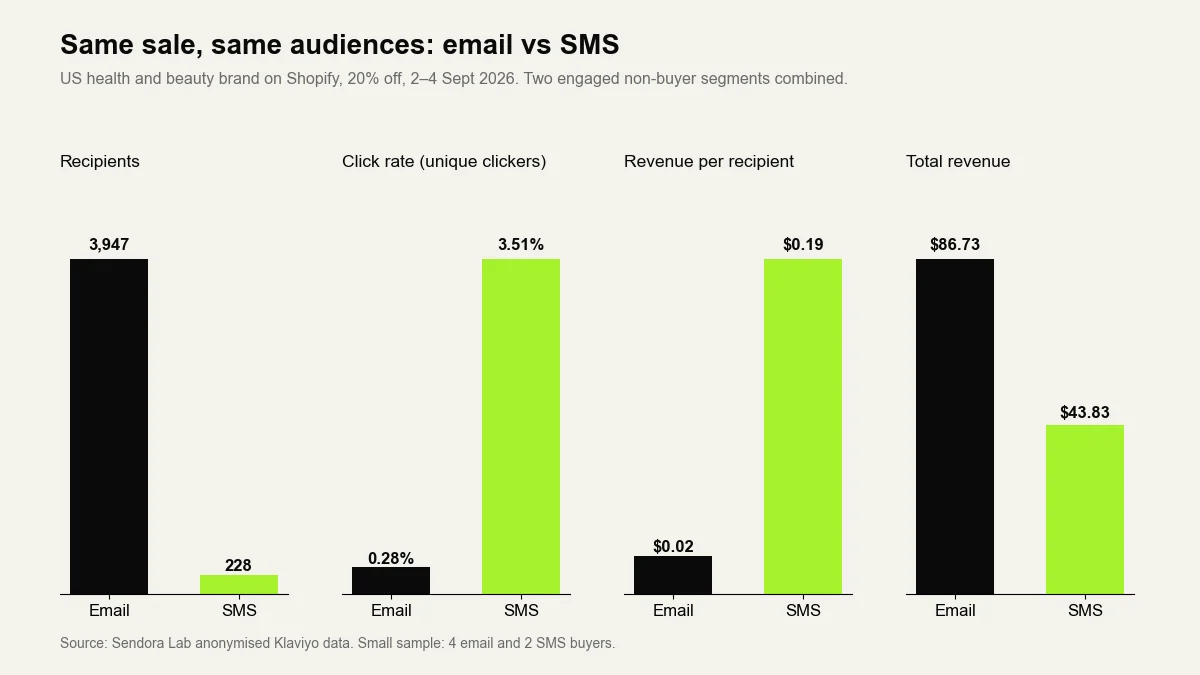
When the same store sent the same offer by email and by text, SMS earned almost nine times more per recipient, but email still brought in about twice the money because it reached seventeen times more people.
The store is a US health and beauty brand on Shopify that added SMS in May 2026. For a Labor Day sale (20% off, 2–4 September 2026), it sent email and SMS to the same two segments of engaged people who had not ordered yet:
| Audience | Channel | Recipients | Click rate | Buyers | Revenue | Unsubscribe rate |
|---|---|---|---|---|---|---|
| Engaged, never ordered | 2,956 | 0.31% | 3 | $59.85 | 0.37% | |
| Engaged, never ordered | SMS | 167 | 4.19% | 2 | $43.83 | 0.60% |
| Engaged prospects | 991 | 0.20% | 1 | $26.88 | 0.81% | |
| Engaged prospects | SMS | 61 | 1.64% | 0 | $0 | 0% |
Added up, the 228 texts earned $43.83, or about $0.19 per recipient. The 3,947 emails earned $86.73, about $0.02 per recipient. That pattern held across the year: in the store’s flows from 21 October 2025 to 20 October 2026, SMS had a click rate of 4.15% against 1.38% for email, but an unsubscribe rate of 1.26% against 0.52%.
The sample is small, and the texts went to fewer, more willing people: anyone with SMS consent has already said yes twice. Read it as a direction, not a law.
Why SMS results often look better than they are
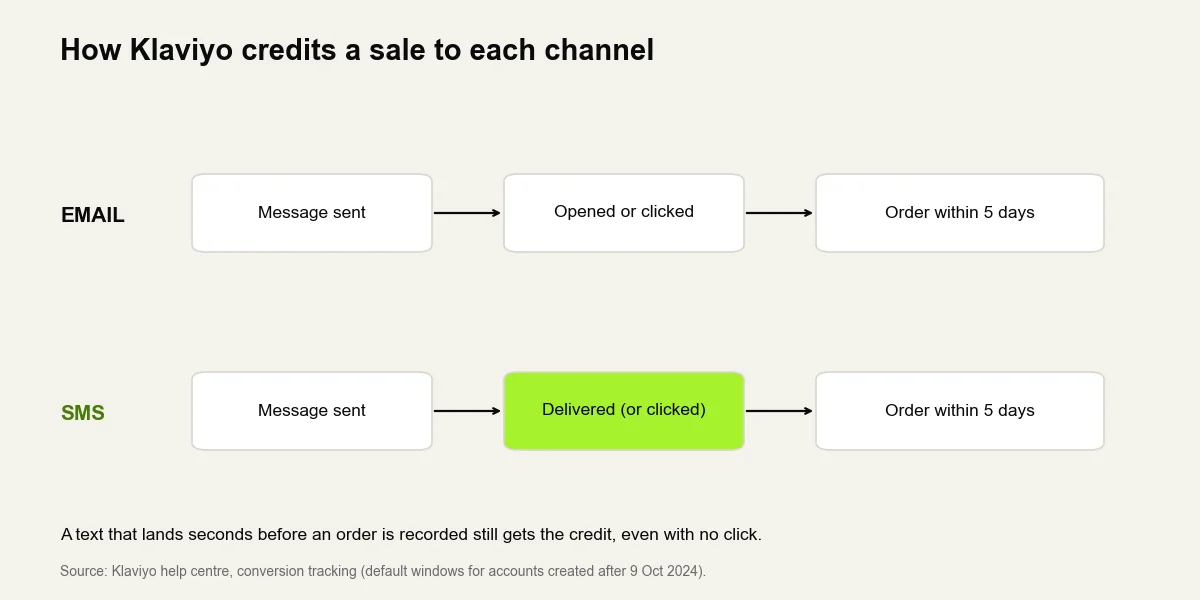
Klaviyo credits a text with a sale when the text was delivered before the order, even if nobody clicked. Email needs an open or a click. So the same order is easier to credit to SMS.
Klaviyo’s guide says SMS attribution happens when a text is delivered before the order or clicked, within a five-day window by default, while email conversions are only tracked after an open or click (Klaviyo conversion tracking). We cover the wider picture in attributed revenue, explained.
Here is how far that can go. The same US brand had an SMS welcome text with a 10% code for new SMS subscribers who had not bought yet. Klaviyo credited it with 142 orders worth $4,711.33 from 413 recipients, more than all of the brand’s email flows together in the year ($4,154.97). If people tick the SMS box while they are buying, the welcome text can land seconds before their order is recorded and still take the credit. Before you scale SMS on a number like that, check how many of those buyers were already in checkout.
Where SMS earns its place, and where it doesn’t
SMS is worth its cost when timing decides the sale: a checkout left minutes ago, the last hours of an offer, a delivery update. For browsing, routine order messages and anything that needs pictures, email usually does the job better and loses fewer subscribers. If bundled SMS is part of a platform decision, see Klaviyo vs Omnisend.
Checkout reminders: SMS wins on small numbers
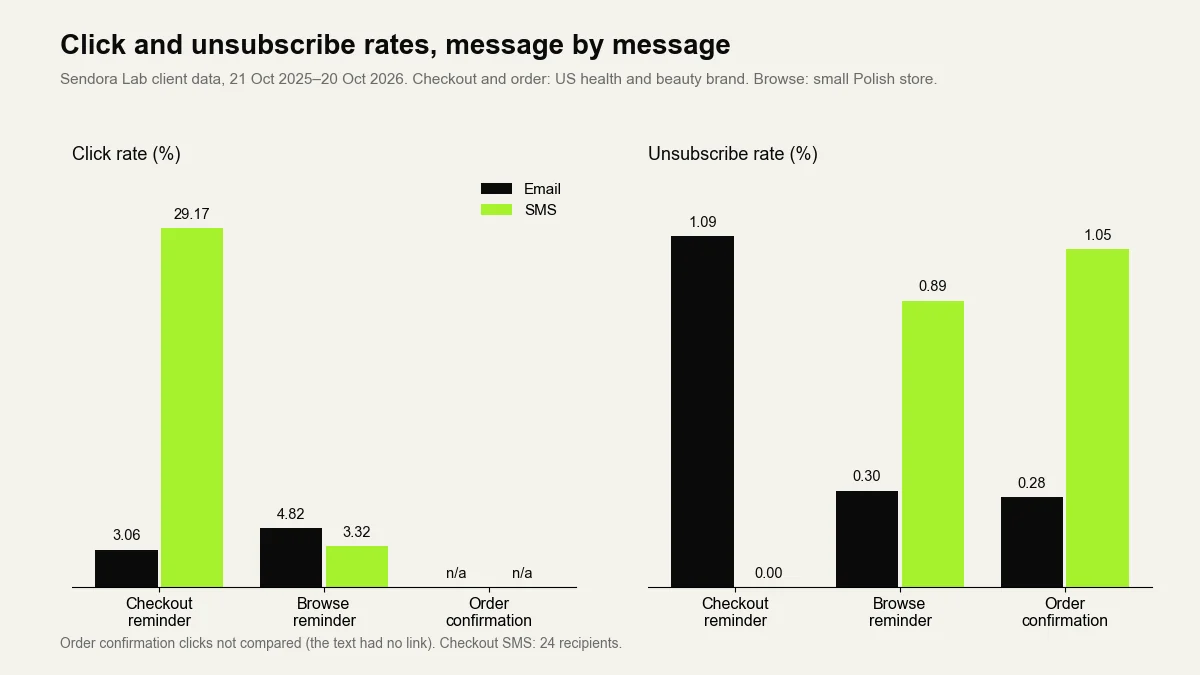
In the US brand’s abandoned checkout flow, the text went to 24 people, got a 29.17% click rate and 3 buyers ($4.09 per recipient). The first email went to 1,028 people, got 3.06% and 8 buyers ($0.28 per recipient). Our abandoned cart flow guide shows the same split in another store.
Browse reminders: email did better
A small Polish online store waits two hours after a product view, then sends a text to SMS subscribers and an email to everyone else (flow live from February 2026, data to 20 October 2026). The text went to 787 people with a 3.32% click rate and earned 3.24 zł per recipient; the email went to 364 people with 4.82% and earned 5.36 zł. The text also had three times the unsubscribe rate (0.89% against 0.30%).
Order updates: texts cost subscribers
The US brand’s order confirmation text reached 1,688 people and lost 17 SMS subscribers (1.05%). Its order confirmation email reached 3,944 people with a 0.28% unsubscribe rate. If a text only says “thanks for your order”, email can carry it.
How to split the work between SMS and email in Klaviyo
Let email do most of the work and add a text only where it changes the outcome. In practice that means one flow with a channel split, not two flows racing each other.
- Keep consent separate. Email consent is not SMS consent. Collect SMS consent on its own, with its own disclosure; our guide to starting SMS marketing covers the rules.
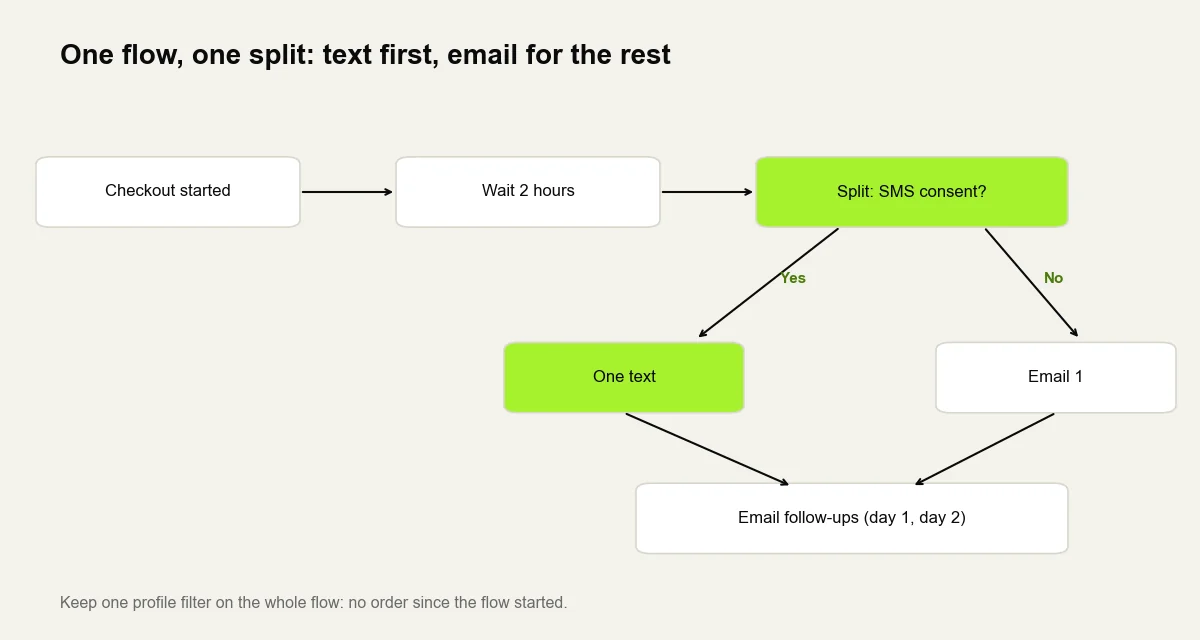
- Split by channel inside the flow. In abandoned checkout, add a conditional split on SMS consent (subscribed and able to receive SMS marketing): the yes branch gets one text, then joins the email path; the no branch gets the email. A conditional split sends people down different paths based on a profile property or behaviour.
- Send the text first, the email later. A text two hours after a checkout, then email for the follow-ups, keeps the urgent nudge short and the detail in the inbox.
- Remember the timers are separate. Smart Sending runs a separate timer per channel, so an email never stops a text. Plan the total number of messages per person yourself.
- Text fewer people than you email. For campaigns, send texts to the most engaged SMS subscribers and only for real deadlines. Our email marketing frequency guide shows what happens when sends pile up.
- Report the channels apart. Read SMS revenue next to email revenue, with SMS’s delivery-based credit in mind.
Conclusion
In the SMS vs email marketing choice, email is the base and SMS is the extra. Texts click better and earn more per recipient, but they reach fewer people, cost more per send, lose subscribers faster and get credit more easily. Start with a text in checkout recovery, measure it with the attribution rule in mind, and grow from there.
If you want a second pair of eyes on how your email and SMS share the work, see our email and SMS marketing services or book a free audit. Comparing platforms for it? Read Klaviyo SMS vs Attentive. Weighing an SMS-only app? See Klaviyo vs Postscript.
FAQ
Is SMS better than email for ecommerce?
Not overall. In Sendora Lab’s data from a US health and beauty brand, a holiday text earned about $0.19 per recipient against $0.02 for email, but email earned about twice as much in total because it reached far more people.
Why does SMS show more revenue in Klaviyo?
Klaviyo credits a text when it was delivered before an order, even without a click, while email needs an open or click. That makes SMS revenue easier to credit and harder to compare.
Do SMS subscribers unsubscribe more than email subscribers?
In our client data, yes. One store’s flow texts had a 1.26% unsubscribe rate against 0.52% for its flow emails over the same year.
How long can a text be?
One segment holds 160 characters, or 70 with an emoji or special character. Longer texts are split into 153-character segments, and each segment costs credits.
Want this set up in your Klaviyo account?
A free 30-minute audit, your account open on screen.
Book a free audit