



A Klaviyo abandoned cart flow should send its first reminder two to four hours after someone leaves, a second about a day later, and stop the moment they buy. Show the exact items they left, answer the doubts that stopped them, and keep any discount for the last message, if you use one at all. Below are the triggers, filters and timings I set up, and real data from a small store whose checkout flow brought 18 attributed orders between October 2025 and September 2026.
Short answer: build two flows, one triggered by Added to Cart and one by Started Checkout, each with a “Placed Order zero times since starting this flow” filter. Send two or three messages over about two days and lead with the cart, not a code. In Sendora Lab’s data below, the discount email earned almost the same per recipient as the plain first reminder.
How a Klaviyo abandoned cart flow works
An abandoned cart flow is an automated sequence that reminds a shopper about items they added but didn’t buy. In Klaviyo, a flow is a set of messages that sends on its own when a trigger fires, here an event from your store.
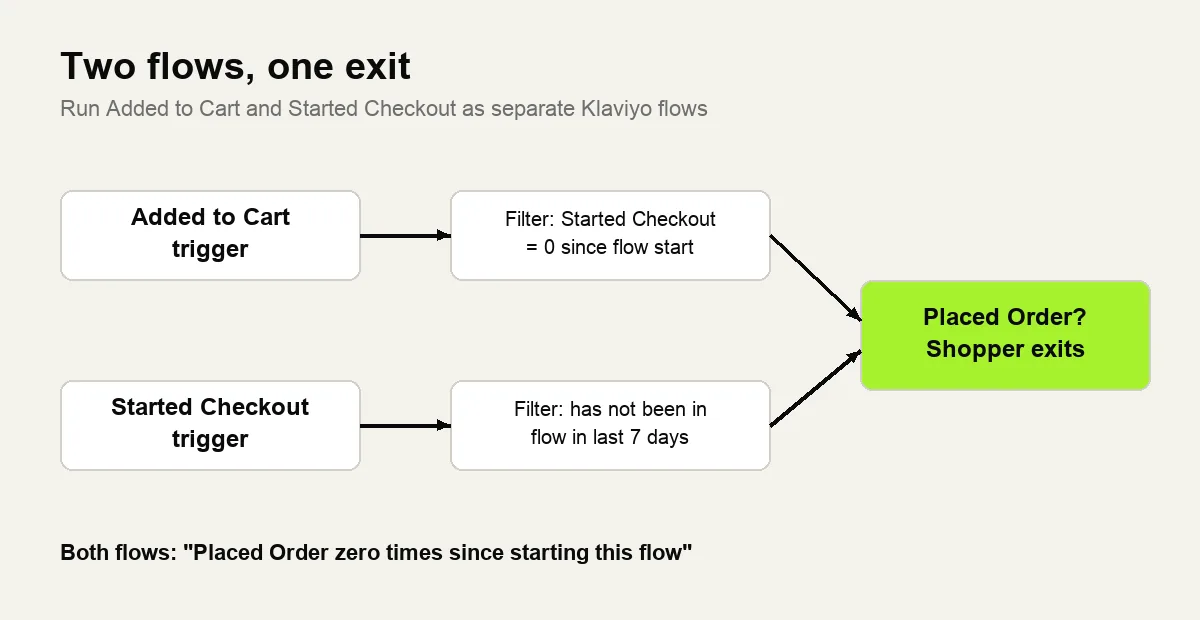
There are two possible triggers. Added to Cart fires when someone puts an item in the cart. Started Checkout fires when they reach checkout and enter their email. Klaviyo’s abandoned cart guide recommends running both as separate flows, because a checkout starter has shown stronger intent and deserves different timing or copy. If more than one tool sends checkout events to Klaviyo, see how to audit your Klaviyo integrations.
Added to Cart needs tracking switched on
On Shopify, Added to Cart only reaches Klaviyo if the Klaviyo app embed is on and “Track behavioral events” is ticked in the integration settings, as Klaviyo’s Shopify Added to Cart article explains. The ready-made flow sits in the flow library under “Prevent lost sales”. Klaviyo can also only send to shoppers it can identify, so if events look thin, check why Klaviyo isn’t tracking visitors first.
The filters that stop a cart flow misfiring
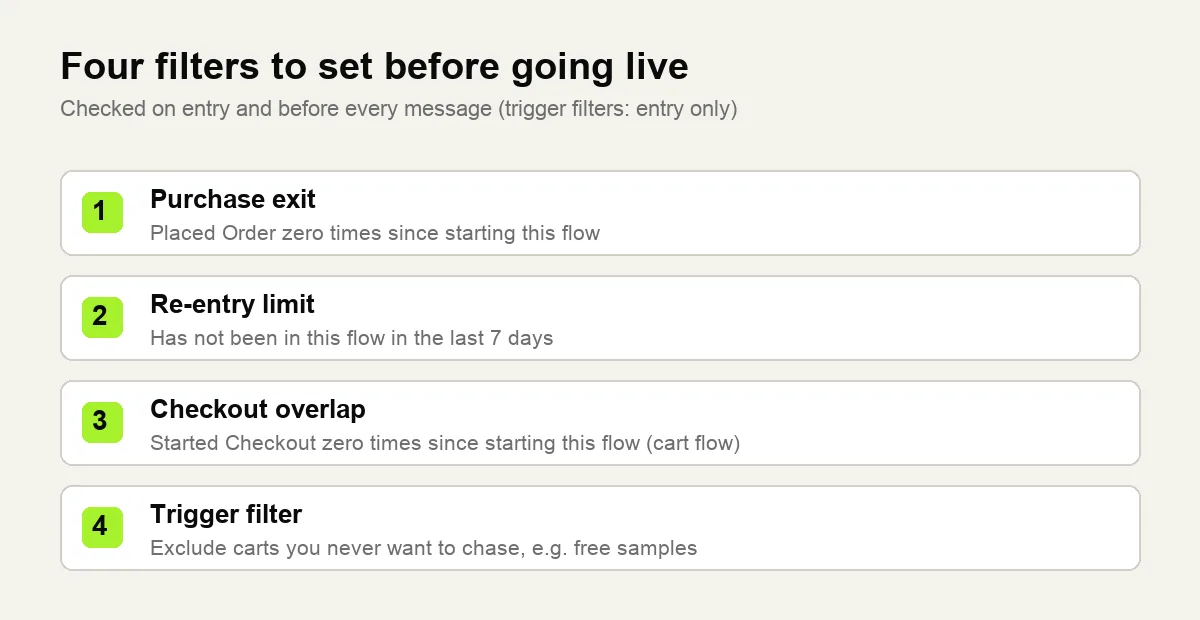
Filters decide who keeps receiving the flow, and most cart flow complaints come from missing ones. Set these before the flow goes live. If you are unsure which filter type to use, see Klaviyo trigger filter vs flow filter.
- Purchase exit. “Placed Order zero times since starting this flow” on both flows. Klaviyo checks flow filters when someone enters and again before every message, per its guide to triggers and filters, so buyers drop out before the next email and move into your post-purchase flow.
- Re-entry limit. “Has not been in this flow in the last 7 days”. Without it, a shopper who adds items three times in a week gets three sequences.
- No double flows. On the Added to Cart flow, add “Started Checkout zero times since starting this flow”. Anyone who reaches checkout then moves to the checkout flow only.
- Trigger filters for odd events. A trigger filter checks the event itself and only runs once, at entry. Use it to exclude carts you never want to chase, such as free samples or very low values.
The store in the data below uses the first two exactly: a Placed Order exit and a 7-day re-entry limit.
When to send each abandoned cart message
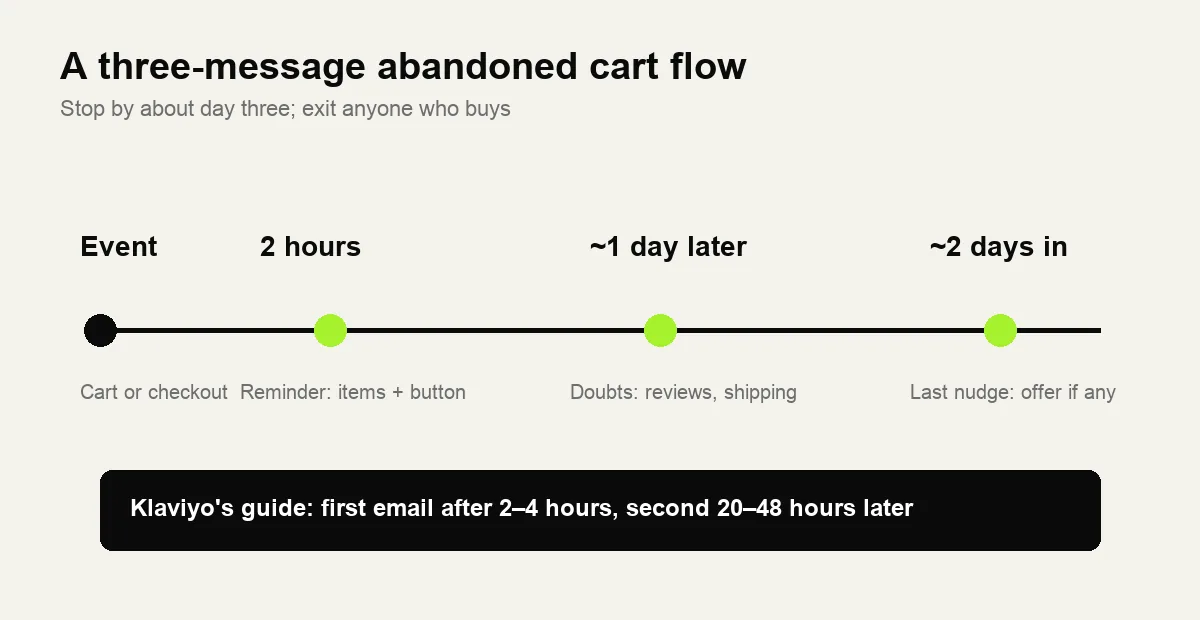
Send the first message two to four hours after the event, the second 20 to 48 hours later, and stop by about day three. Klaviyo’s pre-built flow waits four hours for the first email, and its guide puts the second 20 to 48 hours after that.
Shorter gaps suit cheap, quick buys. Longer ones suit considered purchases where people compare and come back. Three messages is enough for most stores; after that you are mostly emailing people who have decided.
A timing that works in practice
- 2 hours: the reminder. Cart items with images, a “Return to cart” button, delivery and returns in one line.
- About 1 day later: the doubts. Reviews, sizing or fit help, shipping times, and an easy way to ask a question.
- About 2 days in: the last nudge. If you offer an incentive, this is where it goes, with a real end date.
The cart block in Klaviyo’s template pulls in each item’s image, title, quantity and price, so the shopper sees exactly what they left. Keep it near the top.
What one store’s Klaviyo data shows
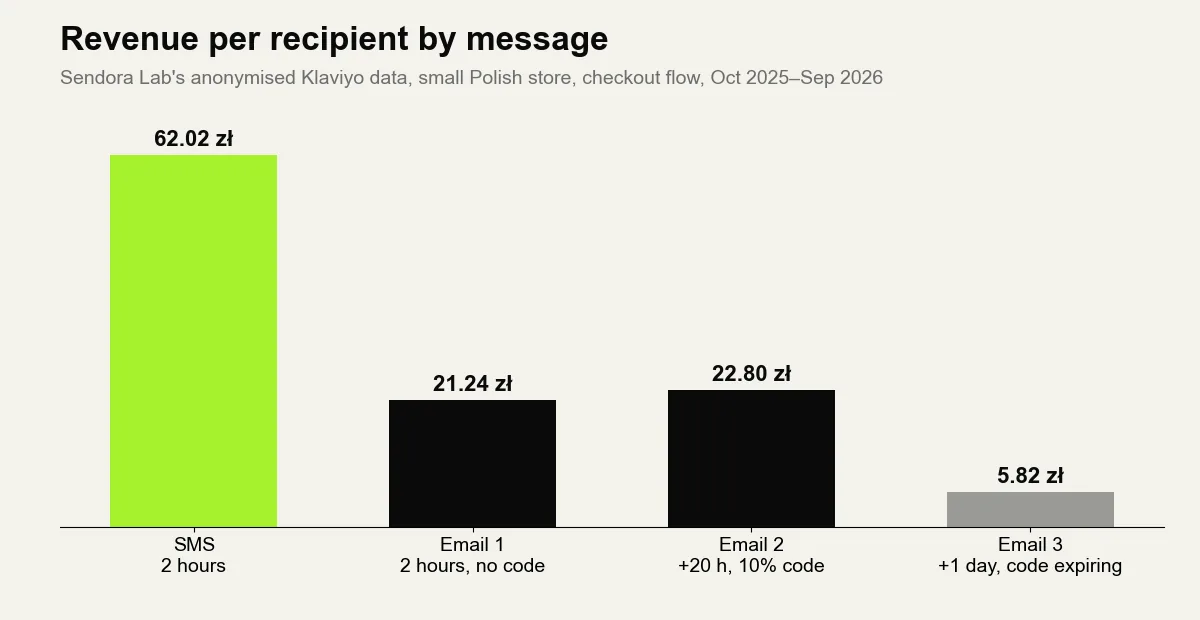
In this store’s flow, the first message and a discount email earned about the same per recipient, and the SMS earned the most. The sample is small, so read it as a direction, not a rule.
The data comes from Sendora Lab’s anonymised Klaviyo account for a small Polish ecommerce store, 1 October 2025 to 30 September 2026 (the flow went live in December 2025). It is a Started Checkout flow. After 2 hours, SMS subscribers get a text and everyone else gets Email 1. Twenty hours later both branches get Email 2 with a 10% code, then Email 3 a day after that saying the code is about to expire.
“Attributed revenue” below means orders Klaviyo credits to a message because the shopper received or clicked it shortly before buying. Revenue per recipient (RPR) is that revenue divided by the people who got the message.
| Message | Recipients | Click rate | Placed orders | Attributed revenue | RPR |
|---|---|---|---|---|---|
| SMS, 2 hours | 34 | 17.65% | 7 | 2,108.70 zł | 62.02 zł |
| Email 1, 2 hours (no code) | 78 | 10.61% | 4 | 1,402.00 zł | 21.24 zł |
| Email 2, +20 hours (10% code) | 80 | 5.33% | 5 | 1,710.20 zł | 22.80 zł |
| Email 3, +1 day (code expiring) | 67 | 9.23% | 2 | 378.10 zł | 5.82 zł |
| Whole flow | 259 | 9.58% | 18 | 5,599.00 zł | 23.33 zł |
Three things stand out. The SMS went to 34 people and brought 7 of the 18 orders. The 10% email earned 22.80 zł per recipient against 21.24 zł for the first email, which had no code at all. And the “code expiring” email added only 2 orders. Nobody unsubscribed from any message.
With numbers this small, a couple of orders either way would change the ranking. What it doesn’t support is the idea that a discount is what makes a cart flow work. Here, the plain reminder did nearly as well. For more on choosing channels, see SMS vs email.
Discount last, if at all
Lead with reassurance and keep any incentive for the final message. Klaviyo’s own guide advises against a coupon in the first email and suggests holding it for the last one, or offering it only to people who have never bought.
The risk of a code in every cart flow is that shoppers learn to abandon on purpose and wait. These settings limit that.
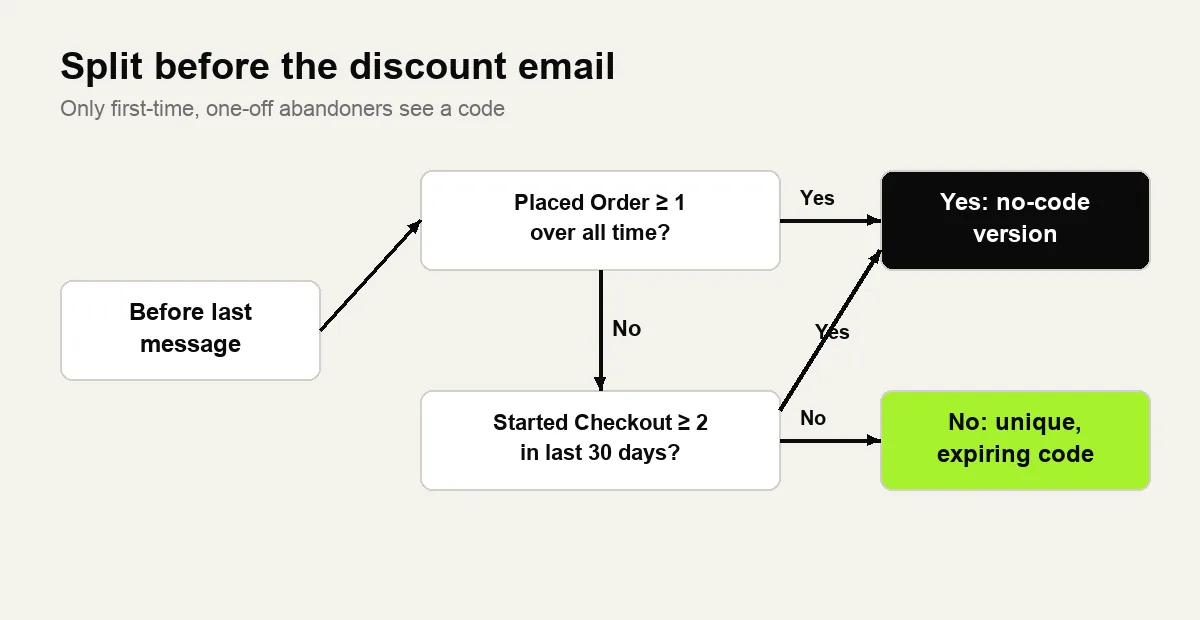
- Split before the offer. Add a conditional split before the discount email: if “Placed Order at least once over all time”, send a version without a code. Existing customers already trust you.
- Catch repeat abandoners. In the same split, send “Started Checkout at least 2 times in the last 30 days” down the no-code path. They have already seen the offer.
- Use unique, expiring codes. A shared code ends up on coupon sites. Klaviyo can create single-use Shopify codes that expire after a set number of days, the same setup I use in the Klaviyo welcome series.
If your margins are thin, test a version with no incentive at all. Free shipping above a threshold or a clear returns promise often answers the real doubt for less.
Abandoned cart, checkout and browse: how they fit together
These three flows catch shoppers at different stages, and each one should hand off to the next. Browse abandonment covers people who viewed products, the cart flow covers people who added items, and the checkout flow covers people who started paying. For how the two recovery flows compare, see abandoned checkout vs abandoned cart.
Build the checkout flow first, because those shoppers are closest to buying. Add the cart flow next with the overlap filter, then browse abandonment. The order matters more than the copy; I explain the full build order in the Klaviyo retention strategy guide. If checkout emails show skipped recipients, check your Klaviyo Smart Sending settings. Selling out of sizes too? Our Klaviyo back in stock flow guide covers the shoppers who are waiting. Using Okendo for reviews? See our Okendo Klaviyo integration guide. Offering a discount in the last step? Use unique coupon codes so it can only be used once. Not sure when the code should appear? See our email discount strategy guide.
FAQ
Should a Klaviyo abandoned cart flow use Added to Cart or Started Checkout?
Use both, as separate flows. Started Checkout shows stronger intent; Added to Cart reaches people earlier. Add “Started Checkout zero times since starting this flow” to the cart flow so nobody gets both.
How long should I wait before the first abandoned cart email?
Two to four hours. Klaviyo’s pre-built flow uses four hours; the store in this guide sends after two.
Should the first abandoned cart email include a discount?
No. Klaviyo advises keeping any coupon for the last email or for people who have never bought. In the store above, a plain first email earned 21.24 zł per recipient against 22.80 zł for the email with a 10% code.
How many messages should an abandoned cart flow have?
Two or three over about two days is enough for most stores. Add an SMS step for SMS subscribers if you have consent; in the data above it brought 7 of 18 orders.
Conclusion
A good Klaviyo abandoned cart flow is mostly settings: the right trigger, a purchase exit, a re-entry limit and two or three well-spaced messages that show the cart. Discounts come last, and only for people who need one. If you’d like a second pair of eyes on your flows, see how Sendora Lab handles Klaviyo email and SMS flows or book a free audit.
Want this set up in your Klaviyo account?
A free 30-minute audit, your account open on screen.
Book a free audit