



Klaviyo attributed revenue is the number most email reports lead with, and the one most often misread. It is the value of orders Klaviyo links to an email by timing, not the money email added on top of what the store would have made anyway. This guide explains what Klaviyo counts, what it leaves out and how to report it honestly, with real data from two Shopify stores.
Short answer: Klaviyo attributed revenue is the value of orders placed within a set window after someone opened or clicked an email, credited to the last email they touched. It is a slice of total store revenue, it includes orders that may have happened anyway, and it can even include refunds. At Sendora Lab we report it as a share of store revenue, next to the previous period, with the window and the excluded emails stated.
What Klaviyo attributed revenue is
Attributed revenue is the order value Klaviyo credits to a message because the buyer interacted with it shortly before ordering. Klaviyo’s academy lesson on understanding attribution also calls it owned revenue or Klaviyo-attributed value (KAV).
The rule has three parts, set out in Klaviyo’s help centre article on message attribution:
- An interaction. The person opened or clicked an email, or received or clicked a text message (Klaviyo credits a text once it is delivered). Opens are tracked with a pixel and clicks with tagged links.
- A window. The order has to fall inside the attribution window, the number of days after the interaction during which an order still counts. For accounts created after 9 October 2024 the default is five days for email and SMS, and 24 hours for push.
- Last touch. If several messages qualify, the one opened or clicked most recently gets the whole order.
Attributed revenue is also the top half of Klaviyo revenue per recipient, so everything below applies to that number too.
How Klaviyo decides which email gets the credit
Klaviyo gives each order to the last message the buyer opened or clicked, as long as the order lands inside that message’s window. Earlier emails get nothing, even if they started the visit.
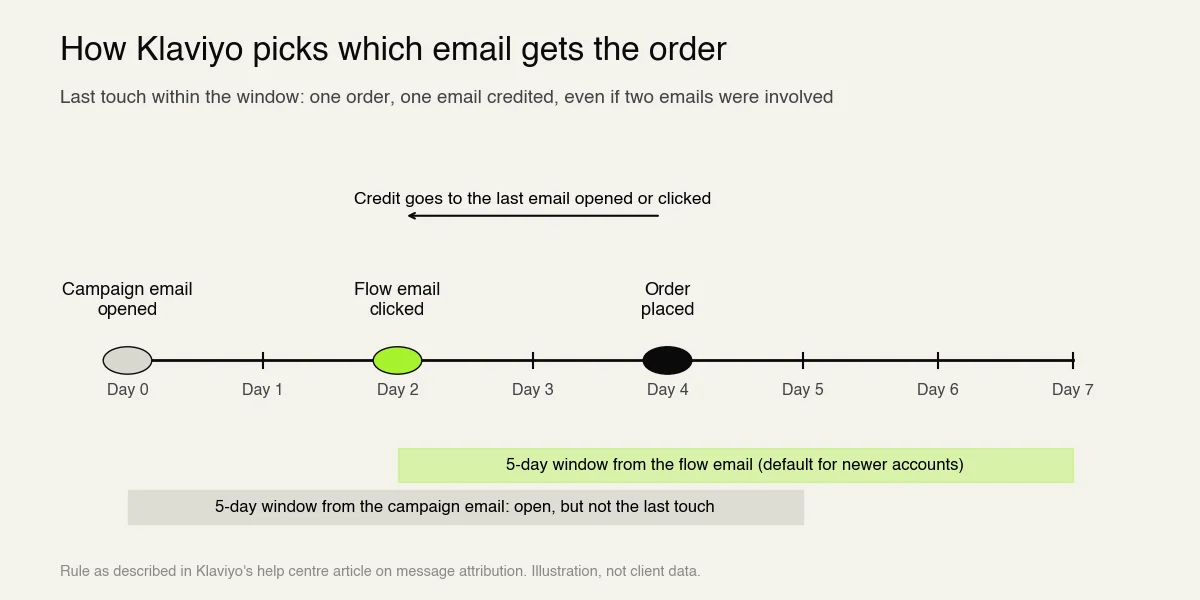
Two side effects follow. First, flows that fire right before a purchase, such as abandoned checkout reminders, collect credit that a campaign may have earned days earlier. Second, an open counts as an interaction, and Apple Mail Privacy Protection can record opens nobody made. Klaviyo’s article on Apple privacy opens says it cannot tell a human open from an automated one, so open-based credit is softer than click-based credit. Our guide to open rates after Apple Mail Privacy Protection covers the open side.
Klaviyo also offers a linear multi-touch model, which splits an order evenly between the messages a person engaged with. Its academy lists it as part of Marketing Analytics or Advanced KDP, so most accounts run on last touch.
What attributed revenue includes that you might not expect
Attribution is a timing rule, so it credits any matching event in the window, whatever the email was about. Three cases show up in real accounts.
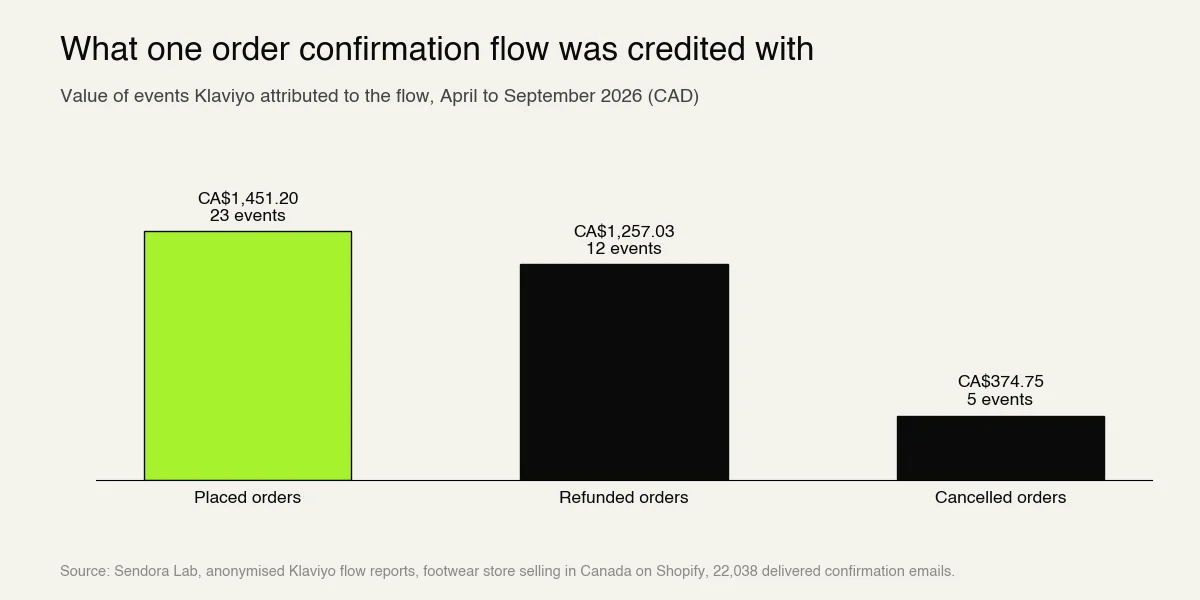
Transactional emails. In Sendora Lab’s anonymised Klaviyo data from a footwear store selling in Canada on Shopify (April to September 2026), the order confirmation flow was credited with 23 orders worth CA$1,451.20 from 22,038 delivered emails. Buyers open their receipt, and any order they place in the next few days lands on it.
Refunds and cancellations. The same rule works for any event you report on. Run the flow report with Refunded Order or Cancelled Order as the conversion metric and the same confirmation flow was credited with 12 refund events worth CA$1,257.03 and 5 cancellations worth CA$374.75.
In a second store, a US sleep-supplement brand on Shopify, 45 refund events worth US$2,384.14 were attributed to email between October 2025 and September 2026. That equals 17.13% of the US$13,917.44 in orders attributed to email over the same months. Attributed revenue is a gross figure; Klaviyo does not net refunds out of it.
Repeat orders from the same people. In that brand’s account, one flow email was credited with 21 orders worth US$2,932.25, placed by just 6 people. Every order in the window counts, so a few loyal or subscription customers can make one email look like a hit.
Attributed revenue vs total store revenue
Attributed revenue is part of total store revenue, never money on top of it. Put the two side by side every month and the real size of email becomes clear.
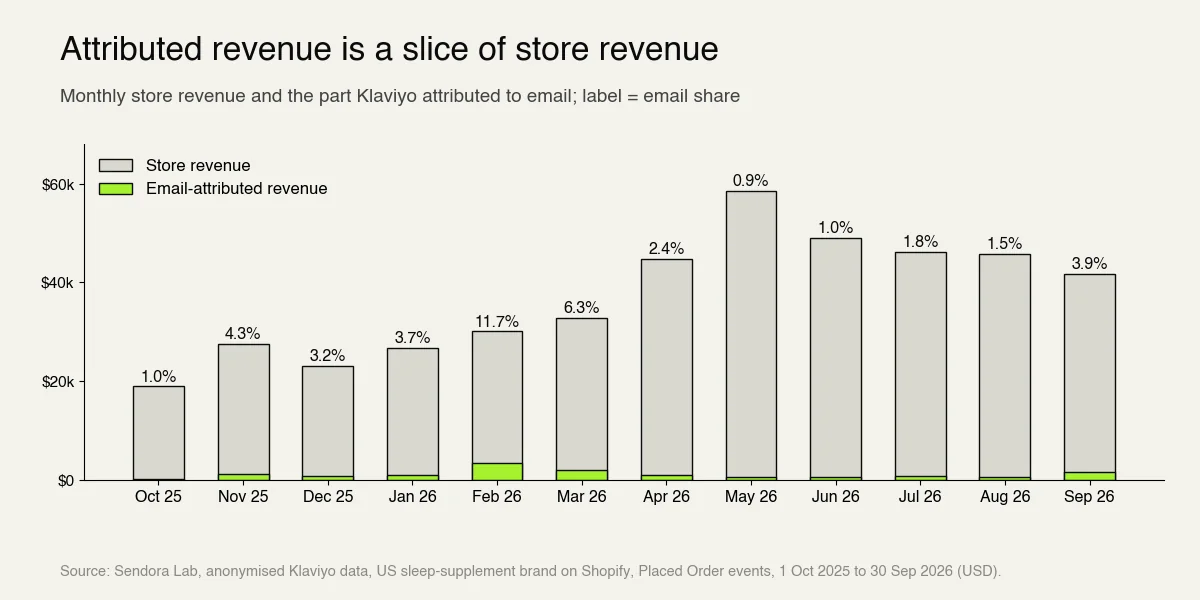
From October 2025 to September 2026 the supplement brand took 10,355 orders worth US$444,691.72. Klaviyo attributed 211 of them, worth US$13,917.44, to email: 3.13% of store revenue. Flows earned US$12,613.94 of that and campaigns US$1,303.50; campaign-attributed orders appeared only in November, December and September.
The monthly share swung from 0.88% in May 2026 to 11.72% in February 2026, when a single flow was credited with US$3,016.21. A share that moves that much from month to month is a sign to read the detail, not a trend. Our guide to email’s share of store revenue covers what a healthy share looks like and how to raise it.
Why attributed revenue can fall while the store grows
Attributed revenue depends on what else the store does. When paid ads or a new channel bring in more buyers, the store grows and email’s share can shrink even if email itself is unchanged.
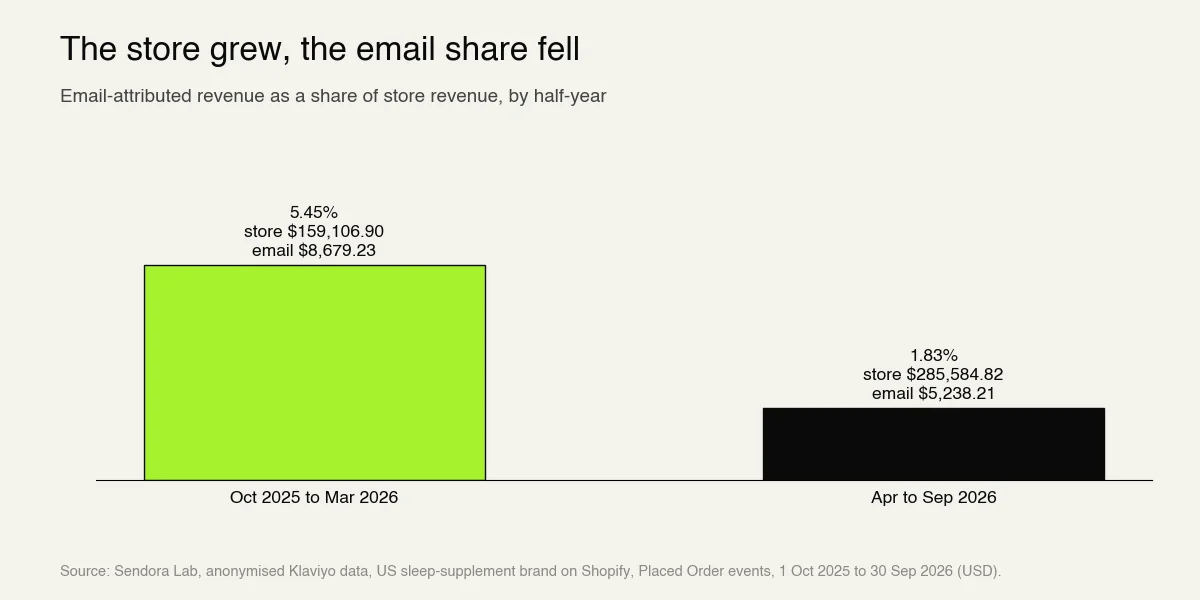
The supplement brand’s store revenue rose 79.5%, from US$159,106.90 (October to March) to US$285,584.82 (April to September). Email-attributed revenue fell 39.6% over the same split, from US$8,679.23 to US$5,238.21, and its share dropped from 5.45% to 1.83%. Reported alone, the email number says “email got worse”. Reported next to store revenue, it says “the store found growth elsewhere and email did not keep pace”, which leads to a better question: are the new buyers being captured and emailed?
How to report Klaviyo attributed revenue honestly
Report it as a share of store revenue, with the rules written next to it. This is the format we use in client reports:
- State the rules. Attribution model, window length, and whether Apple privacy opens and bot clicks are excluded.
- Separate transactional emails. Show order confirmations and shipping updates on their own line, or leave them out.
- Show the share. Email-attributed revenue divided by total store revenue, for this period and the previous one.
- Split flows and campaigns. They answer different questions; our guide to email campaign metrics covers campaign reporting.
- Note refunds. Run the same report with Refunded Order as the conversion metric and show the figure beside the gross one.
- Judge some flows on other outcomes. A post-purchase flow should be judged on repeat orders, as our Klaviyo retention strategy explains.
If you need proof that email causes sales, attribution can’t give it. A holdout test can: keep a random slice of the audience out of a flow or campaign for a few weeks and compare what both groups buy.
Should you change the attribution window?
Only for a clear reason, and only once. Klaviyo’s guide to changing attribution settings lets you set a window per channel (up to 90 days or 720 hours), exclude Apple privacy opens from attribution, exclude bot clicks (excluded by default for new accounts) and preview the effect on revenue before saving.
A longer window credits email with more orders; a shorter one credits fewer. Neither changes how many orders the store took. Klaviyo’s help centre says saved changes also apply to past conversions and can take up to 36 hours, so note the date you changed it in your report and don’t compare periods across the switch.
Conclusion
Klaviyo attributed revenue is a useful, consistent measure of which emails sit closest to a sale. It is not proof of cause, it includes receipts and repeat buyers, and it is gross of refunds. In our data, an order confirmation flow was credited with CA$1,451.20 of orders and CA$1,257.03 of refunds, and a brand’s email share fell from 5.45% to 1.83% while its store grew 79.5%. Report it as a share of store revenue, with the rules stated, and it will tell you the truth.
Sendora Lab sets up honest Klaviyo reporting for Shopify brands as part of our email marketing service. If you want your attributed revenue checked against your store numbers, book a free audit. To make GA4 see the same email traffic, set up Klaviyo UTM tracking on every flow and campaign. To compare this number with GA4, read our Klaviyo Google Analytics integration guide.
FAQ
How does Klaviyo attribute revenue?
It credits an order to the last email or text the buyer opened or clicked, if the order falls inside that channel’s attribution window. For accounts created after 9 October 2024 the default window is five days for email and SMS.
Why is Klaviyo attributed revenue different from Shopify revenue?
Shopify shows every order; Klaviyo counts only orders placed within the window after an email interaction. In one brand’s data, email-attributed revenue was 3.13% of store revenue over twelve months.
Does Klaviyo attributed revenue include refunds?
No. Attributed revenue is gross, so refunds are not subtracted. Refunds are separate events, and Klaviyo can attribute those to emails too: one brand had 45 refund events worth US$2,384.14 credited to email in a year.
Should I exclude Apple privacy opens from attribution?
Excluding them gives a stricter, click-weighted number, because Klaviyo cannot tell automated opens from real ones. Whatever you choose, state it in the report and keep it fixed between periods.
Want this set up in your Klaviyo account?
A free 30-minute audit, your account open on screen.
Book a free audit