



A Klaviyo win-back segment is the group of customers who have bought from you before but have now gone longer than usual without buying again. Built well, it catches people while they still remember you and keeps them apart from subscribers who never cared. Below is how to set the lapse point from your own orders, the exact conditions to use in Klaviyo, and what two real win-back flows earned when they skipped those steps.
Short answer: set the lapse point just past the gap within which most of your repeat customers reorder, build the segment on Placed Order with an upper limit and a consent condition, and send a short sequence with a real reason to come back. Profiles that still do not respond go to your sunset flow. In Sendora Lab’s anonymised data, two generic win-back flows that fired at a fixed delay after every order earned 43 orders from 62,039 recipients and 1 order from 6,578.
What a win-back segment is, and what it is not
It is a customer segment, defined by purchases. A segment in Klaviyo is a group of profiles that updates itself from conditions; a win-back segment uses Placed Order, the event Klaviyo records when someone buys, to find customers whose last order is older than normal for your store.
It is not a sunset segment. A sunset segment holds subscribers who have stopped opening and clicking, whether or not they ever bought, and its job is to protect deliverability by sending less. Our guide to sunset policies covers that side. A win-back segment comes first: these people chose to buy, so they get a real attempt to bring them back before anyone is suppressed.
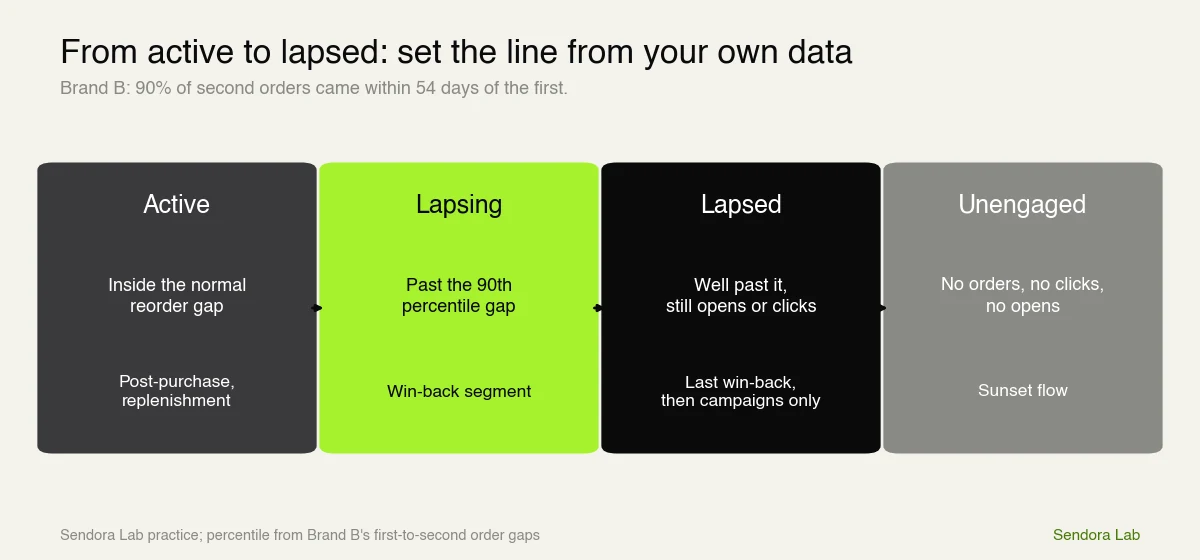
It is also not your whole customer list. Customers who are still inside their normal buying rhythm belong in your post-purchase flow or, for products people use up, a replenishment flow.
Set the lapse point from your own reorder gap
A customer is lapsing once they have gone longer without ordering than most of your repeat customers ever take. Find that gap in your data first; a number copied from another store will be wrong for yours.
Klaviyo’s guide to creating a winback flow suggests learning the buying cycle first, either from predictive analytics or by exporting a segment of customers with two or more orders and averaging their “Average Time Between Orders” column. It then sets the first delay to run a little longer than that cycle.
We prefer a percentile to an average, because a few very late reorders pull the average up. In Sendora Lab’s anonymised data from a Dutch-language fashion store on Shopify (Brand B; Brand A and Brand B are pseudonyms), 10,414 customers placed their first order between October 2025 and September 2026. By 20 October 2026, 368 had ordered again. Of those, 287 came back within 30 days, 58 within 31 to 70 days, and 23 after more than 70 days.
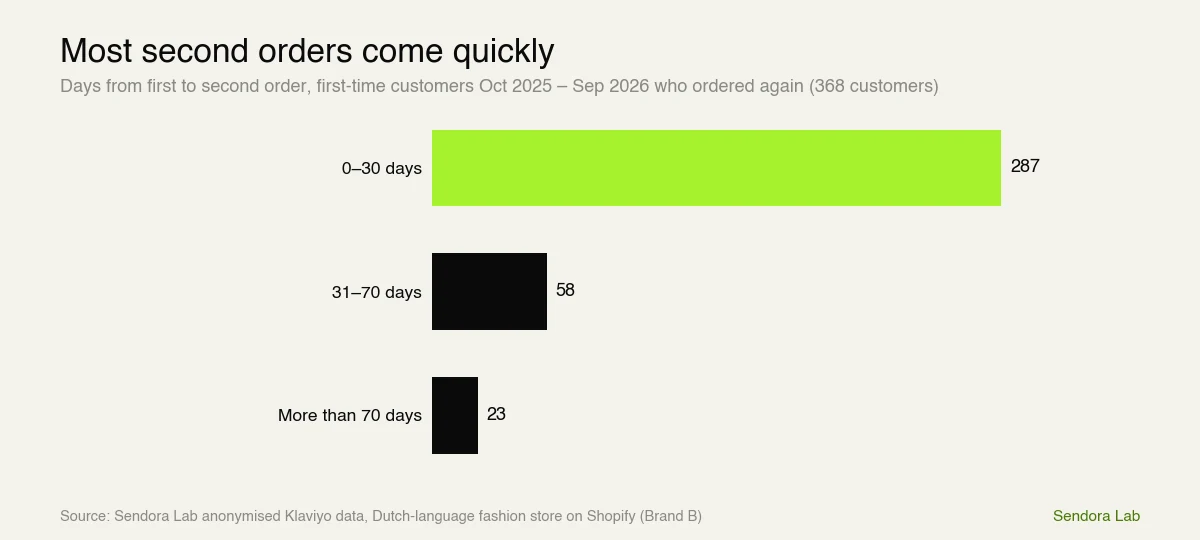
The median gap was 14.84 days and the 90th percentile 53.35 days. For this store, a lapse point around 60 days would sit just past the point where nine in ten second orders had already happened. One caveat: customers who first bought late in the period had less time to come back, which pulls these gaps down, so recheck them every few months.
Measuring the reorder gap for a product people use up is a separate job; our replenishment guide shows how. Here you only need one line: the point after which a return becomes unusual.
See how many customers are lapsing right now
Before you build anything, count your customers by days since their last order. It shows how big the win-back segment will be and how much of the list is already past saving.
In the same store, on 20 October 2026, customers with an order since October 2023 split like this by days since their most recent order: 6,189 at 0 to 70 days, 1,529 at 71 to 120 days, 2,322 at 121 to 180 days, 2,844 at 181 to 365 days and 12,045 at more than 365 days.
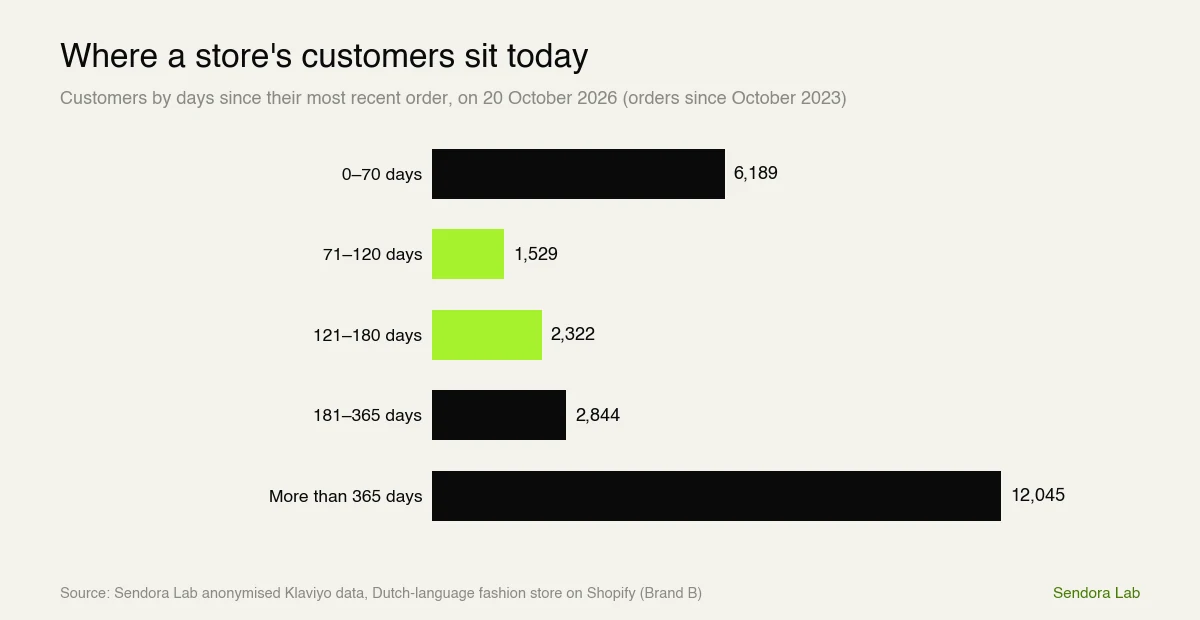
The largest group has not ordered for over a year. Those people are better handled by an occasional big campaign and your sunset rules than by a win-back flow. The bands just past the lapse point are where a win-back still has a chance.
How to build a Klaviyo win-back segment
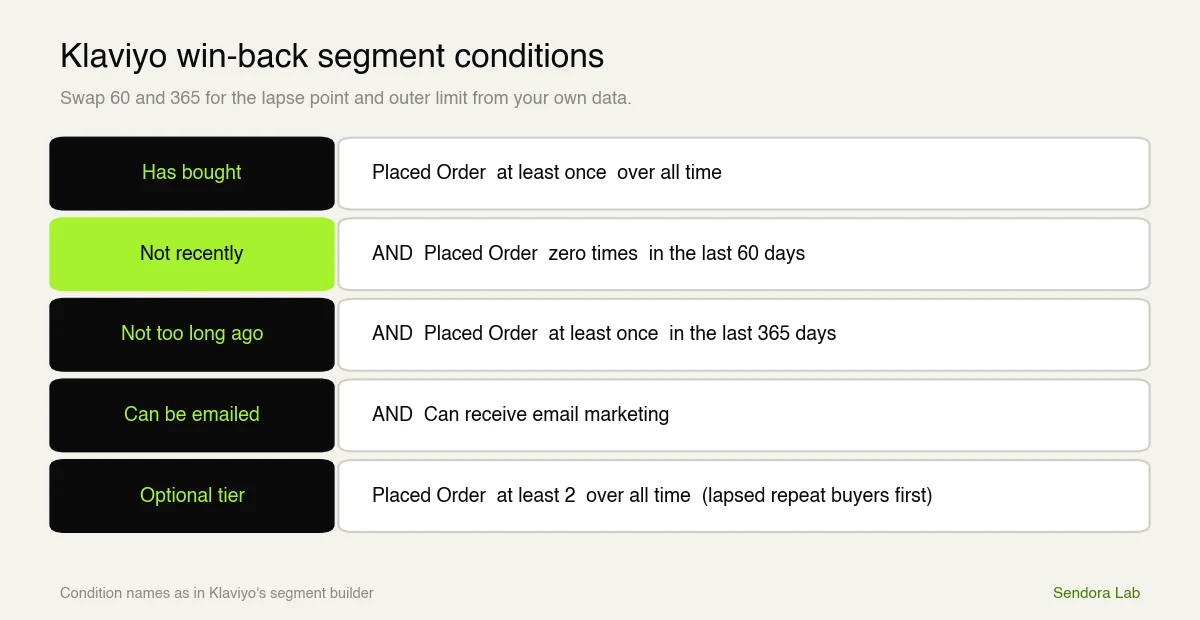
Use four conditions joined with AND: has bought, not recently, not too long ago, and can be emailed. Klaviyo’s segment conditions reference explains each operator.
- “What someone has done”: Placed Order at least once over all time.
- AND Placed Order zero times in the last 60 days (your lapse point).
- AND Placed Order at least once in the last 365 days (your outer limit).
- AND “Can receive email marketing”, so the count shows people you may actually email.
Add a second tier for lapsed repeat customers: the same conditions plus Placed Order at least 2 over all time. They had a buying habit to restore, so they deserve the first and best message. If they are among your highest spenders, treat them as described in our VIP segment guide.
Segment or flow?
Use both. The segment is for campaigns and for counting. A win-back flow sends to each customer at the right moment: trigger it on Placed Order, set the first delay to your lapse point, and add the flow filter “Placed Order zero times since starting this flow”, which Klaviyo checks before every step so anyone who buys stops getting win-back emails. Klaviyo’s guide recommends keeping it to three emails per recipient.
What two generic win-back flows actually earned
A fixed delay and a “we miss you” message are not enough. Both stores below ran that pattern, and neither earned much.
| Win-back flow | Recipients | Orders | Revenue per recipient | Unsubscribe rate |
|---|---|---|---|---|
| Brand A: emails 25 and 29 days after every order (Oct 2025 – Sep 2026) | 62,039 | 43 | €0.0376 | 3.63% |
| Brand B: emails 70 and 72 days after every order (20 Oct 2025 – 20 Oct 2026) | 6,578 | 1 | €0.0023 | 1.19% |
Brand A is a Dutch-language fashion and lifestyle store on Shopify. Its first win-back email had a 3.89% unsubscribe rate, against 1.72% for the same store’s browse abandonment flow over the same year. Brand B’s timing sat just past its own 53-day percentile, yet one order came from 6,578 recipients.
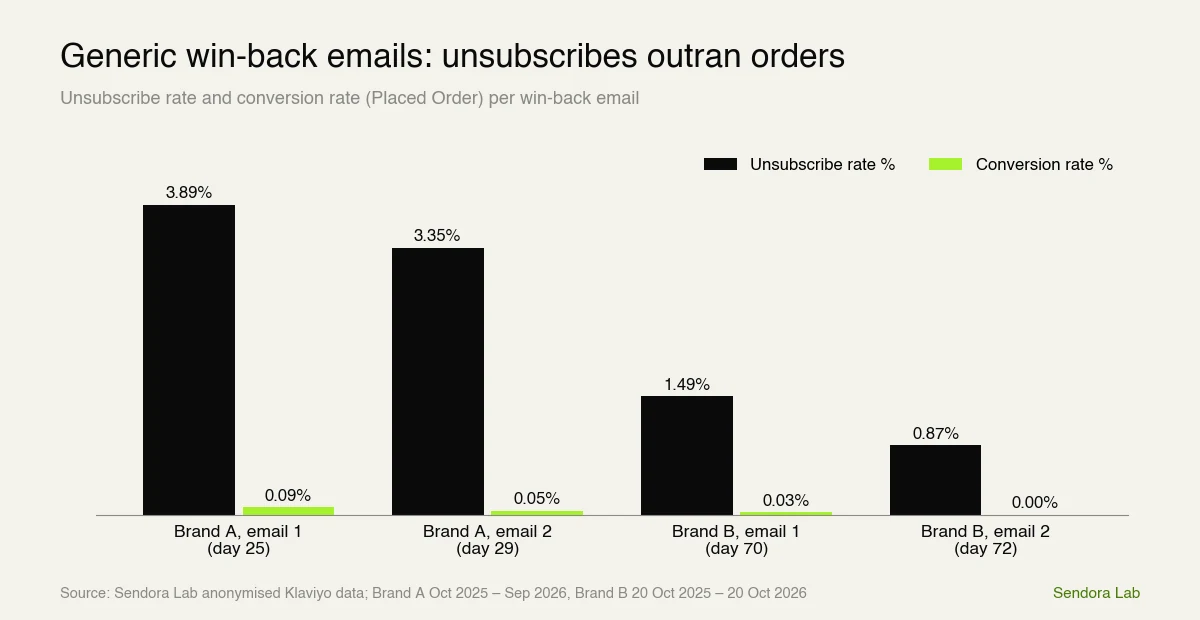
Both flows sent the same short message to everyone who had ever ordered, and in both stores most customers buy only once. Timing alone could not fix that. What we change when we rebuild a win-back:
- Who: lapsed repeat customers first, then single-order customers who still click.
- Why come back: something new in the category they bought, a restock, or a product that pairs with their last order, not just “we miss you”. A discount is a test, not a default.
- When to stop: after two or three emails, people who did not click move to the sunset path instead of staying in full campaigns.
Measure the result on orders and unsubscribes, not opens. A win-back that loses more subscribers than it wins back customers is costing you list, not saving it.
Conclusion
A good Klaviyo win-back segment starts with your own reorder gap, has an upper limit and a consent condition, and puts lapsed repeat customers first. Give each email a reason to return and hand non-responders to your sunset rules. If you want help setting the lapse point and rebuilding your win-back for a real result, see our Klaviyo email marketing service, read how we work, or book a free audit. To rank lapsed buyers by how often and how much they bought, use Klaviyo RFM segmentation. For subscription brands, our Recharge Klaviyo integration guide shows how to find lapsed subscribers with Recharge properties. Win-back is one of seven stages in the ecommerce customer journey email map.
FAQ
When does a customer count as lapsed?
When they have gone longer without ordering than most of your repeat customers ever take. In one store in our data, 90% of second orders came within 53.35 days, so a lapse point around 60 days fits that store.
What is the difference between a win-back and a sunset flow?
A win-back targets customers who bought before and have gone quiet. A sunset flow handles subscribers who stopped opening and clicking, and reduces or stops sending to protect deliverability.
How many emails should a win-back flow have?
Klaviyo’s winback guide recommends three emails per recipient. Use a purchase exit filter so anyone who buys stops receiving them. It has to be a profile filter, not a trigger filter.
Do win-back flows make money?
Only when they target the right people with a real reason to return. Two generic flows in our data earned €0.0376 and €0.0023 per recipient.
Want this set up in your Klaviyo account?
A free 30-minute audit, your account open on screen.
Book a free audit