



Klaviyo revenue per recipient (RPR) tells you how much money each delivered email earned. It is the one number that lets you compare a 300-person flow email with a 30,000-person campaign on equal terms. This guide shows how Klaviyo calculates it, where to find it, what a good figure looks like and how to use it without fooling yourself, with real data from one Shopify store.
Short answer: revenue per recipient is attributed revenue divided by delivered emails. Use it to compare flows, campaigns and single emails of different sizes, but take transactional emails out first, wait for the attribution window to close, and ignore results built on a handful of orders. In Sendora Lab’s anonymised Klaviyo data from a footwear store selling in Canada on Shopify (flows live April to September 2026), the abandoned checkout flow earned CA$1.48 per delivered email while the order confirmation flow, with the highest click rate in the account, earned CA$0.07.
What revenue per recipient means in Klaviyo
RPR is the revenue Klaviyo credits to a message, divided by the number of people it was delivered to. Klaviyo’s help centre article on calculating revenue per recipient describes it as campaign revenue divided by deliveries, with failed deliveries left out; flows use the same formula.
The revenue in that formula is attributed revenue: the value of orders Klaviyo credits to an email because the buyer opened or clicked it and then ordered within the account’s attribution window. That window is five days by default for accounts created after 9 October 2024, according to Klaviyo’s guide to message attribution. Our guide to Klaviyo attributed revenue explains what that number includes and what it leaves out.
A worked example from the store’s data: its abandoned checkout flow delivered 2,712 emails between April and September 2026 and was credited with 55 orders worth CA$4,017.06. CA$4,017.06 divided by 2,712 is CA$1.48 per delivered email, exactly the figure in Klaviyo’s report.
One trap: Klaviyo’s own blog post on RPR writes the formula as revenue divided by messages sent. Divide by the 2,753 emails sent instead and you get CA$1.46. The gap is small here, but on a list with many bounces it grows, so always say which one you used.
Where to find RPR in your Klaviyo account
Klaviyo shows RPR in three places. You don’t need a spreadsheet unless you want to combine sends.
- All campaigns, last 30 days: the Campaigns tab, in the Email Performance Review panel on the right. Klaviyo also rates it against similar companies there.
- Single campaigns: Analytics, then Dashboards, then a Campaign Performance Detail card. The column is called Rev/Rec.
- Single flows: the same place, with a Flow Performance Detail card, also in the Rev/Rec column. Open a flow’s analytics to see it per email.
Check that the report uses your real order metric. Most Shopify stores use Placed Order from the Shopify integration. Some accounts also carry a second “Placed Order” metric from another app, and choosing the wrong one changes every RPR in the report.
What a good revenue per recipient looks like
A good RPR depends on the type of message far more than on the store. Klaviyo’s blog (published 12 December 2024) quotes its benchmarks as an average of US$0.11 per email campaign, US$1.94 for automated flows, US$3.65 for abandoned cart series, US$2.65 for welcome series, US$1.07 for browse abandonment and US$0.41 for post-purchase series.
The store’s own flows fall in the same order, even though its figures are in Canadian dollars and its flows are young.
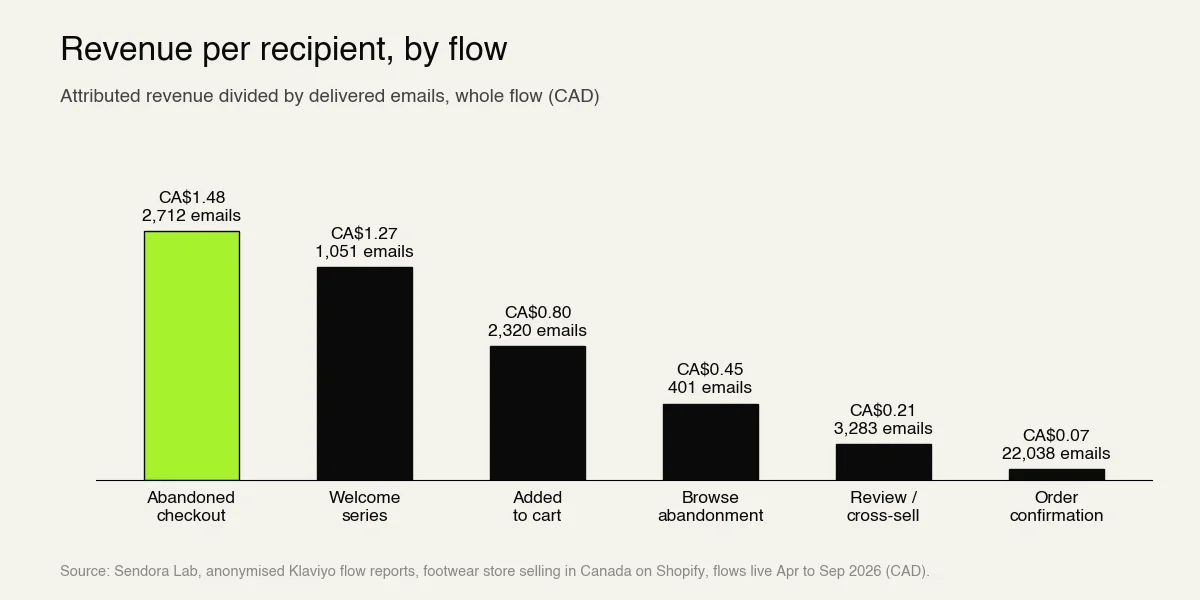
Flows that react to buying intent earn the most: abandoned checkout CA$1.48, the welcome series CA$1.27 (live only from mid-September, so built on 1,051 emails) and added to cart CA$0.80. Flows sent after a purchase earn the least, because the customer has just paid. Compare your figures with your own history first and with benchmarks second; a benchmark in another currency, from other industries, is a rough guide at best.
Why RPR beats open rate and click rate
Opens and clicks show attention; RPR shows whether the attention turned into orders. Open rates are also inflated by Apple Mail Privacy Protection, which loads emails automatically, so our guide to email campaign metrics treats open rate as a rough inbox check only.
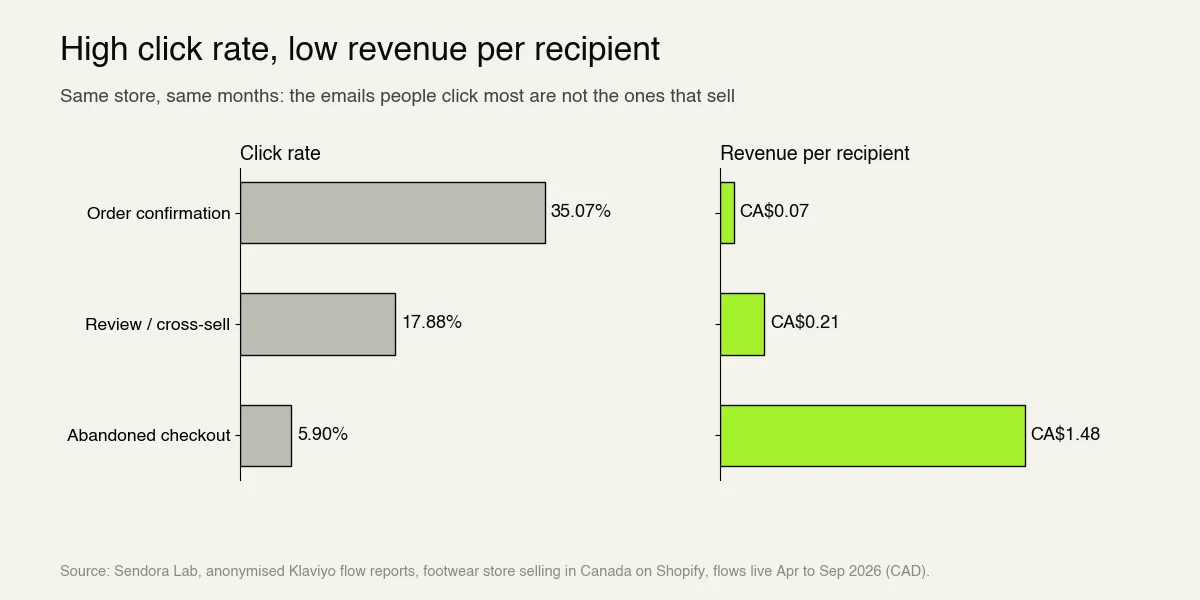
In the store’s data, the order confirmation email had a 35.07% click rate, because people click to track their parcel. It earned CA$0.07 per delivered email. The abandoned checkout flow had a 5.90% click rate and earned CA$1.48. Ranked on clicks, the confirmation email looks like the star of the account. Ranked on RPR, it is near the bottom, which is where a receipt belongs.
Flows vs campaigns: take transactional emails out first
Comparing flow RPR with campaign RPR only works if you leave transactional emails out of the flow total. Order confirmations go to every buyer, so they add huge volume and almost no attributed revenue.
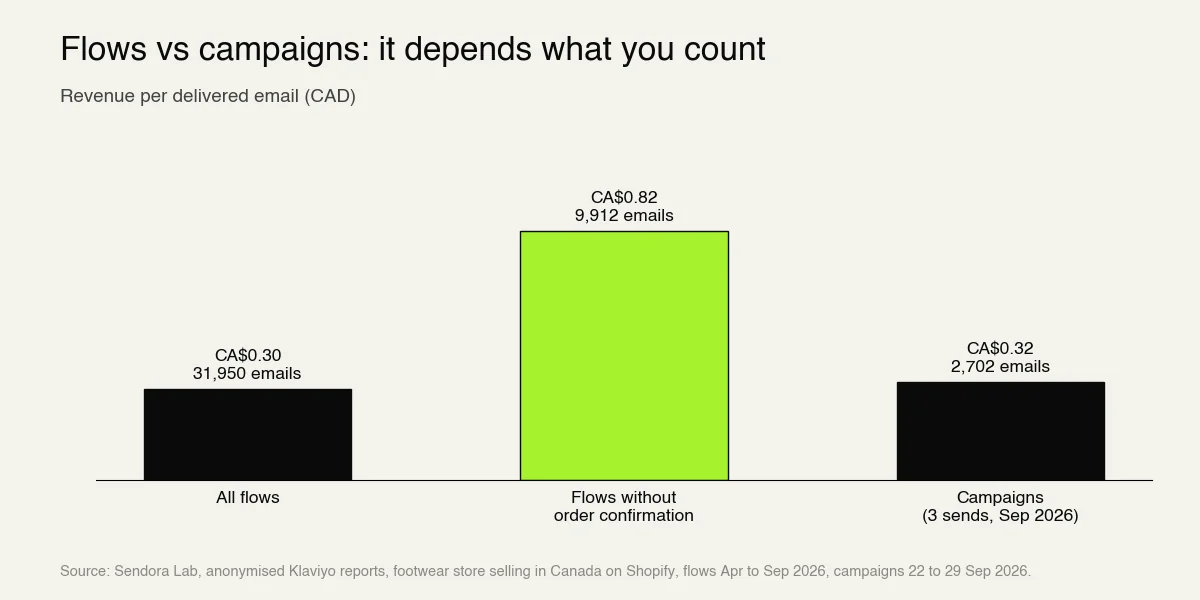
All seven flows together earned CA$9,533.71 from 31,950 delivered emails: CA$0.30 each. That is slightly below the CA$0.32 the store’s three campaigns earned in late September 2026 (CA$865.67 from 2,702 emails). Take out the order confirmation flow and the remaining flows earn CA$0.82 per email, more than double the campaigns. Same data, opposite conclusion, so state which flows you counted.
The three campaigns also show RPR doing its main job. The 10%-off email went to 1,085 people across several engaged segments and earned CA$0.14 per email. Two days later a plain-text resend of the same offer went to the 1,048 people who had engaged in the last 30 days but not ordered, and earned CA$0.36. A narrower, better-chosen audience earned more per email; our guide to the Klaviyo engaged segment covers how to build one.
Use RPR inside a flow, email by email
A flow’s total RPR hides which emails do the work. Open the flow’s analytics and compare each email; the weak ones are where to test new content or cut.
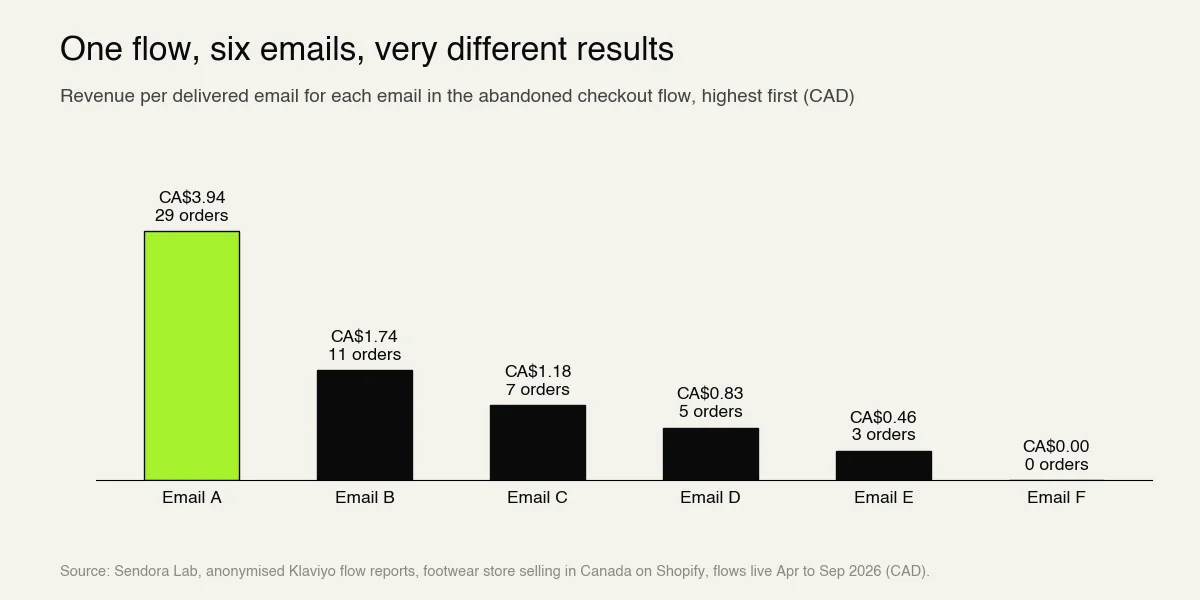
In the store’s abandoned checkout flow, the best email earned CA$3.94 per delivered email and 29 of the flow’s 55 orders. Another earned nothing from 422 deliveries. Our abandoned cart flow guide covers timing and content that tend to lift the weaker emails.
Watch the sample size. The store’s browse abandonment flow delivered only 401 emails across eight messages and was credited with 4 orders. One email shows CA$1.41 per recipient because a single CA$74.95 order landed on 53 deliveries; the next order could double or halve that figure. As a working rule, we don’t judge an email until it has at least 20 or so attributed orders, or we combine several months. Our browse abandonment guide shows what the numbers look like at higher volume.
Read RPR next to unsubscribes
RPR shows what an email earned, not what it cost. Divide attributed revenue by unsubscribes to see the price of each lost subscriber, especially for campaigns.
The store’s abandoned checkout flow earned CA$81.98 for every unsubscribe (CA$4,017.06 against 49 unsubscribes). The 10%-off campaign earned CA$4.22 per unsubscribe: 37 people left and 2 orders came in. Both numbers come from the same list, and they point to very different decisions: keep the flow running, and send discount blasts to fewer people.
How to track revenue per recipient week to week
Track RPR as a trend for each type of message, not as one account-wide number. This is the routine we use for clients:
- Group like with like. Compare campaigns with campaigns to the same audience, and each flow with its own past.
- Leave transactional flows out. Order confirmations and shipping updates belong in a separate line.
- Wait for the window. A campaign’s RPR keeps rising for the length of the attribution window, so read it after five days, not the next morning.
- Check the sample. Note the number of orders behind each RPR and treat anything built on a few orders as a hint.
- Add the cost. Put unsubscribes next to every RPR, and look at total email revenue as a share of store revenue once a month, as part of a regular Klaviyo audit.
Conclusion
Klaviyo revenue per recipient is the fairest way to compare emails of different sizes, as long as you know what goes into it: attributed revenue on top, delivered emails underneath. In this store’s data it exposed a high-click receipt that earns almost nothing, a flow average that flipped once order confirmations were removed, and a resend that beat the main send. Track it per message type, with the order count and unsubscribes beside it, and it will tell you where to spend your next hour.
Sendora Lab builds and measures Klaviyo flows and campaigns for Shopify brands as part of our email marketing service. If you want a second pair of eyes on your numbers, book a free audit.
FAQ
How do you calculate revenue per recipient in Klaviyo?
Divide the attributed revenue of a campaign, flow or email by the number of emails delivered. Klaviyo’s help centre uses deliveries and leaves failed deliveries out, so CA$4,017.06 from 2,712 delivered emails gives CA$1.48.
What is a good revenue per recipient for email?
It depends on the message type. Klaviyo’s published averages are US$0.11 for email campaigns and US$1.94 for flows, with abandoned cart series at US$3.65. Compare each type with its own benchmark and with your own history.
Why is my flow revenue per recipient lower than my campaigns?
Often because transactional flows are in the total. In our example, all flows averaged CA$0.30 per email against CA$0.32 for campaigns, but CA$0.82 once the order confirmation flow was removed.
Does revenue per recipient include orders that would have happened anyway?
Yes. RPR is built on attributed revenue, which credits any order placed within the window after an open or click, so it shows correlation, not proof that the email caused the sale.
Want this set up in your Klaviyo account?
A free 30-minute audit, your account open on screen.
Book a free audit