



Email share of revenue is the part of your store’s sales that your email platform credits to email. It is one of the first numbers owners ask about, usually as “what percentage should email drive?” This guide shows how to calculate it properly, what four real Shopify stores got, why the figure moves so much, and how to read it before you set a target.
Short answer: there is no single right percentage. It depends on how long email has been running, how big the store is, how much it spends on ads and how Klaviyo is set to credit orders. In Sendora Lab’s anonymised Klaviyo data from four Shopify stores (October 2025 to September 2026), email’s share of revenue ranged from 2.9% at an outlet store in its first months of email to 22.3% at a small Polish store. Track your own share over a full year, split it into flows and campaigns, and judge it next to total revenue and new customers, not against one benchmark.
What email share of revenue means
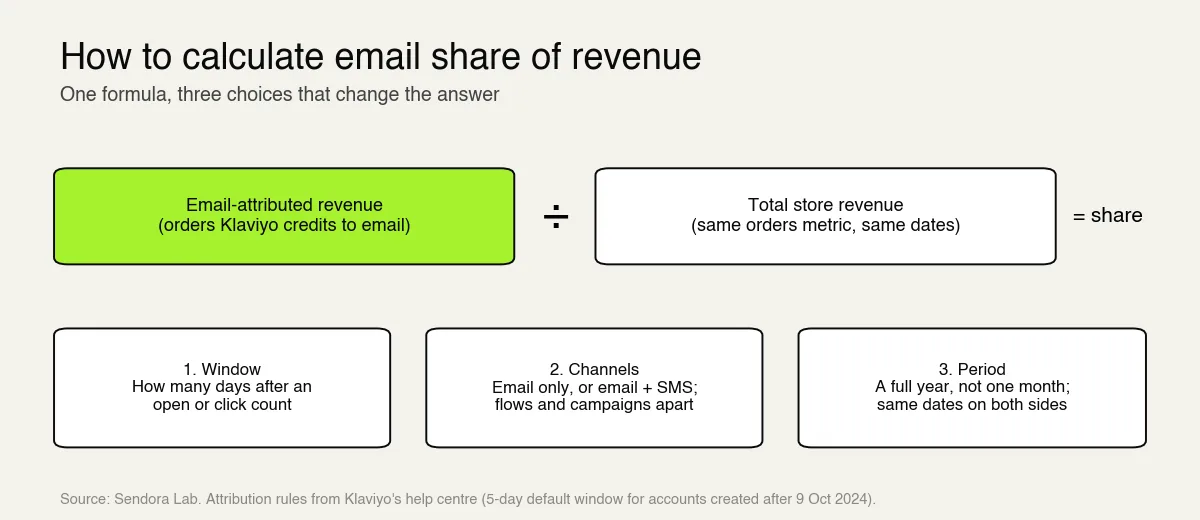
Email share of revenue is email-attributed revenue divided by total store revenue for the same period. Attributed revenue is the value of orders Klaviyo credits to an email because the buyer opened or clicked it and then ordered within the attribution window. Our guide to Klaviyo attributed revenue covers what that figure includes and what it misses.
Three choices change the answer, so write them down before you compare months or stores:
- The window. Klaviyo’s message attribution article sets a five-day default for email in accounts created after 9 October 2024, and opens count as well as clicks. A longer window credits email with more orders.
- The channels. Report email and SMS separately, and split email into flows (automated emails triggered by what someone does, such as a welcome series or abandoned cart reminder) and campaigns (one-off sends to a list or segment).
- The period. Use the same dates and the same order metric on both sides, ideally a rolling 12 months.
What share of revenue email drives in four real stores
Across four Shopify stores in our data, email’s share ran from 2.9% to 22.3%. Each figure is email-attributed Placed Order value divided by all Placed Order value in Klaviyo, from the store’s first month with email-attributed orders to September 2026.
| Store | Period | Store revenue | Email-attributed | Share |
|---|---|---|---|---|
| Small Polish online store | Oct 2025–Sep 2026 | 242,888.85 zł (1,083 orders) | 54,079.45 zł (245 orders) | 22.3% |
| Dutch online fashion store | Mar–Sep 2026 | €568,468.58 (8,700 orders) | €69,913.39 (1,075 orders) | 12.3% |
| Dutch-language fashion and lifestyle store | Oct 2025–Sep 2026 | €2,649,335.99 (40,876 orders) | €274,579.93 (4,239 orders) | 10.4% |
| Dutch outlet store | May–Sep 2026 | €505,288.97 (7,234 orders) | €14,617.95 (205 orders) | 2.9% |
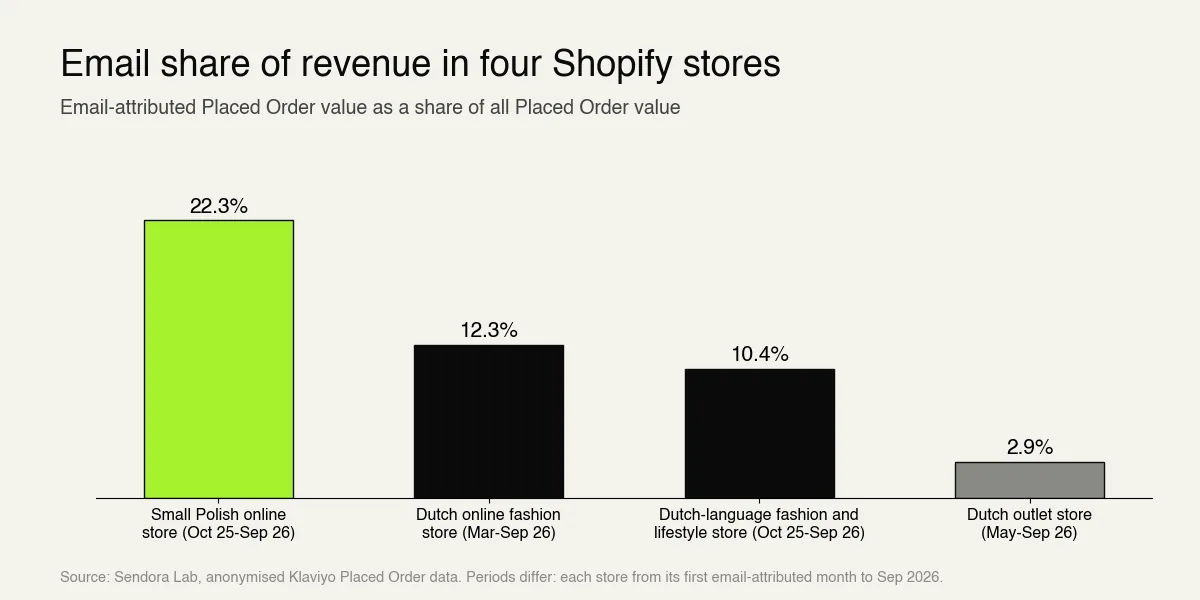
The largest store has half the share of the small Polish store, but by far the most email revenue. The Polish store also earned 4,814.65 zł from SMS, another 2.0% of revenue, which we kept out of the email figure.
Flows carry most of it
In the Dutch-language fashion and lifestyle store, flows brought in €250,863.78, 9.5% of store revenue, and campaigns 0.9%. If your share is low, the gap is usually missing or weak flows rather than too few campaigns. Start with a Klaviyo welcome series and an abandoned cart flow.
Why the share moves from month to month
The share is a ratio, so it moves when either side moves. A big month for ads or a sale can push it down even while email earns more.
Peak months dilute it
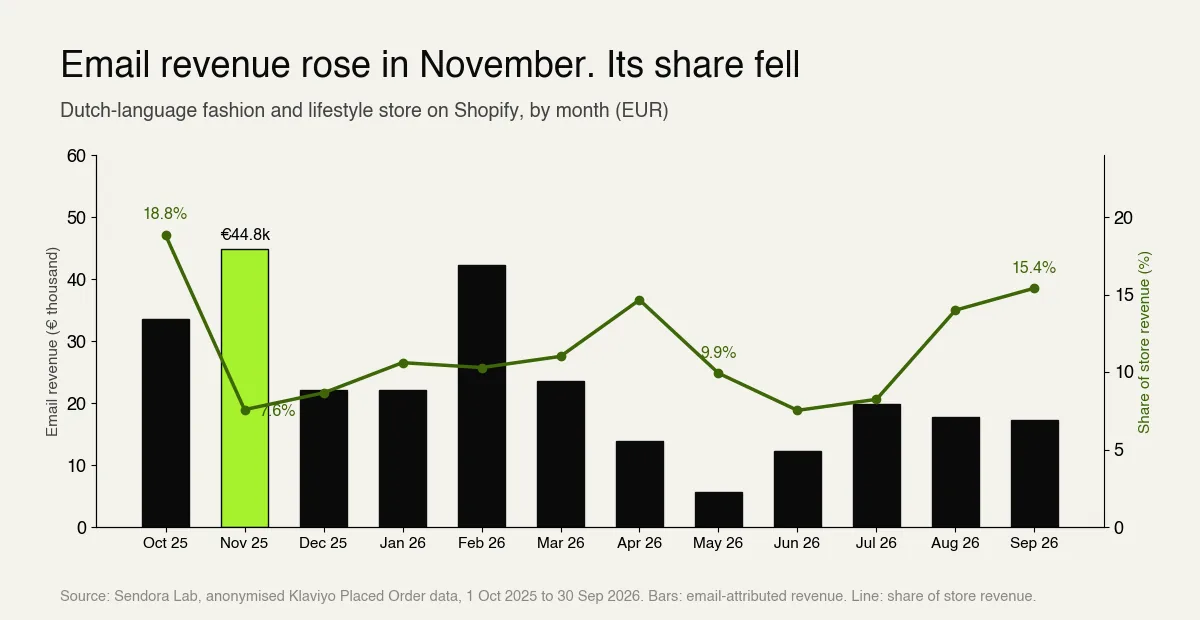
The Dutch-language store’s best email month was November 2025, with €44,809.31 attributed to email. Its share that month was 7.6%, one of the lowest of the year, because total revenue jumped to €591,823.90 during Black Friday. In October 2025 email earned less, €33,505.58, but its share was 18.8%.
Small stores swing hard
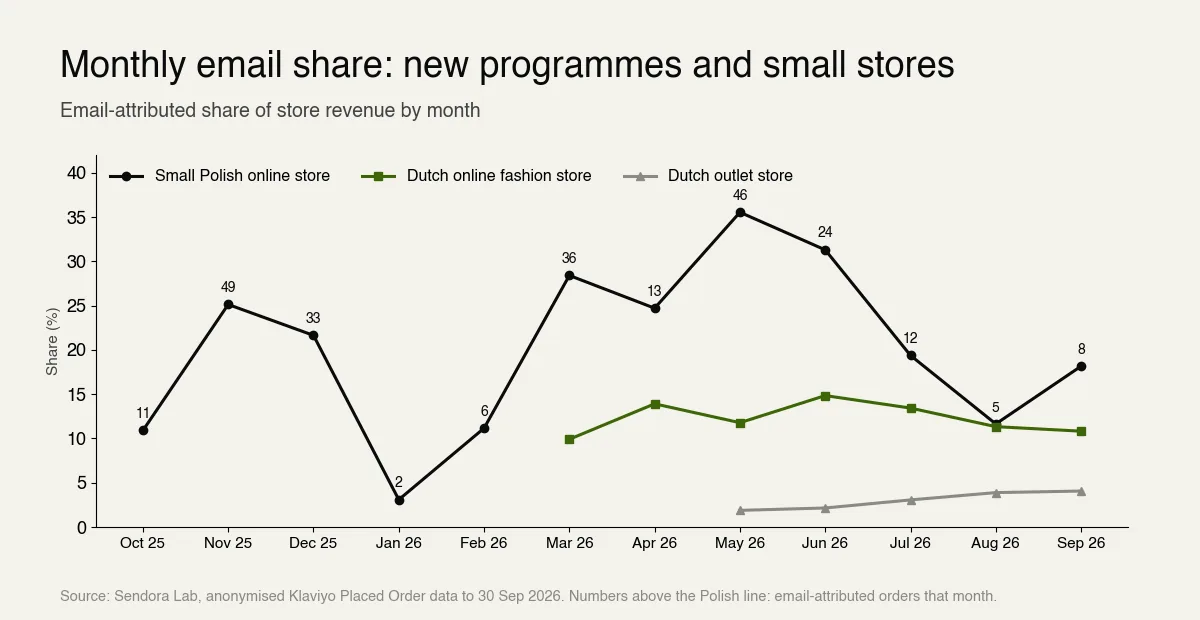
The small Polish store’s monthly share went from 3.1% in January 2026, with 2 email-attributed orders, to 35.5% in May 2026, with 46. When a store takes 46 to 182 orders a month, a handful of orders changes the share by ten points. Read it over a quarter or a year.
New programmes take months to build
The Dutch outlet store’s first email-attributed orders appear in May 2026. Its share climbed from 1.9% that month to 4.1% in September. The Dutch online fashion store, whose email-attributed orders start in March 2026, ran between 9.9% and 14.8% a month from then on. A new account needs a growing list and running flows before the share means much.
Is a higher email share always better?
No. A high share can mean a strong owned channel, or it can mean the rest of the business is shrinking. Read it next to three other numbers.
- Total revenue. If email’s share rises because total sales fell while email revenue stayed flat, nothing got better.
- New customers. Email mostly sells to people already on your list. A store with a rising share and falling first orders is living off its past.
- Other platforms’ credit. Klaviyo, Meta, Google and Shopify each credit orders their own way, so their totals can add up to more than 100%. Shopify’s default model is last non-direct click, which gives all credit to the last marketing channel before purchase, as its guide to measuring multichannel marketing explains. So don’t expect Klaviyo’s email figure to match the email line in Shopify’s reports.
Opens also play a part. Klaviyo credits orders after an open, and Apple Mail can register opens nobody made, which can lift attributed revenue. Our guide to Apple Mail Privacy Protection open rates shows how large machine opens were in real accounts.
How to measure and raise your email share
Measure it the same way every month, then raise it by improving the emails that earn the most per send.
Measure
- Take total revenue from your order metric (Placed Order for most Shopify stores) for the last 12 months, in the same currency and time zone as your reports.
- Take the revenue Klaviyo attributes to email for the same dates, and the same for SMS separately.
- Split email into flows and campaigns, and note your attribution window next to the figure.
- Compare with your own previous year first. Klaviyo’s benchmarks guide says peer groups are about one hundred similar companies, matched on factors including total revenue and email revenue percentage, so use Analytics, then Benchmarks, for an outside comparison.
Raise
- Build the core flows first: welcome, abandoned checkout and cart, browse abandonment and post-purchase. In the Dutch-language store they earned more than ten times what campaigns did.
- Judge each email by revenue per recipient, so a big list can’t hide weak emails. See our guide to Klaviyo revenue per recipient.
- Send campaigns on a steady rhythm to engaged segments, not to the whole list. Our guide to email marketing frequency covers how often.
- Grow the list, because email can only sell to people on it.
Conclusion
Email share of revenue is a useful health check, but not a target to chase on its own. In the four stores we looked at it ranged from 2.9% to 22.3%, fell during the biggest sales month and swung wildly in a small store. Measure it over 12 months, split flows from campaigns and email from SMS, and read it next to total revenue and new customers. If flows are missing, that is where the next point of share usually comes from.
Sendora Lab builds and measures Klaviyo programmes for Shopify brands as part of our email marketing service. If you want to know what share email should drive in your store, book a free audit.
For one store, email went from 2.04% to 32.72% of revenue in a month; we show how in Klaviyo results in 30 days. If GA4 shows a different email share, our Klaviyo Google Analytics integration guide explains why.
FAQ
What percentage of revenue should come from email?
There is no single right figure. In four Shopify stores in Sendora Lab’s data it ranged from 2.9% in a new programme to 22.3% in a small Polish store, so compare against your own previous year and Klaviyo’s peer benchmarks.
How do you calculate email share of revenue?
Divide email-attributed revenue by total store revenue for the same dates and order metric. Keep SMS separate and note your attribution window, which is five days by default for Klaviyo accounts created after 9 October 2024.
Why did my email share drop in November?
Usually because total revenue grew faster than email revenue. In one Dutch store, email earned its most in November 2025 while its share fell to 7.6%.
Should flows or campaigns drive more email revenue?
In most stores flows do. In a Dutch-language fashion and lifestyle store, flows earned 9.5% of store revenue against 0.9% for campaigns over 12 months.
Want this set up in your Klaviyo account?
A free 30-minute audit, your account open on screen.
Book a free audit