



A second purchase email strategy is a short, planned run of emails that helps a first-time buyer place a second order, timed to when people in your store actually come back. You build it from three things: your real time to second order, a first-time customer segment, and a flow that stops the moment someone buys again.
This guide shows how to set each part up in Klaviyo, using a live flow and a year of order data from a store we work on.
Short answer: Split first-time buyers from repeat buyers, teach them to use what they bought, then make one relevant suggestion just before the point where your customers usually reorder. At Sendora Lab we trigger this from the fulfilled order, exit anyone who refunds, cancels or buys again, and judge it by repeat purchase rate, not by opens.
Why the second purchase needs its own plan
The second order is where a one-time buyer becomes a customer, and it rarely happens by itself in the first few weeks. Most stores send a thank-you email and then fold the buyer into the newsletter, which leaves that gap to chance.
In Sendora Lab’s anonymised Klaviyo data from a US sleep-supplement brand on Shopify (Oct 2025–Sep 2026), the store recorded 10,353 orders. Adding up each month’s distinct buyers gives 9,792, so only 561 orders (5.42%) came from someone who had already ordered in the same calendar month. Even in the busiest month, buyers averaged at most 1.083 orders.
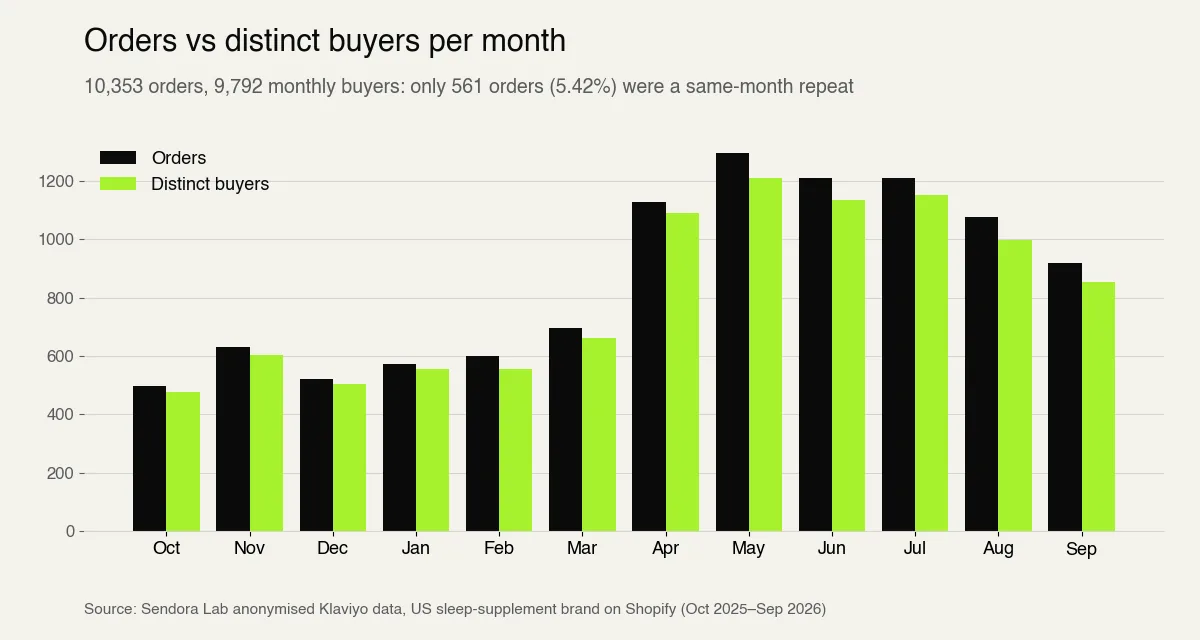
This monthly view can’t show orders that fall in a later month, so it is not a full repeat rate. What it does show is that the second order for this store mostly comes after the first 30 days. A second purchase email that goes out on day 3 with a discount is aimed at the wrong moment.
Find your time to second order first
Time to second order is the number of days between a customer’s first and second order. Measure it from your own data before you set a single delay, because it decides when the most important email in the flow should land.
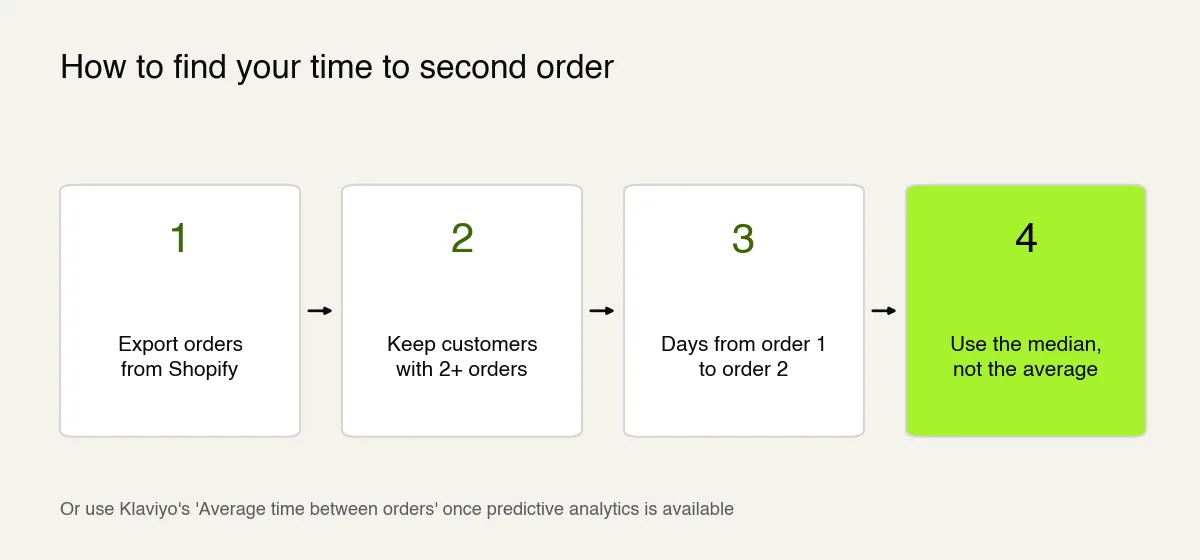
There are two practical ways to get it:
- Klaviyo predictive analytics. Profiles get an “Average time between orders” and an “Expected date of next order”. Klaviyo only shows these once you have at least 500 customers with orders, 180 days of order history, recent orders and some customers with 3 or more orders, as set out in Klaviyo’s predictive analytics guide.
- An order export. Export orders from Shopify, keep customers with two or more orders, and take the median gap between order one and order two. The median is safer than the average because a few very slow returners pull the average up.
For one-time buyers, Klaviyo calculates the expected next order from all your customers, because it knows little about that person yet. That makes it a fair starting point for the first second-purchase nudge, but check it against your export before you rely on it.
Build the first-time customer segment and split in Klaviyo
A segment is a group of profiles that Klaviyo updates automatically when people match its rules. For this strategy you need first-time buyers kept apart from repeat buyers, so each group gets messages that fit where they are.
Inside a flow you don’t need a separate segment. Add a conditional split on “Placed Order equals 1 over all time”, which is the same rule Klaviyo’s post-purchase flow guide suggests for new versus returning customers. For campaigns, build a saved segment with the same condition so first-time buyers can get their own content, as we cover in segmenting by purchase behaviour.
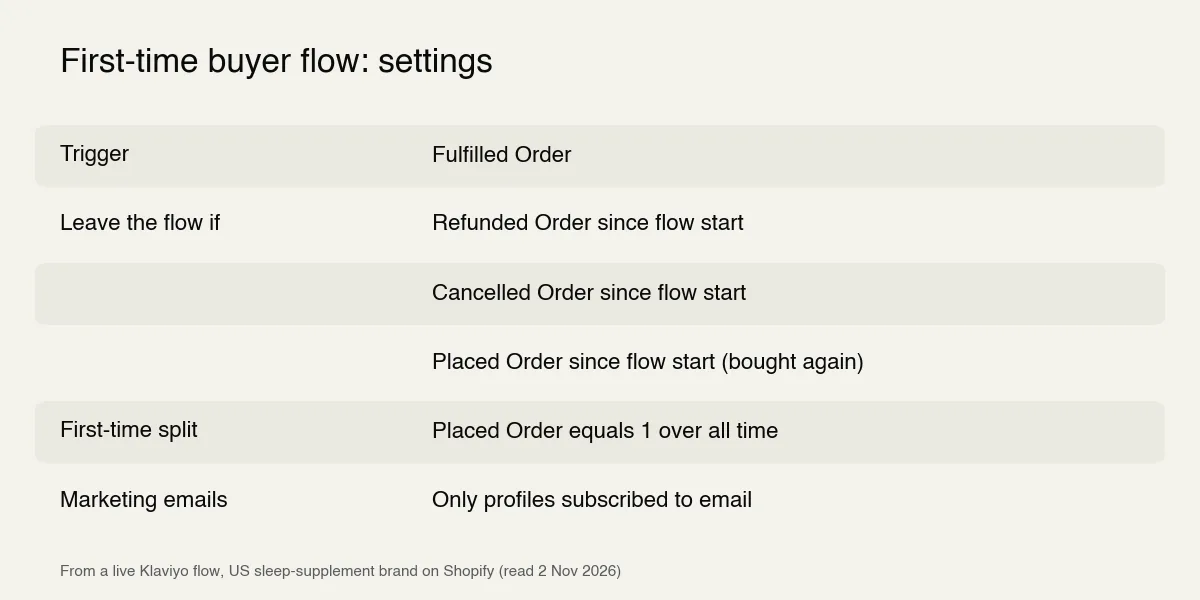
The flow from our sample store adds three exits in the flow filter: no Refunded Order, no Cancelled Order and no new Placed Order since the person entered the flow. A flow filter is checked before every step, so someone who buys again on day 9 never gets the day 19 suggestion. If you’re unsure where each rule belongs, see trigger filters vs flow filters.
A second purchase email strategy, email by email
Start from the fulfilled order, not the placed order, so the timing follows the parcel rather than the checkout. Then help, check in, and only then suggest the next product.
This is how the sample store’s post-purchase flow is built (read 2 November 2026):
- Trigger: Fulfilled Order. Subscription renewals are split out at the first step and leave the flow, because those customers already buy again on a schedule.
- Split by product line. Buyers of the core product and buyers of a second product line each get their own path. Everyone else goes to the first-time check.
- Day 7: how to use it. A plain email on dose and timing for the exact product bought. No offer.
- Day 14: check-in. “Two weeks in, how is it going?” with one habit that helps the product work.
- Day 19: one suggestion. A product from the other range, sent only if the person has never bought it, which a conditional split on past orders checks.
- Other products: first-time buyers only (Placed Order equals 1) wait 14 days, then get a short best-seller selection.
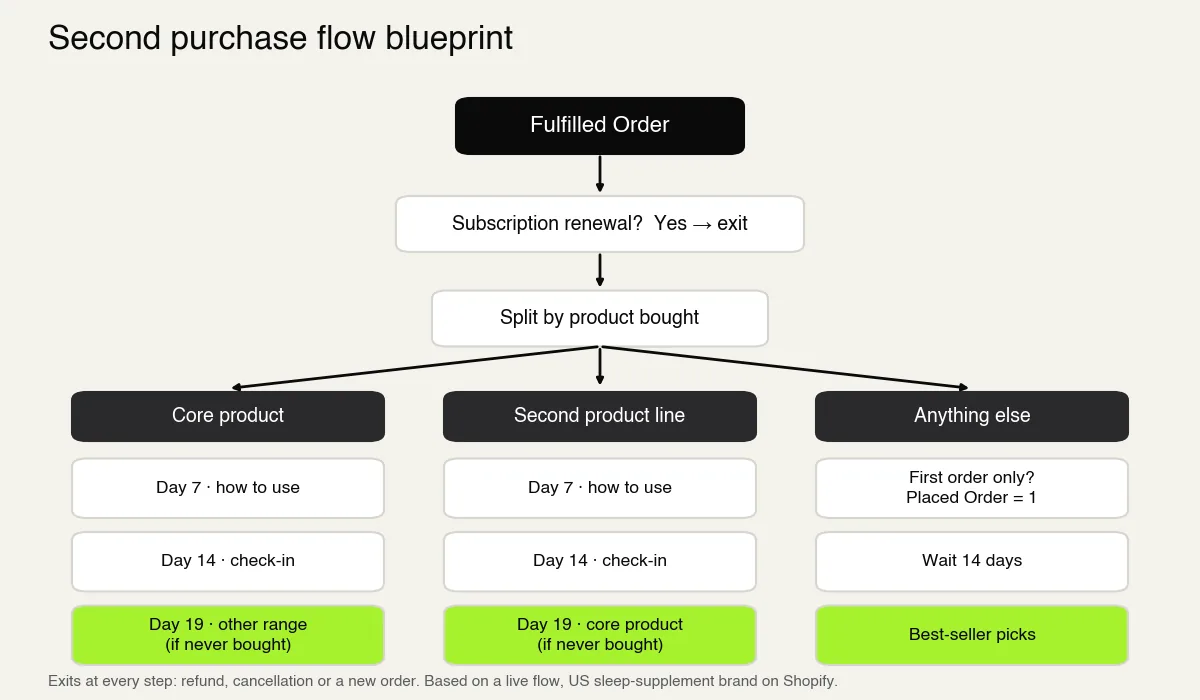
Every marketing email in that flow is also limited to profiles subscribed to email marketing. The shipping email at the top of the flow is switched off; Klaviyo’s guide recommends keeping order and shipping confirmations in their own transactional flows so that information always arrives quickly.
For products people use up, the next step after this flow is a reminder timed to the refill date; our replenishment flow guide covers that. For products people buy once, the follow-up is a related item, which the post-purchase flow guide explains in more depth.
Where a discount fits
Leave the discount out of the first three emails. A buyer who just paid full price and hears “here’s 15% off” on day 3 learns to wait for codes. If you test an incentive, put it on the last suggestion email, after the median time to second order has passed without a reorder.
How to measure whether it works
Judge the strategy by repeat purchase rate and time to second order, not by the flow’s opens. Repeat purchase rate is the share of first-time buyers in a period who place a second order within a set window, for example 90 days.
- Before you launch, record the median time to second order and the 90-day repeat rate for buyers from the last few months.
- After launch, compare buyers who entered the flow with that baseline, month by month.
- Watch the sample size. In its first weeks the sample store’s flow had 57 recipients and no attributed orders yet. That is too early to judge, and it is normal for a flow built around day 19 and later.
Attributed revenue, the sales Klaviyo credits to an email clicked or opened within its attribution window, is useful for each email but flatters the flow as a whole. Our guide to attributed revenue explains why the baseline comparison is the fairer test.
Conclusion
A good second purchase email strategy is mostly timing and restraint: find when your customers really come back, separate first-time buyers, help before you sell, and stop the moment someone orders again. In the sample store, almost every second order fell outside the first month, so the suggestion email waits until day 19 and the flow exits buyers who have already reordered.
If you’d like this built from your own order data, Sendora Lab’s email and retention service starts with exactly this measurement.
FAQ
When should I send the second purchase email?
Just before your median time to second order, which you get from Klaviyo’s average time between orders or an order export. In the sample store, few second orders came within the same month, so the suggestion waits until about day 19 after fulfilment.
How do I target first-time customers in Klaviyo?
In a flow, add a conditional split on “Placed Order equals 1 over all time”. For campaigns, build a segment with the same condition.
Should the second purchase email include a discount?
Not in the first emails. Teach and check in first; if you test an incentive, add it to the last email for people who have passed the usual reorder point without buying.
Should I trigger on Placed Order or Fulfilled Order?
Fulfilled Order follows delivery, so how-to and check-in emails arrive when the customer has the product. Placed Order suits thank-you messages sent straight after checkout.
How do I stop the flow when someone buys again?
Add a flow filter for “Placed Order zero times since starting this flow”. Klaviyo checks it before each step, so a new order removes the person from the rest of the flow.
Want this set up in your Klaviyo account?
A free 30-minute audit, your account open on screen.
Book a free audit