



A good email discount strategy for ecommerce gives a code only to people who would not buy without one, and only after a code-free email has had its chance. In most Klaviyo accounts we audit, discounts go out too early, to too many people, and in a form that can be shared. The fix is about order and eligibility, not a smaller percentage.
Short answer: Send the first abandoned cart or checkout email without a code, offer a single-use discount only to people who still haven’t bought, and keep repeat customers out of percentage offers. Check how many of your orders already use a code before you add another one. At Sendora Lab, that order of steps is the default in every flow we build.
What an email discount strategy decides
An email discount strategy answers three questions: who gets a code, at which step, and in what form. Everything else (the size of the offer, the subject line) comes after.
A flow in Klaviyo is an automated series triggered by behaviour, such as a started checkout. Attributed revenue is the order value Klaviyo credits to an email because the person opened or clicked it within the attribution window; it is a credit, not proof the email caused the sale (more in our guide to attributed revenue). Discount leakage is margin given away to people who would have paid full price, or to people the code was never meant for.
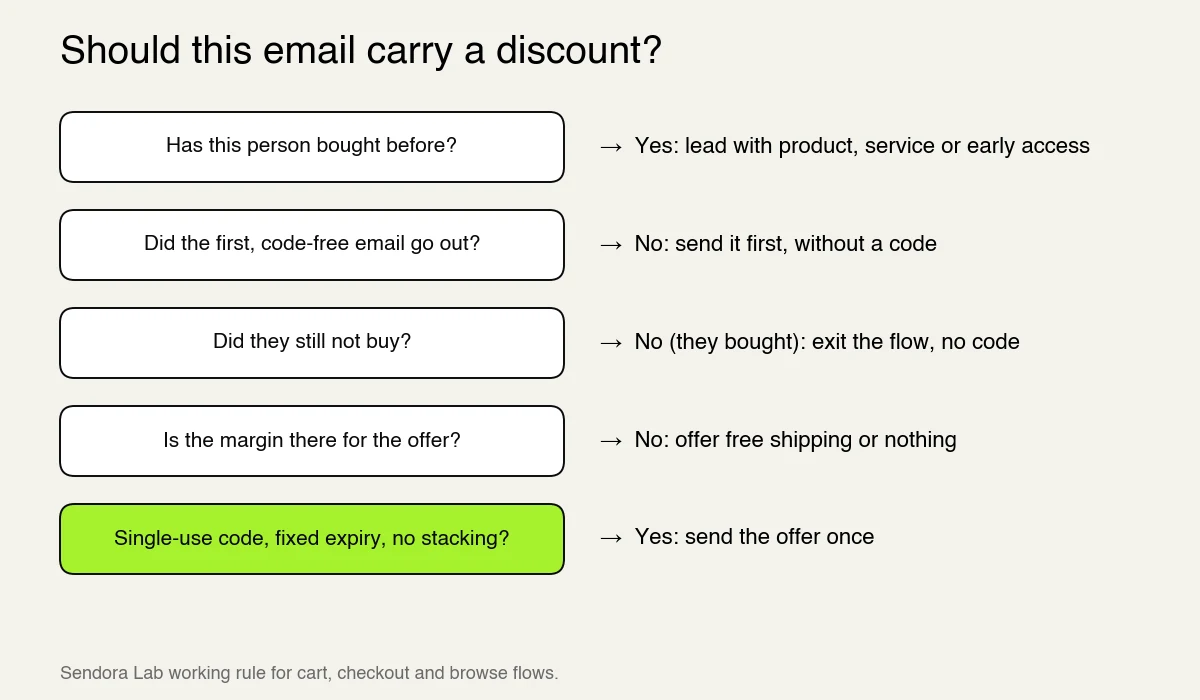
Walk through these questions for every flow that holds a code. If you can’t answer one, the discount is probably doing less than you think.
Lead with no code: what real flow data shows
The first, code-free email usually recovers more orders than the discount email that follows it. That is the clearest argument for waiting.
In Sendora Lab’s anonymised Klaviyo data from a Dutch fashion and home store on Shopify, the abandoned checkout flow (live since July 2026) splits people 50/50 into two versions. Both send a plain reminder 20 minutes after the checkout starts, then a 10% code about 12 hours later in version A and 6 hours later in version B. From July to November 2026, the flow was credited with 189 orders. The code-free first email brought 57 of them in version A and 65 in version B. The 10% emails brought 14 and 29.
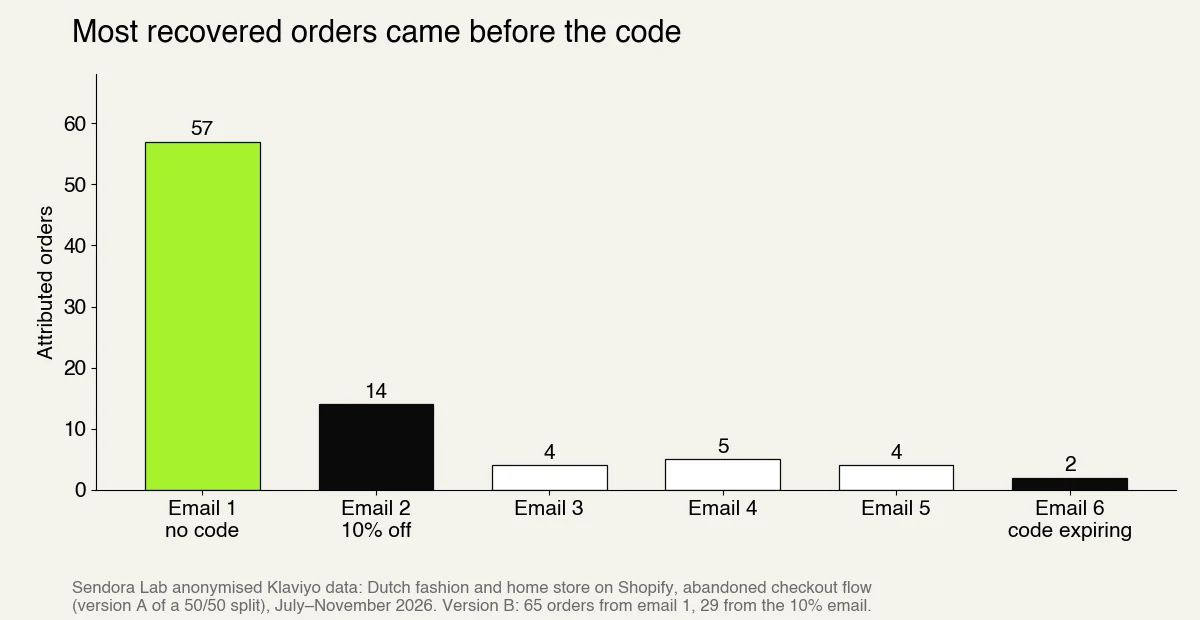
Two caveats. The first email reaches more people (1,749 and 1,763 recipients against 1,502 and 1,522 for the code email), because buyers drop out. And the 10% email may still earn its place: it brought 43 orders across both versions that might otherwise have been lost. The point is that putting the code in email 1 would have handed a discount to the 122 people who came back without one.
The same store’s abandoned cart flow (triggered by Added to Cart) shows the same shape at smaller volume, from March to November 2026: 9 orders from the code-free first email, 5 from the 5% email that follows. The abandoned cart flow guide covers timing in more detail.
Watch the offer size between flows
This store offers 5% in the cart flow and 10% in the checkout flow. That rewards the person who got further before leaving. If you treat people at each stage differently, make sure the logic is deliberate. The difference between cart and checkout abandonment is worth reading before you set the numbers.
Do discounted orders cost you more than the code?
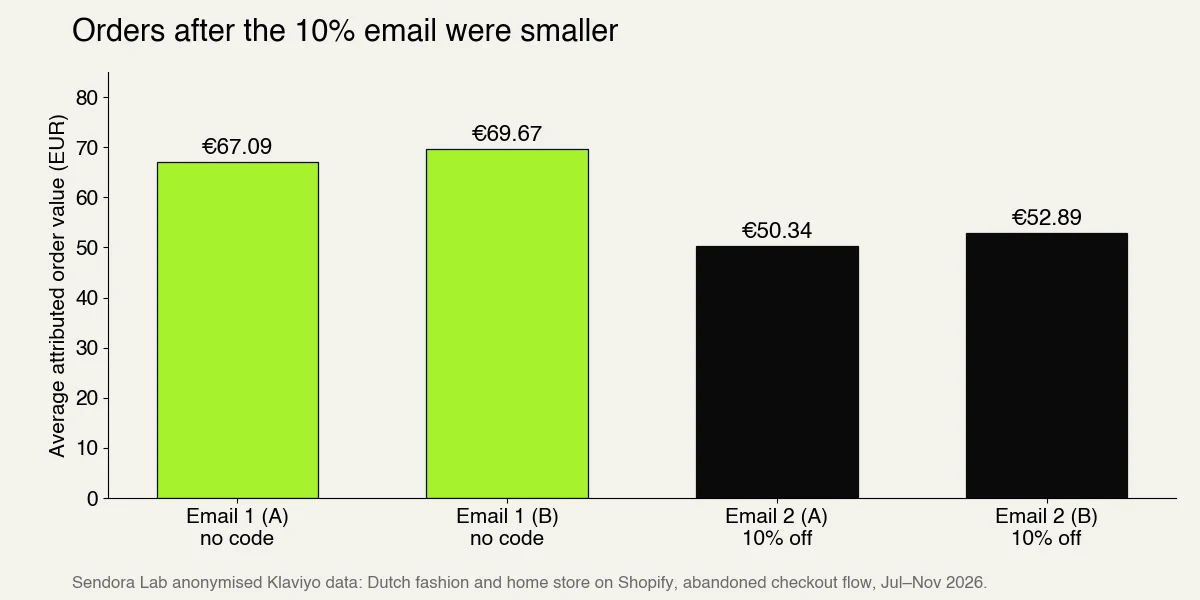
Often, yes: orders that follow a discount email tend to be smaller, so you give away margin on a lower basket.
In the same checkout flow, the average attributed order after the code-free first email was €67.09 (version A) and €69.67 (version B). After the 10% email it was €50.34 and €52.89. These are attributed orders, so we can’t confirm every one used the code, and smaller baskets may simply be the people most sensitive to price. Either way, the discount brought in cheaper orders.
If you do offer a code, a minimum order value protects the basket. So does a fixed amount off above a threshold instead of a percentage on anything.
How many of your orders already use a code?
Before adding a discount anywhere, measure what share of orders already uses one. Most discount guides skip this check, and it takes ten minutes.
Klaviyo receives coupon information with Shopify order events, so you can build a segment of people whose orders used a given code, as Klaviyo’s coupon code guide explains. The Dutch store also records a separate “Coupon Used” event from an app on its site. Dividing those events by Placed Order (our calculation) gives the share of orders that used an emailed code each month in 2026: 3.1% in June, 15.0% in September and 11.6% in October.
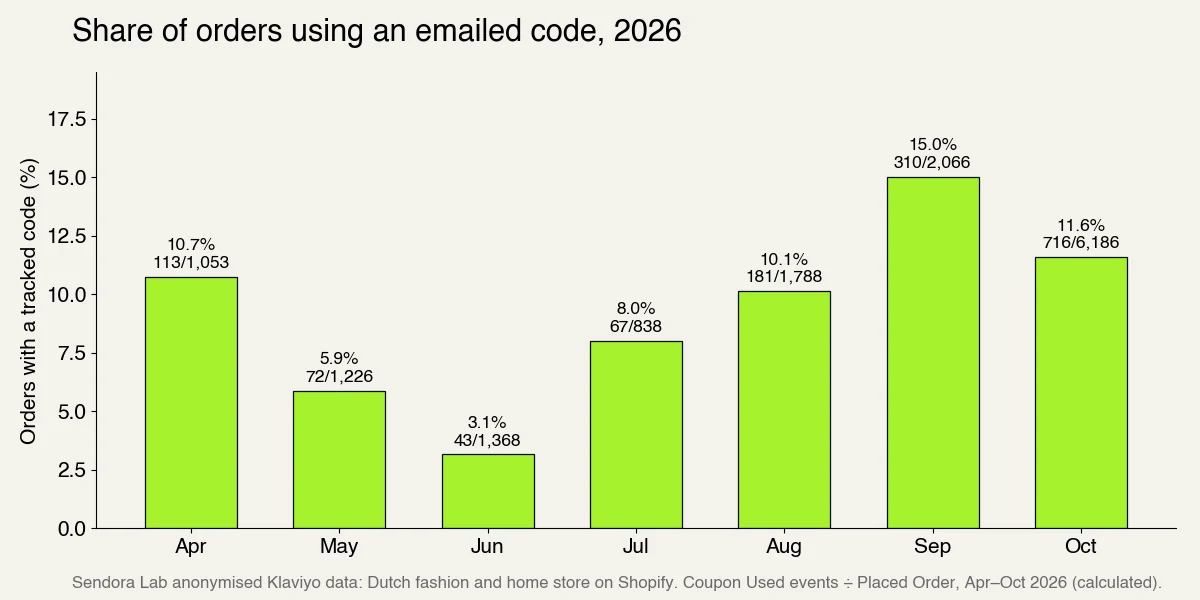
Code supply was far higher than use. In October 2026 Klaviyo logged 24,381 Coupon Assigned events (a code given to a profile) against 6,186 orders. When codes go to everyone, a rising share of orders on discount is the expected result. Track this number monthly; if it climbs while total orders don’t, your list is learning to wait for a code.
Where email discounts leak
Most leakage comes from setup, not strategy: codes that can be shared, codes that stack, and codes sent to people who were going to buy anyway.
- Static codes in flows. One shared code in an automated email ends up on coupon sites. Use unique coupon codes, which can be redeemed once.
- Stacking. In Shopify, discounts don’t combine unless each one allows it in its Combinations settings, according to Shopify’s discount combinations help page. Leave combinations off for email codes unless you mean it.
- Repeat buyers in recovery flows. A loyal customer who leaves a cart open will often come back. Split on “has placed order at least once” and send them a plain reminder.
- No exit filter. Without “Placed Order zero times since starting this flow”, people who already bought can still get the code.
- Expiry reminders on every flow. “Your code expires in 24 hours” works because it’s rare. In the Dutch store, the expiry email at the end of the checkout flow brought 2 orders from 1,144 recipients.
A discount ladder by lifecycle stage
Match the offer to where the person is. New subscribers and lapsed buyers can justify a code; browsers, recent buyers and your best customers mostly don’t.
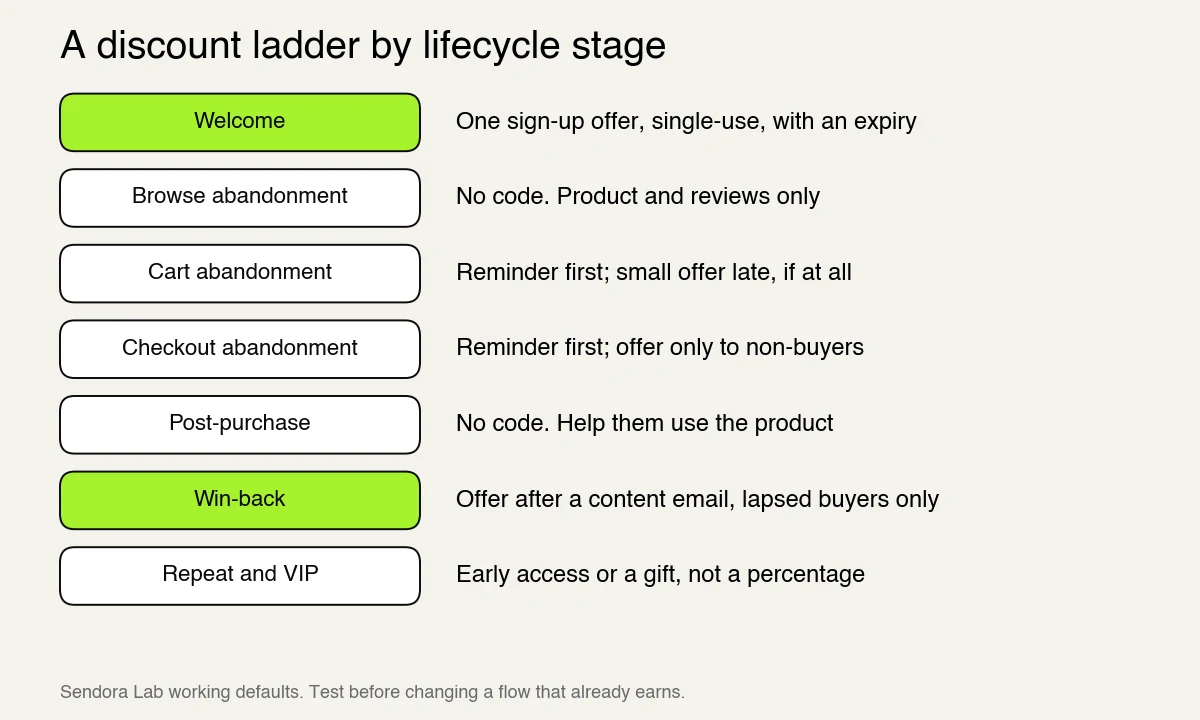
| Stage | Default | Why |
|---|---|---|
| Welcome | One single-use offer with an expiry | A clear reason to place the first order |
| Browse abandonment | No code | Intent is low; a code trains people to browse and wait |
| Cart and checkout | Reminder first, offer later to non-buyers only | Most recoveries come before the code |
| Post-purchase | No code | They just paid full price |
| Win-back | Content email first, then an offer | Lapsed buyers need a reason; a code can be it |
| Repeat and VIP | Early access or a gift | Protects margin on your most valuable orders |
For the welcome offer itself, see our welcome series guide.
Conclusion
An email discount strategy for ecommerce works when the code is the last step, not the first. Send a code-free reminder, offer a single-use code only to people who still haven’t bought, keep repeat customers on non-price offers, and track the share of orders using a code every month. If you’d like us to check where your Klaviyo flows give away margin, take a look at our email marketing services. For markdowns on items people already viewed, see our Klaviyo price drop flow guide.
FAQ
Should the first abandoned cart email include a discount?
Usually not. In a Dutch fashion and home store’s checkout flow, the code-free first email brought 57 and 65 orders in two versions, against 14 and 29 from the 10% email that followed.
How do I see how many orders used a discount code in Klaviyo?
For Shopify stores, Klaviyo receives coupon information with order events. Build a segment on Placed Order filtered by the discount code, then compare it with the people who received the code.
Do Shopify discount codes stack with other discounts?
Not by default. Each discount must allow the combination in its Combinations settings before Shopify applies more than one to an order.
Should repeat customers get discount codes by email?
Mostly no. Split recovery flows on past orders and give repeat buyers a plain reminder, early access or a gift instead of a percentage.
Do discount emails lower average order value?
They can. In the same store, orders after the 10% email averaged €50.34 and €52.89, against €67.09 and €69.67 after the code-free first email.
Want this set up in your Klaviyo account?
A free 30-minute audit, your account open on screen.
Book a free audit