



A Klaviyo audit checklist is a fixed list of checks that shows where an account is losing money or risking the inbox. You can run the core of it yourself in about 20 minutes, before you pay anyone to look. This guide gives you the checklist in the order we run it, what to look for at each step, and what we found when we ran it across real client accounts.
Short answer: check five things in this order: your sending setup (branded domain, DMARC, bounce and spam rates), your core flows (live, sending and filtered), your list health (how many subscribers clicked or bought in 90 days), your campaigns (who they go to and what each send costs in unsubscribes) and your reporting (email revenue next to store revenue). When Sendora Lab ran the flow check on 7 client Klaviyo accounts, all 7 had a live welcome, abandoned checkout and browse flow, but only 2 had a live win-back flow.
What a Klaviyo audit checks, and what 20 minutes can’t
A 20-minute audit finds the gaps and the obvious leaks; it doesn’t rewrite emails or test offers. Its job is a short, ranked list of fixes.
Two Klaviyo terms come up throughout. A flow is an automated series of emails or texts that starts when someone does something, such as joining your list or leaving a checkout. A segment is a list of profiles that updates itself from rules, such as “clicked an email in the last 90 days”. Most money in an account comes from a handful of each, so that is where the checklist spends its time.
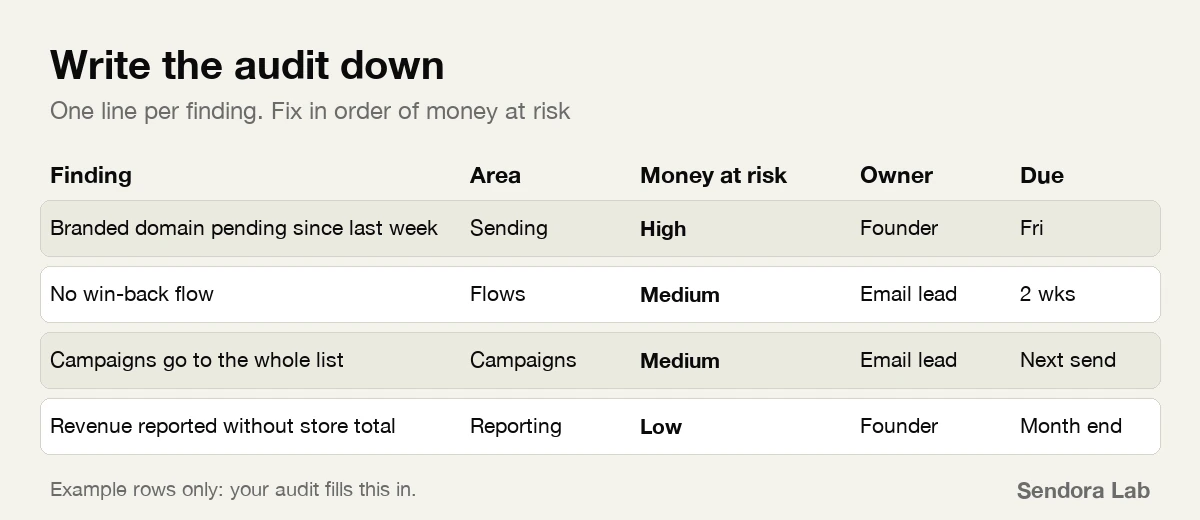
Klaviyo’s own best practices for auditing your account stress the step most people skip: write the findings down, then turn them into tasks with deadlines and an owner for each. Do that at the end of every block below.
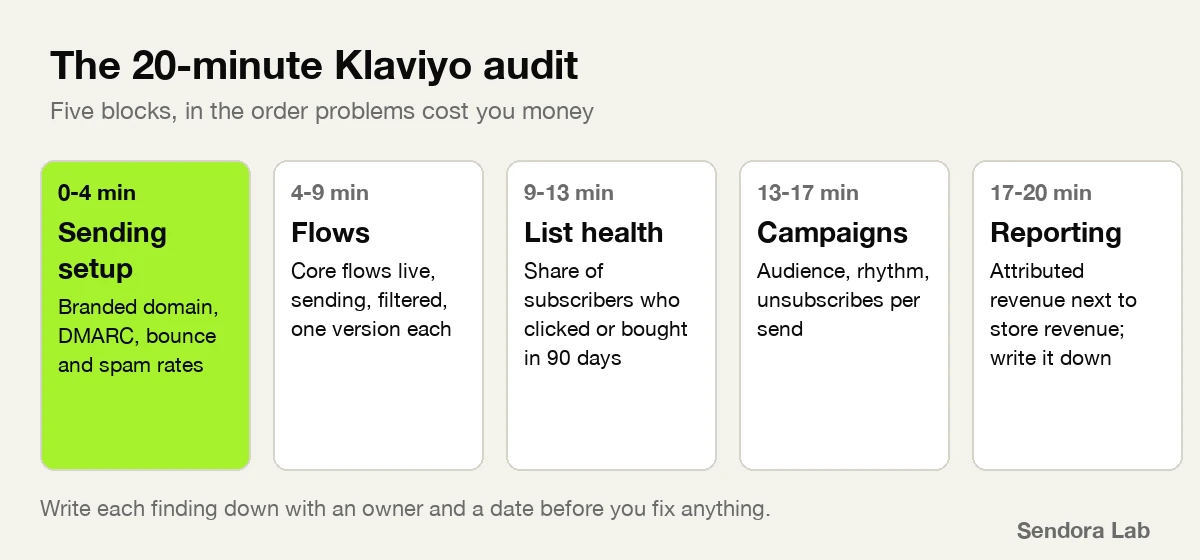
Minutes 0 to 4: sending setup and deliverability
Start here because nothing else matters if email doesn’t reach the inbox. Check three settings and three numbers.
- Branded sending domain. Settings → Domains should show your own sending domain as active. If it is missing or pending, you are sending from Klaviyo’s shared domain.
- DMARC record. Your domain needs one, at least p=none, and your From address must use the same root domain. Our guide to SPF, DKIM and DMARC explains the setup and shows a campaign where 60.08% of emails bounced because this didn’t line up.
- Sender details. Every flow and campaign should use the same From address on that domain, and a reply-to someone reads.
- Bounce, unsubscribe and spam complaint rates for the last 30 days, under Analytics → Deliverability.
Klaviyo’s deliverability monitoring guide rates a bounce rate under 1.0% as healthy and over 2% as needing attention, an unsubscribe rate under 0.3% as healthy and over 1% as needing attention, and a spam complaint rate under 0.01% as healthy and over 0.05% as needing attention.
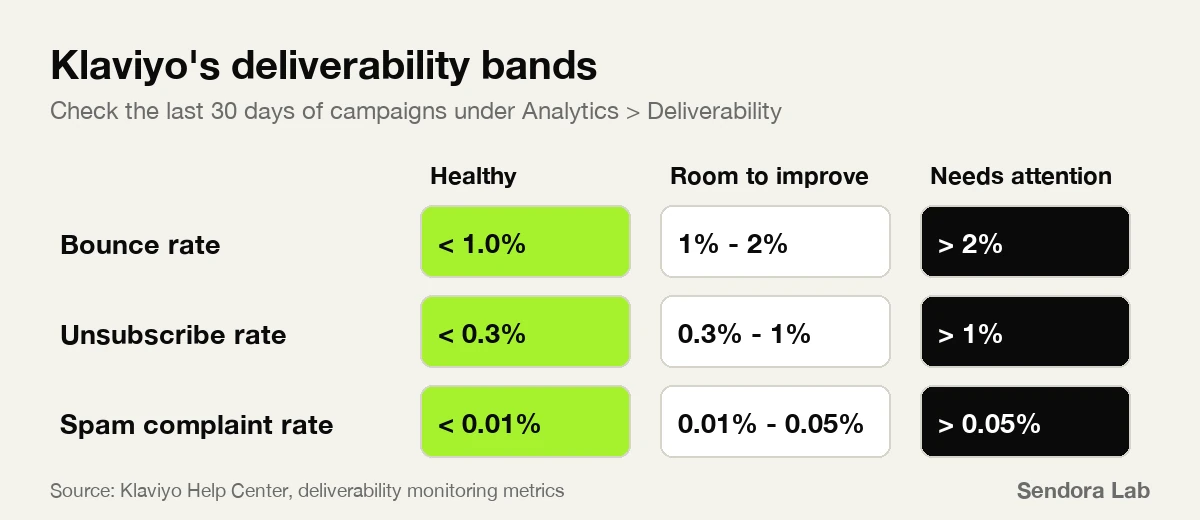
This check fails more often than you’d think. Across 17 client Klaviyo accounts we checked on 20 Oct 2026, 11 had an active branded sending domain, 4 had one stuck in pending and 2 had none. If any rate sits in the red band, our Shopify email deliverability guide covers the fixes.
Minutes 4 to 9: the core flows
Open Flows and check that seven flows exist, are live, are actually sending, and exist only once. A flow can be “live” and still send nothing if its trigger or tracking is broken.
| Flow | Trigger | Check |
|---|---|---|
| Welcome series | Added to your signup list | Email 1 sends at once and delivers what the form promised |
| Abandoned checkout | Started Checkout | Flow filter excludes anyone who has placed an order since |
| Added to cart | Added to Cart | Excludes people already in the checkout flow |
| Browse abandonment | Viewed Product | Recipients in the last 30 days; zero means tracking is broken |
| Post-purchase | Placed Order or Fulfilled Order | More than an order confirmation: a thank-you, help or next step |
| Win-back | Placed Order, with a long delay | Timed to your real reorder gap, not a guess |
| Sunset | Joining an unengaged segment | Ends with profiles being suppressed, not just tagged |
For each live flow, open its analytics for the last 30 days. Recipients should match roughly how many people do the trigger action, and the flow filter should stop people who already bought. Our guide to trigger filters vs flow filters shows where that rule belongs.
What we found in 7 accounts
We ran this check on 7 client Klaviyo accounts on 20 Oct 2026: two Dutch-language fashion stores, a Dutch outlet store, a small Polish store, a US sleep-supplement brand, a footwear store selling in Canada and a US health and beauty brand. All 7 had a live welcome, abandoned checkout and browse abandonment flow. Six had a post-purchase flow beyond the order confirmation, 4 had an added-to-cart flow, 3 had a sunset or suppression flow and only 2 had a win-back flow. If you are choosing between the two recovery flows, see abandoned checkout vs abandoned cart.
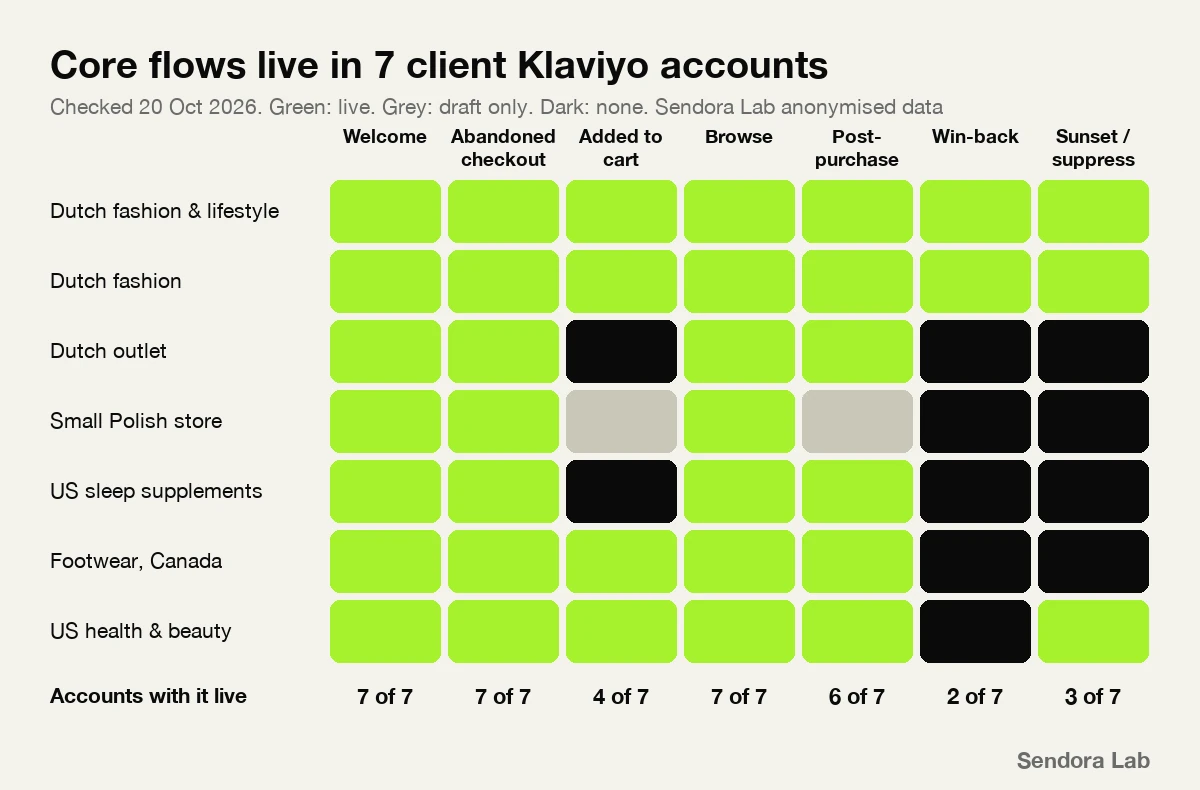
Two more patterns are worth checking in your own account. One store had two live abandoned-checkout flows and two live browse flows, each fed by a different tracking source, so the same shopper could qualify for both; check that duplicates exclude each other. Our guide to Klaviyo integrations shows how to find every tracking source in an account. In the same account, the sunset flow had not been edited since August 2024. Old flows aren’t wrong by default, but every flow should be opened at least once a year to check offers, links and filters still match the store.
Minutes 9 to 13: list health
Find out what share of your email subscribers clicked or bought in the last 90 days. Opens alone overstate it.
Build a segment of profiles who can receive email marketing and who clicked an email or placed an order in the last 90 days, then compare its size with everyone who can receive email. Our guide to the Klaviyo engaged segment has the exact conditions.
In Sendora Lab’s anonymised Klaviyo data for the 90 days to 20 Oct 2026, Store A, a Dutch-language fashion and lifestyle store on Shopify with 21,471 subscribers, saw 59.0% of them open an email but only 26.6% click or order. Store B, a Dutch outlet store on Shopify with 2,025 subscribers, showed 59.9% opening and 35.7% clicking or ordering. (Store A and Store B are labels for this guide only.) Both stores emailed more than 92% of their subscribers in that window.
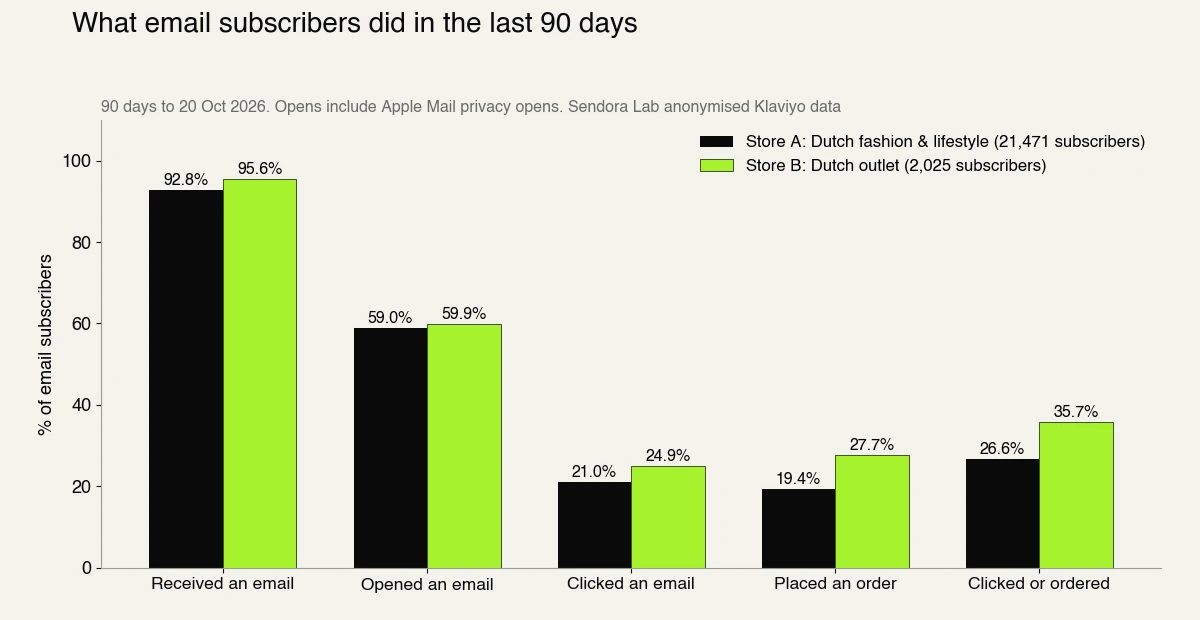
The gap between opens and clicks matters because Apple Mail privacy records opens that no person made. Count engagement on clicks and orders. If fewer than a third of subscribers clicked or bought in 90 days, as in Store A, check that campaigns go to an engaged segment and that a sunset rule moves the rest out.
Minutes 13 to 17: campaigns
Open the last ten campaigns and check who they went to and what each cost in unsubscribes and complaints. The audience choice usually matters more than the subject line.
- Audience. Are most sends going to an engaged segment, with the whole list saved for a few big moments? Sending everything to everyone is the most common finding.
- Exclusions. Recent buyers, people in a sunset flow and suppressed profiles should be left out.
- Rhythm. Sends should be steady from week to week, without long silences followed by a burst.
- Cost per send. Put the unsubscribe and spam complaint rate of each campaign next to its revenue per recipient. One send in the red band of the table above is worth a closer look.
Our guide to email campaign metrics explains which numbers to trust in the campaign report and which to treat as rough checks.
Minutes 17 to 20: reporting, then write it down
Put the last 30 days of Klaviyo attributed revenue next to total store revenue for the same 30 days. Attributed revenue is the order value Klaviyo credits to an email or text that someone opened or clicked within its attribution window.
Check two things. First, that the attribution window is written down and hasn’t changed since the last report, or month-to-month comparisons mean nothing. Second, that email is reported as a share of store revenue, not as a standalone total. Our guide to Klaviyo attributed revenue shows what gets counted and how to report it honestly.
Then finish the audit the way Klaviyo’s guidance recommends: one line per finding, with the area, how much money is at risk, an owner and a date. Fix sending setup first, then missing or broken flows, then list health, then campaigns. Run the same 20 minutes again every quarter.
Conclusion
A Klaviyo audit checklist works because it runs in the same order every time: sending setup, flows, list health, campaigns and reporting. In our data the gaps are rarely the welcome or checkout flows; they are the win-back and sunset flows, the pending sending domain and the list that opens but doesn’t click. If you’d rather have someone run the full version with you, see how we work, read about our Klaviyo email marketing service or book a free audit. For a store that is connecting Klaviyo for the first time, start with our Klaviyo Shopify integration guide. Add a monthly Klaviyo UTM tracking check so new flows and campaigns stay tagged. To review who can reach your data, see our Klaviyo private API key guide.
FAQ
How long does a Klaviyo audit take?
The core checks in this guide take about 20 minutes. A full audit with fixes, flow-by-flow results and a written plan takes longer, but the 20-minute version finds the biggest gaps.
How often should you audit a Klaviyo account?
Run the 20-minute checklist every quarter, and again after any big change such as a new sending domain, a new store platform or a new tracking app. If you are still choosing a platform, see Klaviyo vs Mailchimp.
Which Klaviyo flows should every store have?
Welcome, abandoned checkout, added to cart, browse abandonment, post-purchase, win-back and sunset. In our check of 7 accounts, win-back and sunset were the ones most often missing.
What is a healthy bounce rate in Klaviyo?
Klaviyo rates a bounce rate under 1.0% as healthy, 1% to 2% as room for improvement and over 2% as needing attention.
Want this set up in your Klaviyo account?
A free 30-minute audit, your account open on screen.
Book a free audit