



An abandoned cart means a shopper added an item and left before checkout. An abandoned checkout means they started checkout, gave an email or phone number, and left before paying. In Klaviyo these are two different flows with two different triggers, and the checkout one is usually worth more per email. Below is how they differ, how to run both without sending double emails, and what one store’s data shows.
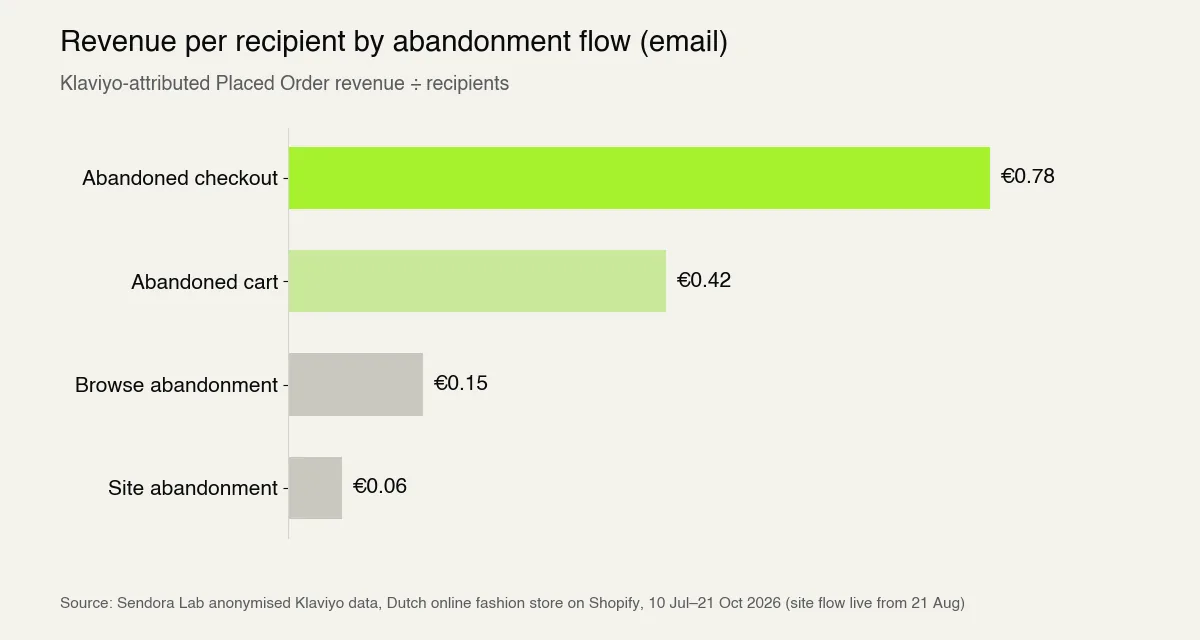
Short answer: build the abandoned checkout flow first, because it catches more shoppers and earns more per recipient. Then add an abandoned cart flow for people who never reach checkout, and filter it so anyone who starts checkout moves to the checkout flow. In Sendora Lab’s anonymised data from a Dutch fashion store, the checkout flow earned €0.78 per recipient and the cart flow €0.42.
What is the difference between an abandoned cart and an abandoned checkout?
The difference is how far the shopper got. A cart is abandoned on the store; a checkout is abandoned on the checkout page, after the shopper has typed in contact details.
In Klaviyo, a flow is a series of messages that sends on its own when something happens, and that “something” is the trigger. The cart flow is triggered by the Added to Cart event. The checkout flow is triggered by Checkout Started (some accounts call it Started Checkout). Klaviyo’s Shopify data reference says Checkout Started is recorded once Shopify sends checkout details with a valid email address or phone number.
Both sit in a ladder of four abandonment flows, from weak to strong intent:
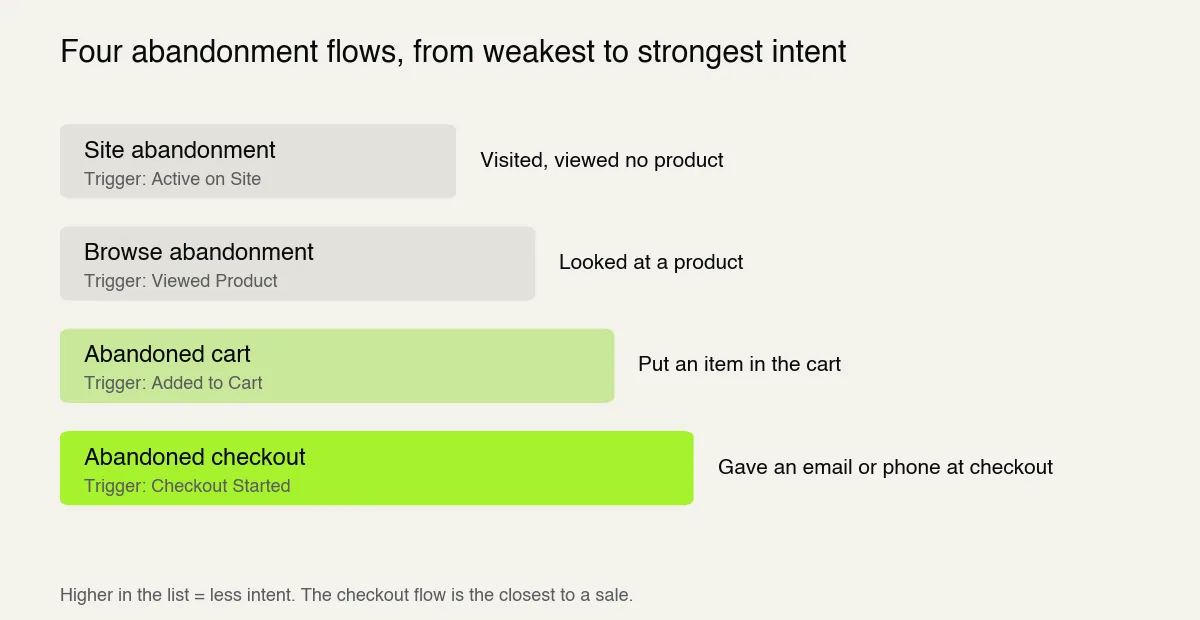
| Flow | Klaviyo trigger | What the shopper did | What the email should do |
|---|---|---|---|
| Site abandonment | Active on Site | Visited, viewed no product | Reintroduce the brand once |
| Browse abandonment | Viewed Product | Looked at a product | Help them judge that product |
| Abandoned cart | Added to Cart | Put an item in the cart | Bring them back to the cart |
| Abandoned checkout | Checkout Started | Gave contact details at checkout | Remove the last bit of friction |
If you want the detail on the lighter flows, see our guide to the Klaviyo browse abandonment flow.
Why Klaviyo often sees more checkouts than carts
Klaviyo can only record Added to Cart for shoppers it already knows. Checkout Started arrives from Shopify with the contact details the shopper just typed in, so it catches people the cart event misses.
Klaviyo’s guide to the Added to Cart flow for Shopify says the flow relies on Added to Cart events from identified shoppers, and that the event needs the Klaviyo app embed and the “Track behavioral events” setting switched on. An identified shopper is one Klaviyo can tie to a profile, for example because they once signed up or clicked an email.
The gap can be large. In Sendora Lab’s anonymised Klaviyo data from a Dutch online fashion store on Shopify, 697 unique profiles added to cart in August 2026, while 2,287 started checkout. In September 2026 the figures were 1,012 and 2,673. The same store recorded 1,761 and 2,014 profiles who placed an order in those months.
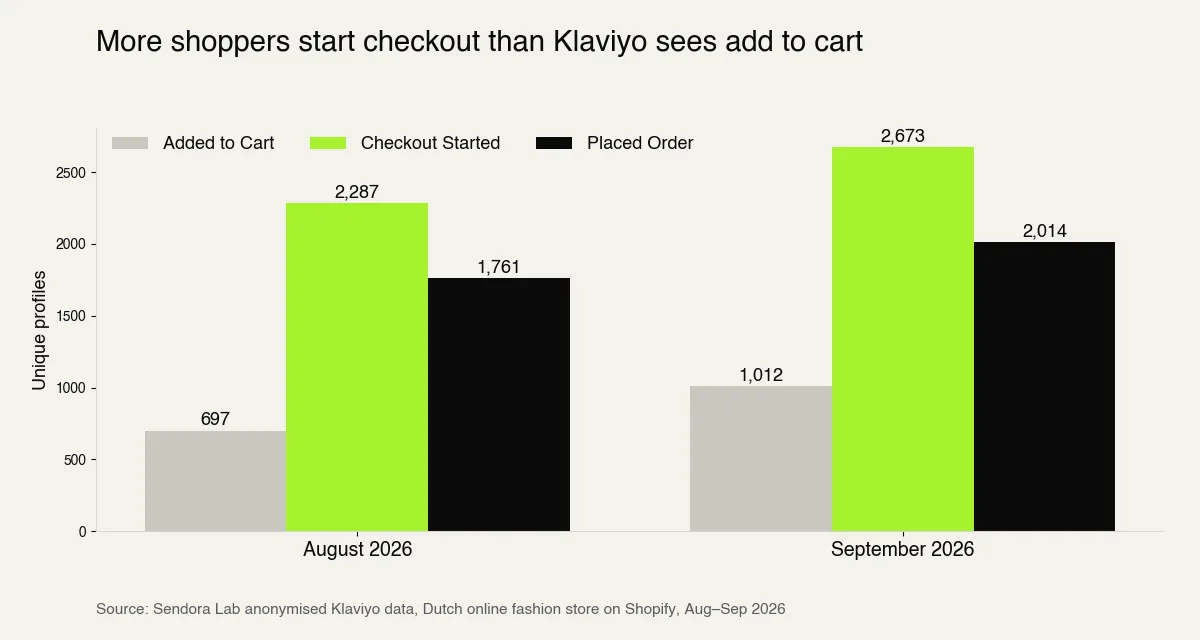
Note that Checkout Started also counts people who went on to buy, so it is not the number of abandoned checkouts. What the chart does show is that a cart-only setup would miss most shoppers who got as far as checkout. If your Added to Cart numbers look thin, check tracking first with our guide to Klaviyo integrations for Shopify.
Abandoned checkout vs abandoned cart: what one store’s flows earned
The checkout flow earned almost twice as much per recipient as the cart flow, and the cart flow earned almost three times the browse flow. Each step up the ladder was worth more.
These figures come from Sendora Lab’s anonymised Klaviyo data for the same Dutch online fashion store, email only, from 10 July to 21 October 2026 (the checkout flow was set up on 9 July and the site flow on 21 August). Revenue per recipient (RPR) is the Placed Order revenue Klaviyo attributes to the flow, divided by the people who received it. Our guide to Klaviyo revenue per recipient explains the maths.
| Flow | Recipients | Click rate | Placed order rate | RPR | Unsubscribe rate |
|---|---|---|---|---|---|
| Site abandonment | 26,887 | 2.31% | 0.12% | €0.06 | 2.35% |
| Browse abandonment | 17,499 | 3.08% | 0.25% | €0.15 | 1.51% |
| Abandoned cart | 1,818 | 4.70% | 0.77% | €0.42 | 1.44% |
| Abandoned checkout | 9,151 | 4.48% | 1.20% | €0.78 | 2.85% |
The first email shows the gap most clearly. The cart flow’s first email, sent 15 minutes after the event, reached 529 people, and 1.15% of them placed an order (€0.64 per recipient). The checkout flow ran a 50/50 test on its first email, sent after 20 minutes. One version reached 1,069 people with a 2.96% placed order rate (€1.78 per recipient); the other reached 1,086 people with 3.63% (€2.70 per recipient).
What the numbers don’t say
One store over about three months is a direction, not a benchmark. The checkout flow also had the highest unsubscribe rate, 2.85%, and it is six emails long. That is a reason to review the later emails, not to drop the flow.
How to set up both flows without double emails
Run them as two flows and let the cart flow hand shoppers over. Klaviyo’s guide on how to create an abandoned cart flow recommends separate Added to Cart and Started Checkout flows, because a checkout starter has shown stronger intent.
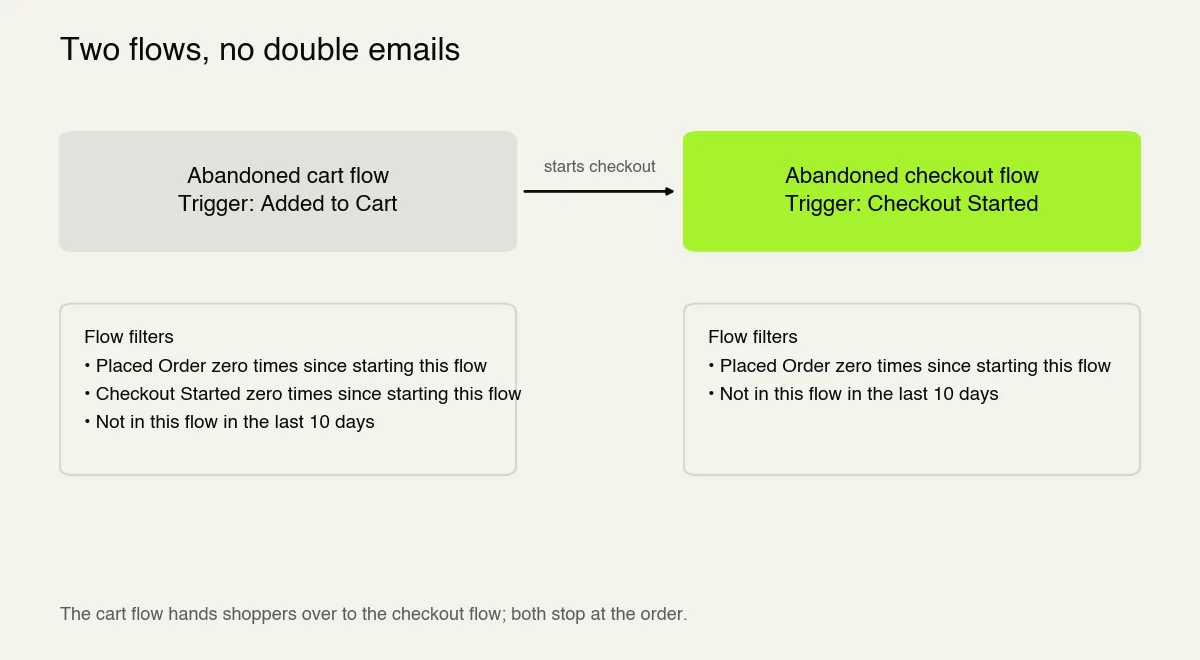
A flow filter is a rule Klaviyo checks when someone enters a flow and again before each message; anyone who no longer matches leaves. Set these:
- Both flows: “Placed Order zero times since starting this flow”. Buyers drop out before the next email.
- Cart flow only: “Checkout Started zero times since starting this flow”. Klaviyo’s guide names this filter. Anyone who reaches checkout leaves the cart flow and gets the checkout flow instead.
- Both flows: a re-entry limit. The store above uses 10 days, so a shopper who adds items three times in a week gets one sequence, not three.
If you are unsure which filter type to use, read Klaviyo trigger filter vs flow filter.
Write the two flows differently
The cart email reminds; the checkout email reassures. A cart shopper may still be comparing, so show the items, a review or two and delivery times. A checkout shopper had already decided, so answer the doubts that stop people at the last step: shipping cost, delivery date, returns and payment options.
Keep any discount out of the first email in both flows. The store above put a 5% code in its second cart email and a 10% code in its second checkout email. Our Klaviyo abandoned cart flow guide covers timing and when a code is worth it.
Which flow should you build first?
Build the abandoned checkout flow first. It catches the shoppers closest to buying, it doesn’t depend on Klaviyo recognising a browser, and in the data above it earned the most per recipient.
Add the cart flow second, with the checkout exclusion in place from day one. Then add browse abandonment, and site abandonment last. The site flow sent the most email of the four and earned the least per recipient. Our guide to the Klaviyo abandoned site flow covers its filters and unsubscribe risk.
Conclusion
Abandoned checkout vs abandoned cart is not a choice between two flows; it is a question of order. Start with checkout, add cart with a clean hand-over, and keep each flow’s message matched to how far the shopper got. If you want a second pair of eyes on your recovery flows, Sendora Lab builds and checks them as part of our Klaviyo email marketing service, or you can book a free audit. For when each flow should carry a code, read our email discount strategy guide. If browse, cart and checkout flows still reach the same shoppers, our Klaviyo flow overlap guide shows how to fix it.
FAQ
Is an abandoned checkout the same as an abandoned cart?
No. An abandoned cart means the shopper added an item and left before checkout. An abandoned checkout means they started checkout and gave an email or phone number, then left before paying.
Do I need both an abandoned cart and an abandoned checkout flow in Klaviyo?
Most Shopify stores benefit from both, and Klaviyo recommends running them as separate flows. Add a “Checkout Started zero times since starting this flow” filter to the cart flow so nobody gets both.
Why does my Klaviyo abandoned cart flow send so few emails?
Added to Cart is only recorded for identified shoppers, and it needs the Klaviyo app embed and “Track behavioral events” switched on. In one store, 697 profiles added to cart in August 2026 while 2,287 started checkout.
Which abandonment flow earns the most?
In Sendora Lab’s anonymised data from a Dutch fashion store (10 July–21 October 2026), the checkout flow earned €0.78 per recipient, the cart flow €0.42, browse €0.15 and site €0.06.
How soon should the first abandoned checkout email go out?
Klaviyo’s pre-built flows wait 4 hours. The store in this post sends after 20 minutes. Test what suits your buying cycle and keep the Placed Order filter in place either way.
Want this set up in your Klaviyo account?
A free 30-minute audit, your account open on screen.
Book a free audit