



A Black Friday email plan is the list of emails you will send around the sale, who gets each one, and what has to be ready before November. The work that decides the result happens weeks earlier: warming the list, building the sequence and checking your flows. This guide gives you a plan you can copy every year, with real Klaviyo data from two stores.
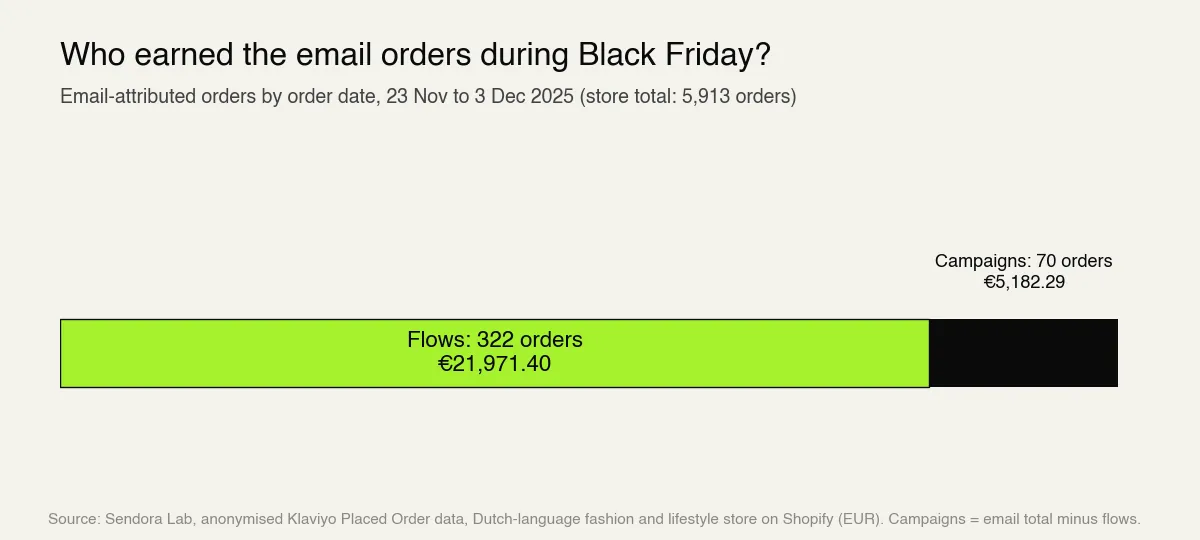
Short answer: keep sending steadily from October so inbox providers know your volume, build and schedule the whole sequence by early November, send most emails to engaged segments and only two or three to the full list, and check your flows, because they do most of the selling. In Sendora Lab’s anonymised Klaviyo data from a Dutch-language fashion and lifestyle store on Shopify, flows earned 322 of the 392 email-attributed orders between 23 November and 3 December 2025, and the eight campaigns earned the rest.
What a Black Friday email plan includes
A good plan covers four things: the warm-up in October, the sequence of campaigns, the audience for each email, and the state of your flows. A campaign is a one-off email you send to a list or segment on a day you choose. A flow is an automated series, such as an abandoned cart email, that sends when a shopper does something. A segment is a group of profiles that matches rules you set, such as “clicked an email in the last 30 days”, and Klaviyo keeps it up to date.
The stakes are high because the week is so much bigger than the rest of the season. In Sendora Lab’s anonymised Klaviyo data from the Dutch-language store (we call it Brand A; the label is a pseudonym), the store took 3,936 orders worth €266,875.61 in the week of Black Friday, starting Monday 24 November 2025. In the first full week of November it took 1,116 orders worth €68,826.92.
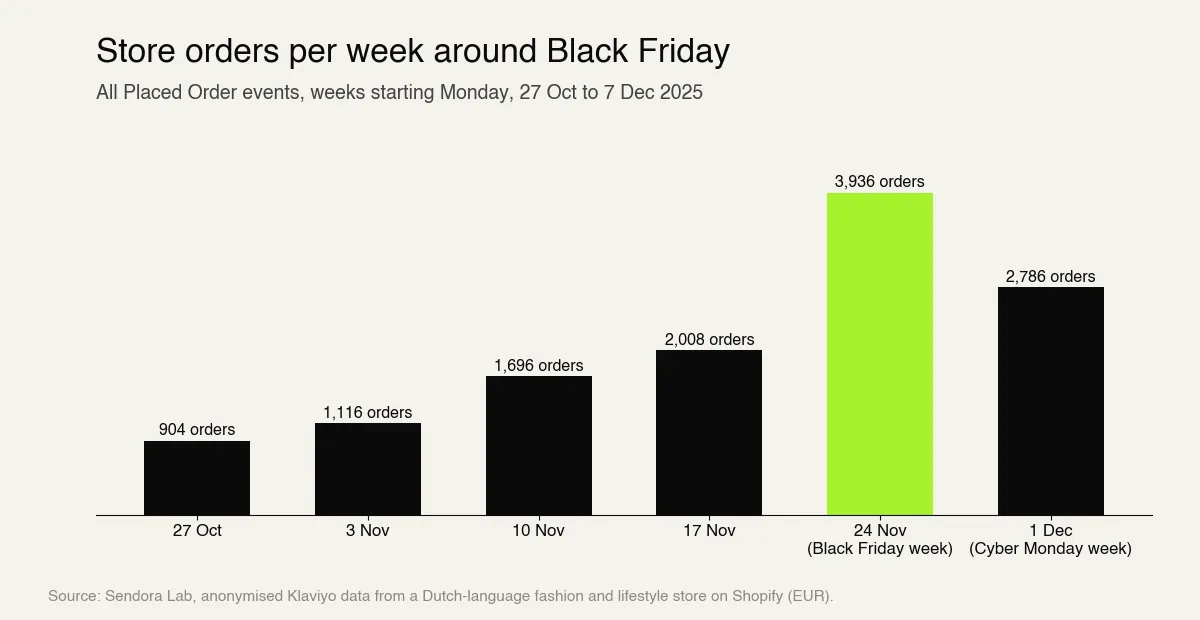
Most of those orders did not come from email, and that is normal. Email-attributed orders were 392 of the store’s 5,913 orders from 23 November to 3 December. Attributed means Klaviyo credited the order to an email the shopper opened or clicked shortly before buying; our guide to attributed revenue explains what that does and does not prove.
October: warm up the list before you need it
Inbox providers judge you on a steady pattern. A list that hears nothing for months and then gets a big sale email looks like a spammer to Gmail and Outlook. Check your SPF, DKIM and DMARC setup well before the sale too. Google’s email sender guidelines ask senders to send at a consistent rate, avoid bursts, and increase volume slowly, starting with engaged users.
The second store in our data shows what the opposite looks like. Brand B (also a pseudonym) is a US sleep-supplement brand on Shopify. Between 1 May and 27 November 2025 it sent two email campaigns, on 6 and 26 September, to 11,997 and 11,867 people. Then it sent one Black Friday email late on 28 November (US Eastern time) to 13,166 people.
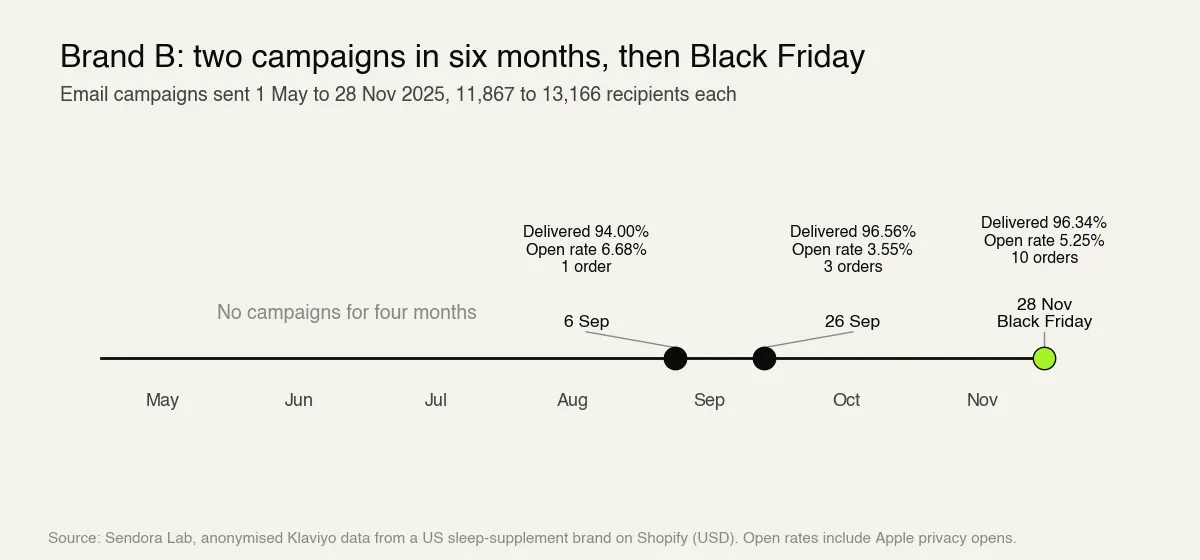
That Black Friday email reached the inbox of too few people to matter. 96.34% were delivered, 5.25% opened, 0.20% clicked, and it brought 10 attributed orders worth $496.38. Open rates include automatic opens from Apple Mail Privacy Protection, so the real figure is likely lower. We cannot say how much better a warmed list would have done, but a list that rarely hears from you cannot be woken up in one day.
Brand A did the opposite. It sent five campaigns to engaged or high-intent segments between 3 and 17 November, so its regular readers were active right up to the sale. Klaviyo’s article on Black Friday email deliverability suggests starting a list review at least three months before, in August or September, and removing people who have not clicked in 12 months. A sunset flow, which asks long-inactive subscribers whether they still want your emails and then stops sending to them, does this automatically.
The sequence: eight emails in eleven days
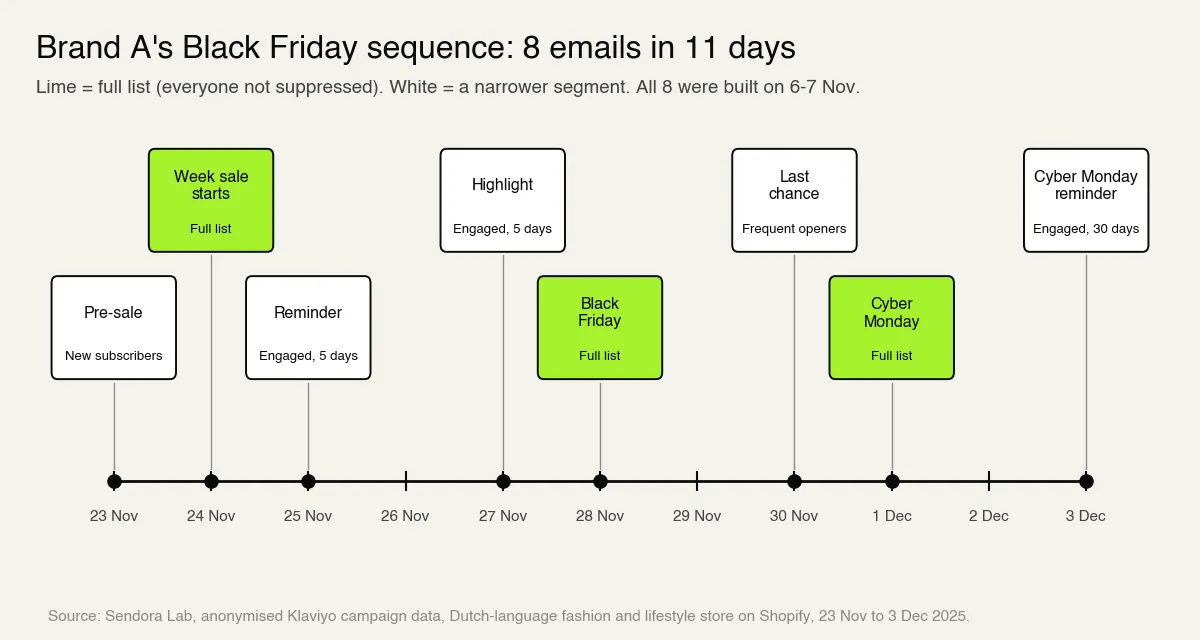
Brand A sent eight campaigns from Sunday 23 November to Wednesday 3 December. All eight were built in Klaviyo on 6 and 7 November, more than two weeks before the first send. That left time for checks and nothing for panic.
| Date | Audience | Recipients | Orders | Revenue per recipient | Unsubscribe rate | |
|---|---|---|---|---|---|---|
| Sun 23 Nov | Pre-sale | Joined in last 30 days | 4,855 | 3 | €0.040 | 3.10% |
| Mon 24 Nov | Week sale starts | Full list | 35,904 | 12 | €0.026 | 0.81% |
| Tue 25 Nov | Reminder | Engaged, last 5 days | 11,575 | 10 | €0.066 | 1.22% |
| Thu 27 Nov | Highlight | Engaged, last 5 days | 13,068 | 12 | €0.062 | 1.24% |
| Fri 28 Nov | Black Friday | Full list | 36,485 | 15 | €0.043 | 0.69% |
| Sun 30 Nov | Last chance | Opened 4+ times in 30 days | 12,175 | 6 | €0.041 | 1.45% |
| Mon 1 Dec | Cyber Monday | Full list | 28,767 | 9 | €0.020 | 0.65% |
| Wed 3 Dec | Cyber Monday reminder | Engaged, last 30 days | 18,425 | 8 | €0.031 | 1.16% |
Revenue per recipient is attributed revenue divided by the number of people who received the email, so you can compare a send to 5,000 people with a send to 36,000 (see revenue per recipient). Across the eight emails, 161,254 recipients produced 75 attributed orders worth €5,910.64, from Klaviyo’s campaign reports.
The shape is worth copying: a pre-sale for new subscribers, an opening email, reminders and highlights for engaged readers, one email on Black Friday itself, a last chance, and a Cyber Monday pair. Use the same skeleton next year and change only the offer, the dates and the design.
Who gets each email: full list or engaged segment
Send most of the sequence to people who engaged recently, and save the full list for two or three key moments. The data shows the trade-off clearly.
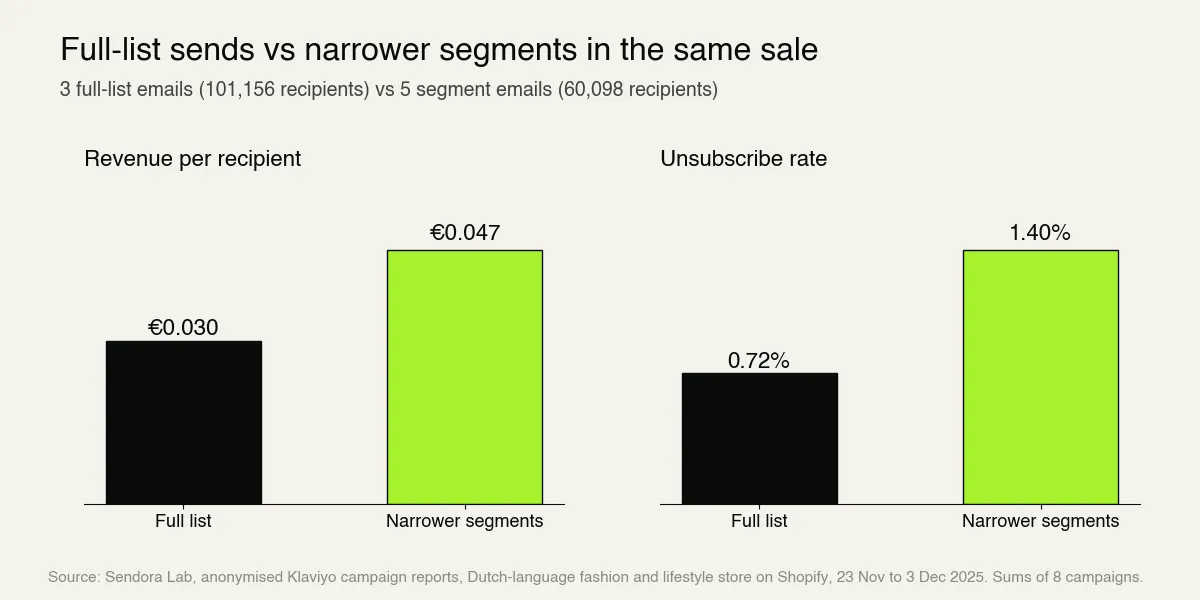
Brand A’s three full-list emails went to 101,156 recipients and earned €3,069.06, or €0.030 per recipient, with about 0.72% unsubscribing. Its five segment emails went to 60,098 recipients and earned €2,841.58, or €0.047 per recipient, but about 1.40% unsubscribed. The segments overlap, so the same active readers got most of the five emails. These are sums of the per-campaign reports, not a controlled test.
Two lessons follow. First, the full-list sends brought orders the segments would have missed, so a few are worth it in a sale week. Second, engaged readers have a limit: the pre-sale to new subscribers had the highest click rate of the sequence, 2.58%, and also the highest unsubscribe rate, 3.10%. Our guide to building an engaged segment in Klaviyo shows how to set these audiences up, and email marketing frequency covers the cost of each extra send.
Check your flows before November
Flows did most of the email selling. From 23 November to 3 December, Klaviyo attributed 392 orders worth €27,153.69 to Brand A’s emails, counted by order date. Flows earned 322 of those orders, worth €21,971.40. The eight campaigns account for the rest.
That makes your flows the first thing to check, not the last. Klaviyo’s guide to preparing flows for BFCM suggests:
- Shorter delays. Cut abandoned cart delays from 2 hours to about 30 minutes, and send the first browse email after 1 to 2 hours instead of 4.
- Smart Sending off on key flows. Smart Sending skips an email if the person got another one recently. Klaviyo suggests turning it off on welcome, abandoned cart and post-purchase flows so they still send during a busy week.
- Offers that match the sale. Replace an abandoned cart discount that clashes with the Black Friday offer, and update the welcome flow if your sign-up form promises a sale code.
- No double sends. If you build a sale version of a flow, add the profile filter “Received email zero times where flow equals” the original flow.
Our guide to the Klaviyo abandoned cart flow covers the base setup these changes start from.
Make it reusable: the yearly checklist
The point of a plan is that next year takes an hour, not a week. Save the sequence as named campaigns or templates, keep the segments live all year, and copy this timeline into your email campaign calendar:
- August to September: review the list and run your sunset flow on people who have not clicked in a long time.
- October: send at your normal weekly rhythm to engaged segments. Do not go quiet.
- First week of November: build and schedule the whole sequence, and update offers and delays in your flows.
- Sale week: watch unsubscribes and spam complaints after each send. Google asks bulk senders to keep the spam rate in Postmaster Tools below 0.10% and never reach 0.30%.
- The week after: put every campaign in one table, as above, and note what to change next year.
Klaviyo also suggests sending big campaigns a few minutes after the hour, for example at 9:15, because inbox providers are busiest on the hour.
Conclusion
A Black Friday email plan is mostly preparation. Keep the list warm through October, build and schedule the sequence by early November, send most emails to engaged readers, and get your flows ready, because in our data they earned four out of five email orders in the sale window. Then save the whole plan so next year starts from a finished draft.
Sendora Lab plans and builds Black Friday campaigns and flows for Shopify brands as part of our email marketing service. If you want your plan and flows checked before November, book a free audit.
FAQ
How many Black Friday emails should I send?
There is no fixed number. Brand A sent eight campaigns in eleven days, but only three went to the full list; the other five went to smaller segments, which earned more per person but had higher unsubscribe rates.
When should I start planning Black Friday emails?
Start the list review in August or September and keep sending steadily in October. Brand A built all eight sale campaigns on 6 and 7 November, more than two weeks before the first send.
Should I send Black Friday emails to my whole list?
Only a few. In Brand A’s data, full-list emails earned €0.030 per recipient against €0.047 for segment emails, but had lower unsubscribe rates. Two or three full-list sends at key moments is a reasonable balance.
Do flows matter during Black Friday?
Yes, a lot. Flows earned 322 of Brand A’s 392 email-attributed orders from 23 November to 3 December 2025. Shorten abandoned cart delays and update offers in your flows before the sale.
Want this set up in your Klaviyo account?
A free 30-minute audit, your account open on screen.
Book a free audit