



There is no single right number of emails per week. The right email marketing frequency depends on how recently each person engaged with you, so a good plan sends more to your best readers and much less to everyone else. This guide shows how to set that frequency, how to raise it without hurting deliverability, and what real send data from three Shopify stores says about sending more.
Short answer: start with one campaign a week to people who opened or clicked recently, add a second weekly send only for your most engaged readers, and send far less to people who have gone quiet. Judge any change on clicks, orders, unsubscribes and spam complaints per send, not on opens. In Sendora Lab’s anonymised Klaviyo data (October 2025 to September 2026), weekly sends to the same 2,300 people fell from PLN 1.453 to PLN 0.088 per recipient within three weeks, and when a store restarted after more than nine months without campaigns, 4.24% of its first big email bounced, against 0.04% on later sends to recently engaged subscribers. Customers who have stopped buying need different treatment, in a win-back segment.
What email marketing frequency means
Email marketing frequency is how many marketing campaigns one person receives in a week or a month. A campaign is a one-off email you send to a list or segment on a day you choose. Automated flows, such as a welcome series or abandoned cart emails, come on top of that, so a new subscriber who also leaves a cart can get far more email in a week than your campaign plan suggests.
Klaviyo’s Smart Sending setting is a safety net for that overlap. It skips a person who already received a marketing message within a set window, 16 hours by default for email, and it never skips transactional messages such as order confirmations. Our guide to Klaviyo Smart Sending explains when to keep it on. It caps collisions; it does not decide your frequency for you.
Frequency also lives on your calendar. Our guide to building an email campaign calendar shows how to turn the number you choose into a weekly rhythm with one job per send.
What real send data shows about sending more
We looked at a year of email campaigns in three stores, 1 October 2025 to 30 September 2026. Brand A, Brand B and Brand C are pseudonyms: Brand A is a small Polish online store on Shopify, Brand B is a Dutch-language fashion and lifestyle store on Shopify, and Brand C is a US supplement brand on Shopify.
Weekly sends to the same people earned less each week
Between 27 February and 4 April 2026, Brand A sent five campaigns to the same core audience of about 2,300 repeat buyers, VIP customers and engaged subscribers, roughly one a week. The restock email on 6 March earned PLN 1.453 per recipient from 15 orders. One week later the next email earned PLN 1.089 from 9 orders, and two weeks after that, on 27 March, PLN 0.088 from a single order.
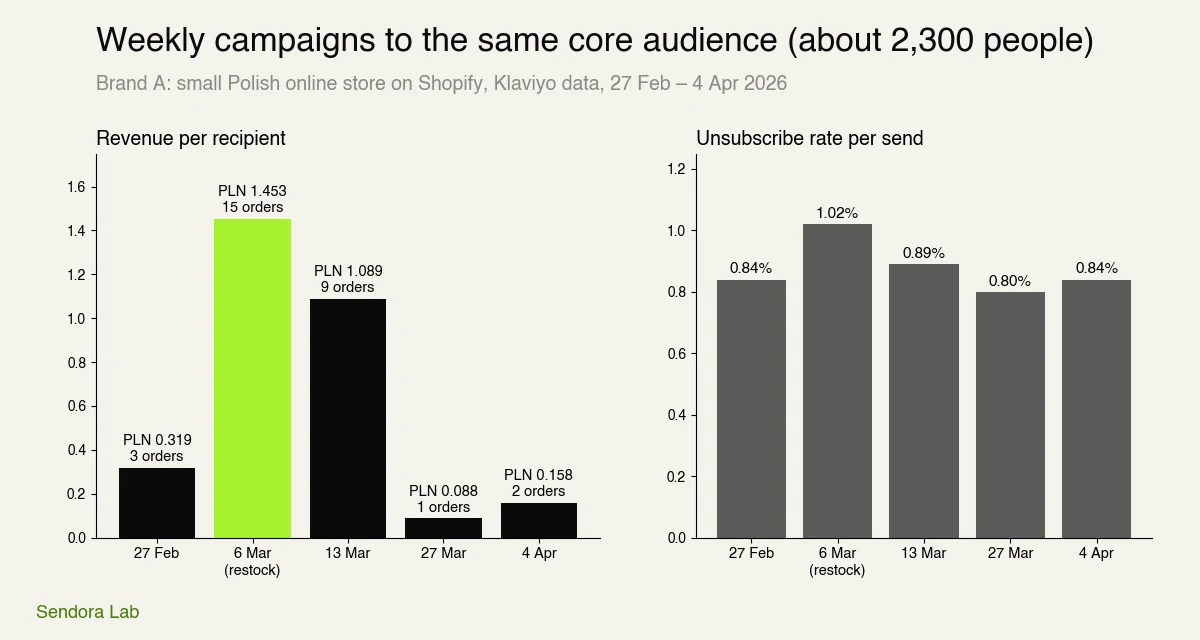
Revenue per recipient is attributed revenue divided by the number of people who received the email; our guide to revenue per recipient explains how to read it. The content changed every week, so this is not a clean test of frequency alone. But the cost side barely moved: every send lost between 0.80% and 1.02% of its recipients to unsubscribes, whether it earned PLN 1.453 or PLN 0.088 per person. A weekly send to the same people needs news worth sending, or the list pays for nothing.
A busy Black Friday stretch lowered clicks on the full list
Between 3 and 17 November 2025, Brand B sent five campaigns, all to engaged or high-intent segments. A segment is a group of profiles that matches conditions you set and updates automatically. Then it sent 8 campaigns in 11 days, from 23 November to 3 December: three to its full list and five to segments such as new subscribers, recent shoppers and frequent openers.
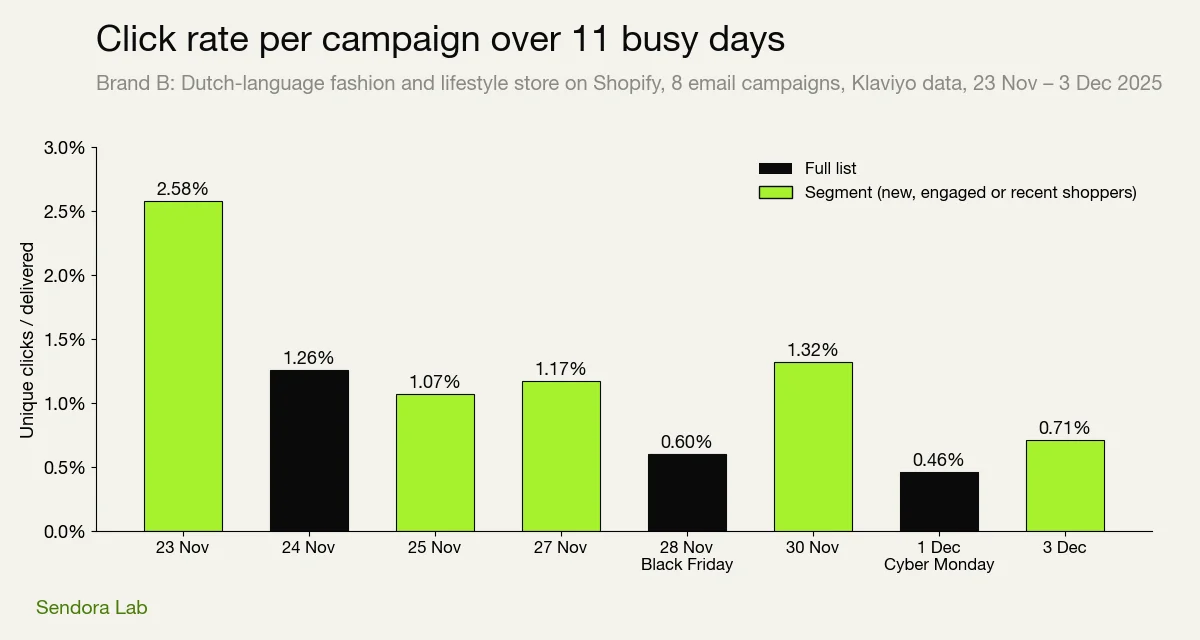
On the three full-list sends, the click rate fell from 1.26% on 24 November to 0.60% on Black Friday and 0.46% on Cyber Monday, while the five segment sends clicked at 0.71% to 2.58%. Every send in the stretch recorded attributed orders, but the full-list sends earned €0.020 to €0.043 per recipient, against €0.031 to €0.066 on the segment sends. The segment sends also lost more people per send, 1.16% to 3.10% unsubscribed against 0.65% to 0.81% on the full list, a pattern the next section explains. The offer and design changed every day and the Black Friday inbox is crowded (our Black Friday email plan shows how to work around that), so read this as a warning sign rather than proof: each extra full-list send reached more people, but fewer of them clicked.
A low unsubscribe rate can mean nobody is reading
Brand A’s six campaigns to its wider list from October to December 2025 had unsubscribe rates of 0.11% to 0.73%, lower than the 0.80% to 1.02% on its five core-audience sends from February to April. Those wider sends also had open rates of only 13.39% to 20.33%, against 30.32% to 42.07% on the core-audience sends. People who never open cannot unsubscribe, so a quiet unsubscribe rate on a cold list is silence, not approval. That is why frequency should follow engagement, not list size.
How to set email marketing frequency by engagement
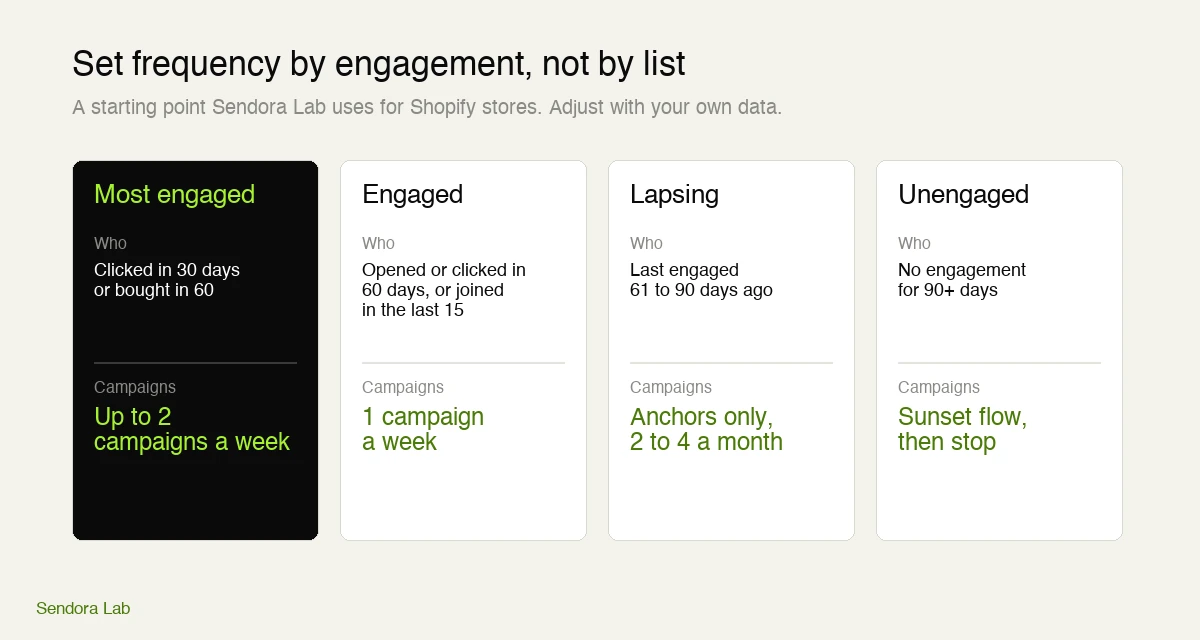
Split your subscribers by how recently they engaged and give each group its own frequency. This is the starting point Sendora Lab uses with Shopify stores; adjust it with your own numbers.
| Tier | Who is in it | Campaigns |
|---|---|---|
| Most engaged | Clicked in the last 30 days or bought in the last 60 | Up to 2 a week |
| Engaged | Opened or clicked in the last 60 days, or joined in the last 15 | 1 a week |
| Lapsing | Last engaged 61 to 90 days ago | Anchor dates only, 2 to 4 a month |
| Unengaged | No engagement for 90+ days | A sunset flow, then stop |
Klaviyo’s guide to increasing campaign open rates takes the same approach. It suggests starting with people who opened or clicked in the last 30 days plus anyone who subscribed in the last 15, widening to 60 days if open rates stay well above 20%, and matching your segments to how often you send. Our guide to building an engaged segment in Klaviyo walks through the exact conditions.
How to raise frequency without hurting deliverability
Add one send per week at a time, to your most engaged tier first, and run it for at least four weeks before you judge it. One busy week tells you very little.
- Compare per send and per week. Revenue per recipient will usually drop on each extra send. What matters is whether total weekly orders rise more than unsubscribes do.
- Watch spam complaints. Gmail’s email sender guidelines ask bulk senders to keep the spam rate in Postmaster Tools below 0.10% and never let it reach 0.30%.
- Keep the pace steady. The same guidelines ask senders to send at a consistent rate and warn that sudden jumps in volume can lead to rate limiting or reputation drops.
- Trust clicks, not opens. Apple Mail privacy opens inflate open rates, so use click rate and orders to decide.
- Step back if two signals turn. If unsubscribes per send rise and clicks fall for two weeks in a row, return to the previous frequency.
When to send less, and how to restart after a break
Send less to anyone who has stopped engaging, and never stop sending to everyone at once. Both mistakes show up in the data.
After its Black Friday email in late November 2025, Brand C sent no campaigns until 4 September 2026, more than nine months later. That Black Friday send to its active-subscriber list bounced 3.66% of 13,166 recipients. The first send back, to 18,281 active subscribers, bounced 4.24%, and Klaviyo recorded spam complaints from 0.09% of recipients. Later in September, two sends to people who had bought in the last 90 days bounced 0.19%, and three sends to people engaged in the last 30 days who had not ordered bounced 0.04%. A bounce is an email the receiving server did not accept, so the break did not clean the list; the stale addresses were still there when the store came back. Blocks can also come from missing SPF, DKIM or DMARC records.
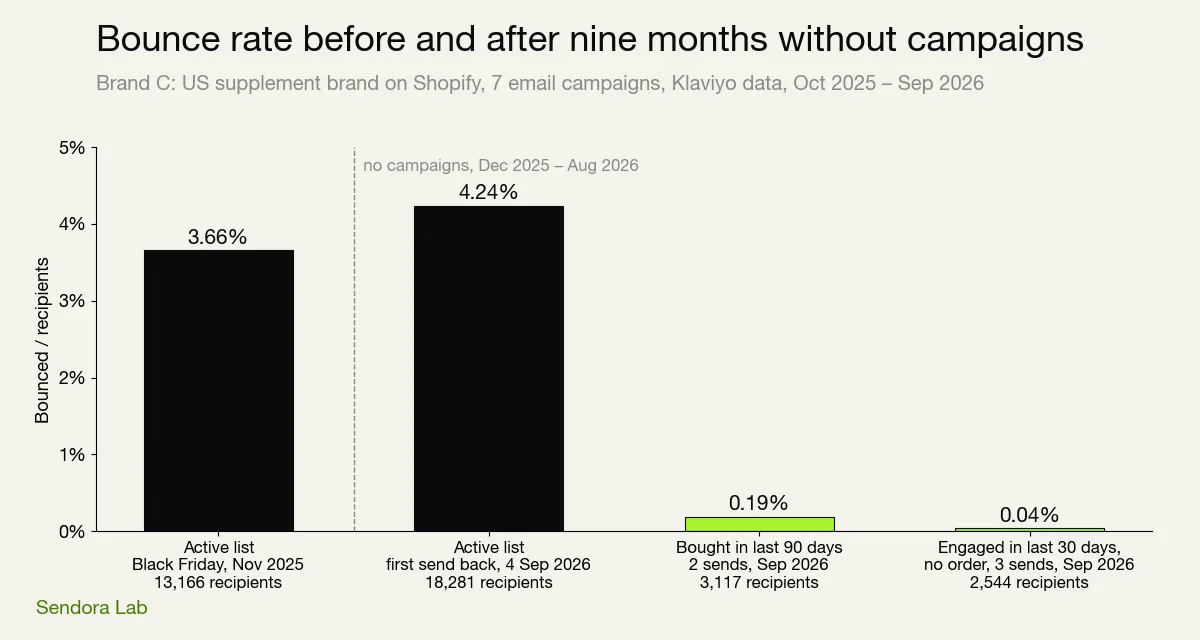
After a long pause, restart with your most engaged tier for two to three weeks, then widen the audience step by step. For people who no longer engage at all, a sunset flow asks once whether they still want your emails and then stops sending to those who don’t answer; our guide to sunset policies shows how to set one up, and email deliverability basics covers the rest of the inbox side.
Conclusion
Good email marketing frequency is not one number for the whole list. Send up to twice a week to people who click and buy, once a week to recent engagers, only big moments to lapsing subscribers, and nothing to people who have stopped reading. Raise frequency one step at a time and judge it on clicks, orders and unsubscribes, not opens.
Sendora Lab sets up engagement tiers and campaign rhythms for Shopify brands as part of our email marketing service. If you are not sure whether you send too much or too little, book a free audit.
FAQ
How often should an ecommerce brand send marketing emails?
Start with one campaign a week to people who engaged in the last 60 days, add a second weekly send only for your most engaged tier, and send far less to lapsing subscribers. Adjust with your own click, order and unsubscribe data.
Does sending more emails increase unsubscribes?
Every send costs some unsubscribes. In Brand A’s data, each weekly send to the same audience lost 0.80% to 1.02% of recipients, whether it earned a lot or almost nothing, so extra sends need a real reason.
Is two emails a week too many?
Not for your most engaged readers, if each email has news worth sending. Test it on that tier for at least four weeks and keep the spam rate below Gmail’s 0.10% guideline.
What happens if I stop sending emails for months?
Addresses go stale and inbox providers lose your sending history. When Brand C restarted after more than nine months, 4.24% of its first large email bounced, while later sends to people engaged in the last 30 days bounced 0.04%, so restart with your most engaged subscribers first.
Want this set up in your Klaviyo account?
A free 30-minute audit, your account open on screen.
Book a free audit