



A Klaviyo welcome series should send its first email the moment someone signs up, then spread four or five more emails across the next 14 days: one to deliver the offer, then education, proof, a decision nudge and a last reminder. Every email should stop as soon as the subscriber buys. Below is the exact plan I build, the settings that keep it from misfiring, and real data from a five-email series where the first email made 35 of 46 orders.
How a Klaviyo welcome series works
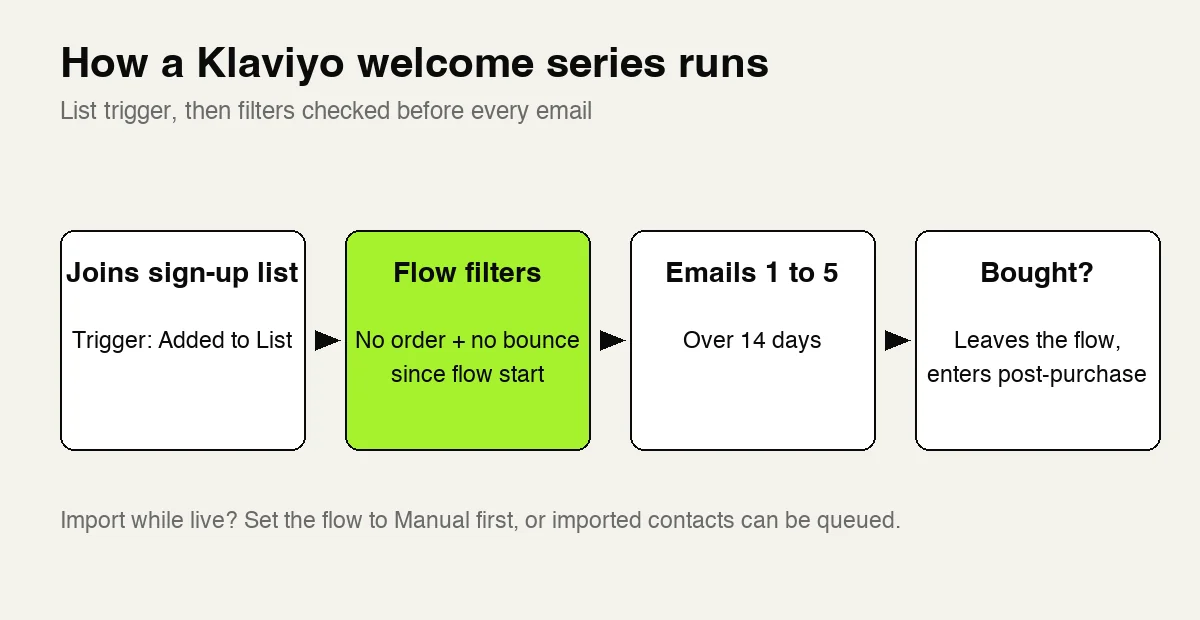
A Klaviyo welcome series is a list-triggered flow: a subscriber enters when they join your main sign-up list, and each person can only go through it once. Everything else, from timing to discounts, is up to you.
Klaviyo’s own welcome series guide ships a three-email default: one immediately, one three days later and one four days after that. That covers about a week. It also recommends keeping the email and SMS welcome flows separate, because people often give email and SMS consent at different times and can only enter a single welcome flow once.
Watch out for imports
If you import a list while the flow is live, everyone imported can be scheduled for the first email. Klaviyo’s advice is to set the flow to Manual before an import and back to Live afterwards. It’s one of the most common ways a store accidentally sends a “welcome” discount to thousands of existing customers.
What one store’s data says about each welcome email
The first email does most of the selling, so every later email needs its own job to earn its place. One account we work with shows how that plays out email by email.
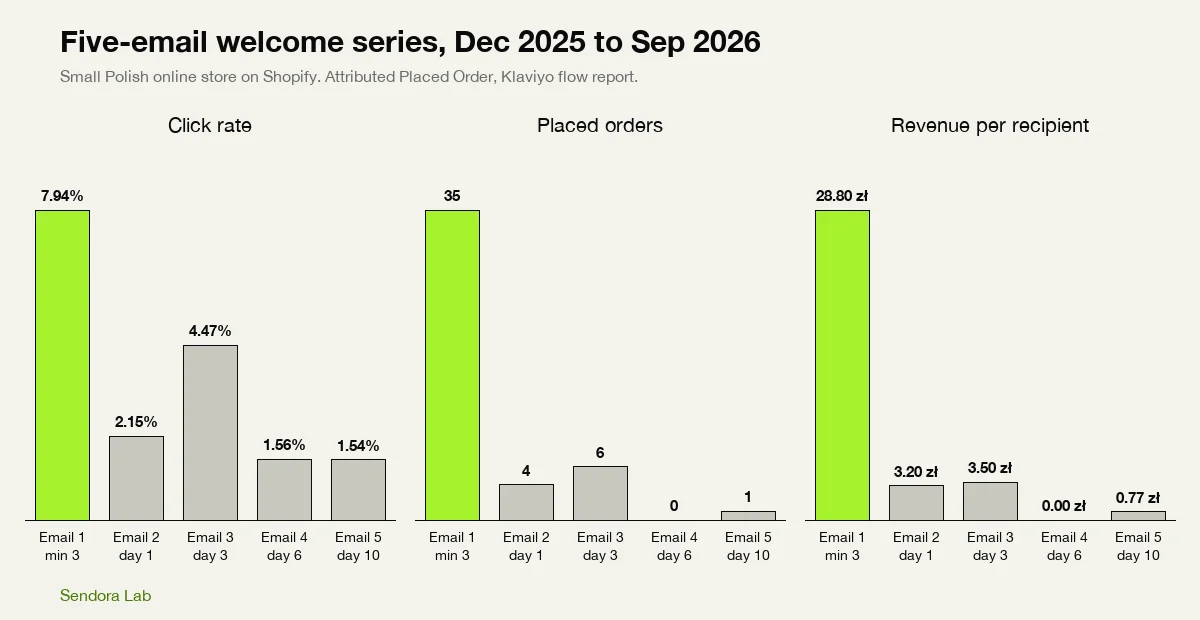
The store, a small Polish online store on Shopify, runs a five-email welcome series. Email 1 goes out three minutes after sign-up with a 10% code. Email 2 tells the brand story the next day, Email 3 on day 3 reminds people the code expires that day, Email 4 on day 6 shows the customer community, and Email 5 on day 10 is the last call. In Sendora Lab’s anonymised Klaviyo data for this store, from the flow’s launch in late December 2025 to September 2026:
| Email 1 (minute 3) | Email 2 (day 1) | Email 3 (day 3) | Email 4 (day 6) | Email 5 (day 10) | |
|---|---|---|---|---|---|
| Recipients | 292 | 340 | 328 | 334 | 271 |
| Open rate | 49.10% | 38.04% | 34.19% | 35.94% | 33.98% |
| Click rate | 7.94% | 2.15% | 4.47% | 1.56% | 1.54% |
| Placed orders | 35 | 4 | 6 | 0 | 1 |
| Revenue per recipient | 28.80 zł | 3.20 zł | 3.50 zł | 0 zł | 0.77 zł |
| Unsubscribe rate | 0.72% | 0% | 0% | 1.56% | 1.16% |
Email 1 brought 35 of the 46 attributed orders, worth 7,978.60 zł of the series’ 10,316.40 zł. The four later emails added 11 orders between them, and the day-3 code reminder did best of the four, with 6. The community email on day 6 converted nobody and had the highest unsubscribe rate in the series, 1.56%. That’s the pattern to look for: a later email earns its place when it does a job the first one didn’t, and the email with no orders is the first to rewrite. Klaviyo’s report counts fewer recipients for Email 1 than for Email 2 over this period, so compare rates and orders rather than volumes.
Bounces don’t stop after the first email
New sign-ups include typos and fake addresses. In this store, 5.14% of Email 1’s recipients bounced, and each later email still bounced between 4.12% and 4.57%. The flow filters out buyers but has no bounce filter. The report doesn’t show how many of the later bounces were repeat addresses, but a filter that removes anyone who has bounced since entering the flow rules that out and protects your sender reputation.
A 14-day Klaviyo welcome series, email by email
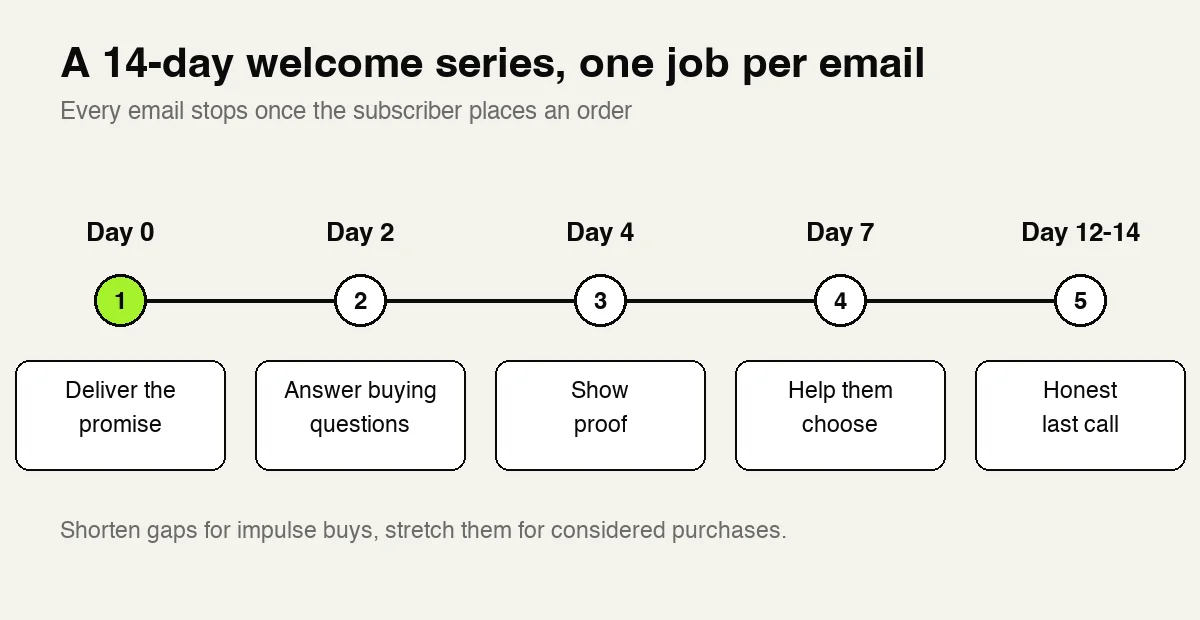
Five emails over 14 days gives each message one job and leaves enough space between them that people don’t feel chased. Adjust the gaps to your buying cycle: shorten them for cheap, impulse products and stretch them for considered purchases.
Email 1, immediately: deliver the promise
Put the code or the promised guide at the top, in text, not only in an image. Add one line about what makes the brand worth buying from and a single button to your bestsellers. If the popup said 10%, the email says 10%, with the same terms the checkout will apply.
Email 2, day 2: answer the buying questions
Cover the objections that stop a first order: sizing, materials, shipping times, returns. The store above uses this slot for a brand story, which added 4 orders, so answering buying questions is a fair test against it.
Email 3, day 4: show proof
Use real reviews, customer photos or a short founder story. The aim is to reduce the risk of a first order, not to add urgency.
Email 4, day 7: help them choose
Send bestsellers or a short “start here” edit by category. If the subscriber has viewed products, a dynamic product block showing what they looked at is more useful than a generic grid.
Email 5, day 12 to 14: the honest last call
If the code really expires, say so, with the date. If it doesn’t, don’t invent a deadline. End by telling people what to expect next, such as one newsletter a week, so they stay subscribed.
Settings that stop a welcome series misfiring
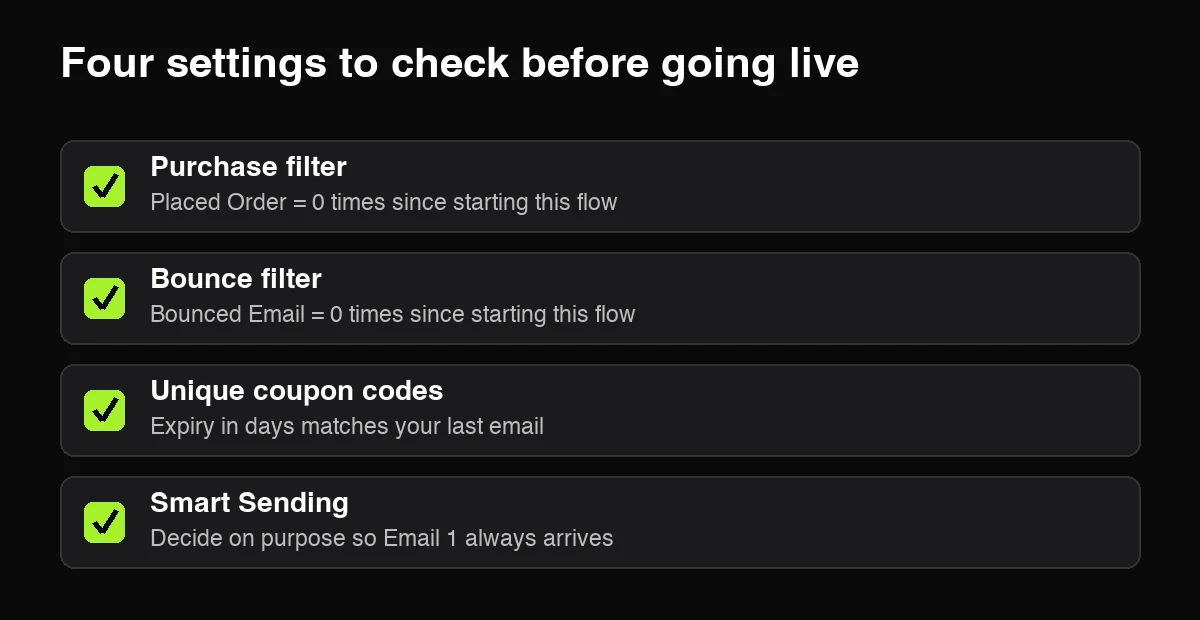
Most welcome series problems come from filters and coupons, not copy. Check these four before you set the flow live, and again in every Klaviyo audit.
- Purchase filter. Add the flow filter “Placed Order equals 0 times since starting this flow”. Klaviyo checks flow filters when someone enters and again before every email, as its guide to triggers and filters explains, so buyers drop out before the next discount email. They should move into your post-purchase flow instead.
- Bounce filter. Add “Bounced Email equals 0 times since starting this flow” so later emails skip addresses that have already failed.
- Unique codes with a real expiry. Klaviyo can create unique Shopify coupon codes for each subscriber and expire them after a set number of days. Match that number to your last email, so “expires Sunday” is true. Use the same coupon in every email and each person sees the same code.
- Smart Sending. Decide on purpose. Leaving it on can hold back a welcome email if the person was just emailed by another flow. The store above has it off on Email 1, so the promised code always arrives, and on for two of the later four.
Existing customers who join the list
People who have bought before sometimes sign up through a popup. Use a conditional split on “Placed Order at least once over all time” and send them a shorter welcome without the first-order discount. That avoids handing a discount to someone who was going to buy anyway.
How to measure a welcome series
Judge a welcome series by first orders, revenue per recipient and unsubscribes per email, not by open rate. Open rates are inflated by Apple Mail Privacy Protection, so clicks and orders are the better signal.
In Klaviyo, open the flow’s analytics, set the date range to at least 90 days and compare each email. Look for an email where orders drop to zero or unsubscribes jump. That email needs a new job, not just new copy. Also compare first-order conversion for subscribers who got the full series against those who bought after the first email, which tells you whether the later emails are adding anything.
One more check: count how many of your welcome orders used the welcome code. If almost every order needs a discount, test a non-discount incentive, such as early access or a useful guide, with a popup that grows the list without training people to wait for codes.
For a real example, see how a welcome series and a checkout reminder helped one brand reach Klaviyo results in 30 days.
Conclusion
A good Klaviyo welcome series sends the promised offer immediately, then uses four more emails over 14 days to answer questions, show proof, help people choose and close honestly. Filter out buyers and bounces, use unique codes with a real expiry, and measure each email by orders. The store above made 35 of its 46 welcome orders in the first email; the one later email with no orders is the cheapest place to test a new job.
If you want a welcome series built and tested alongside the rest of your retention flows, see how we run Klaviyo email marketing for Shopify brands, or book a free audit. Not sure which list should trigger it? See Klaviyo segments vs lists. Not sure what comes after the welcome series? See which Klaviyo flows to build first. To skip reminders for people who already ordered, add a Klaviyo conditional split after the first delay.
Want this set up in your Klaviyo account?
A free 30-minute audit, your account open on screen.
Book a free audit