



An email campaign works in four stages: the inbox provider decides where your email lands, the recipient decides whether to open it, the email earns a click, and the store turns that visit into an order. Each stage loses most of the people who reached it, so small fixes early in the chain matter more than clever copy at the end. Below is how each stage works, how Klaviyo decides which sales a campaign gets credit for, and where campaigns fit next to automated flows.
Short answer: a campaign is one email sent to a chosen list on a chosen day. Inbox providers filter it on your sender reputation, people open it on sender name and subject line, and Klaviyo credits it with any order placed within the attribution window after an open or click. In Sendora Lab’s data from a real store, campaigns sent more than twice as many emails as flows but earned less than a tenth of the revenue, which is why campaigns work best on top of good flows, not instead of them.
What an email campaign is, and how it differs from a flow
A campaign is a one-off email you send to a list or segment at a time you choose: a launch, a sale, a newsletter. A flow is a series of emails that sends automatically when someone does something, such as joining your list, leaving a cart or placing an order.
| Campaign | Flow | |
|---|---|---|
| What starts it | You, on a date you pick | A shopper’s action or a date on their profile |
| Who gets it | A list or segment, all at once | One person at a time, when they qualify |
| Timing | Your schedule | Moments after the trigger, or after a set delay |
| Typical job | News, launches, offers, stories | Welcome, abandoned cart, post-purchase, win-back |
| Work per send | A new email each time | Built once, then runs |
The rest of this guide follows one campaign from send to sale. If you are ready to build one, our step-by-step guide shows how to create a Klaviyo campaign, from audience to schedule.
Stage 1: Send, and the inbox decides first
Before anyone sees your email, Gmail, Outlook, Yahoo and Apple decide whether it goes to the inbox, a promotions tab or spam. That decision rests largely on your sender reputation: a score inbox providers build from how people react to your past emails, how many mark them as spam, and whether your domain is set up correctly. Sending most campaigns to an engaged segment keeps those reactions positive.
Gmail’s email sender guidelines set the floor for anyone sending 5,000 or more messages a day to Gmail accounts: authenticate with SPF, DKIM and DMARC, offer one-click unsubscribe, and keep the spam rate in Postmaster Tools below 0.10%, never reaching 0.30%. Our plain-English guide to SPF, DKIM and DMARC covers the setup.
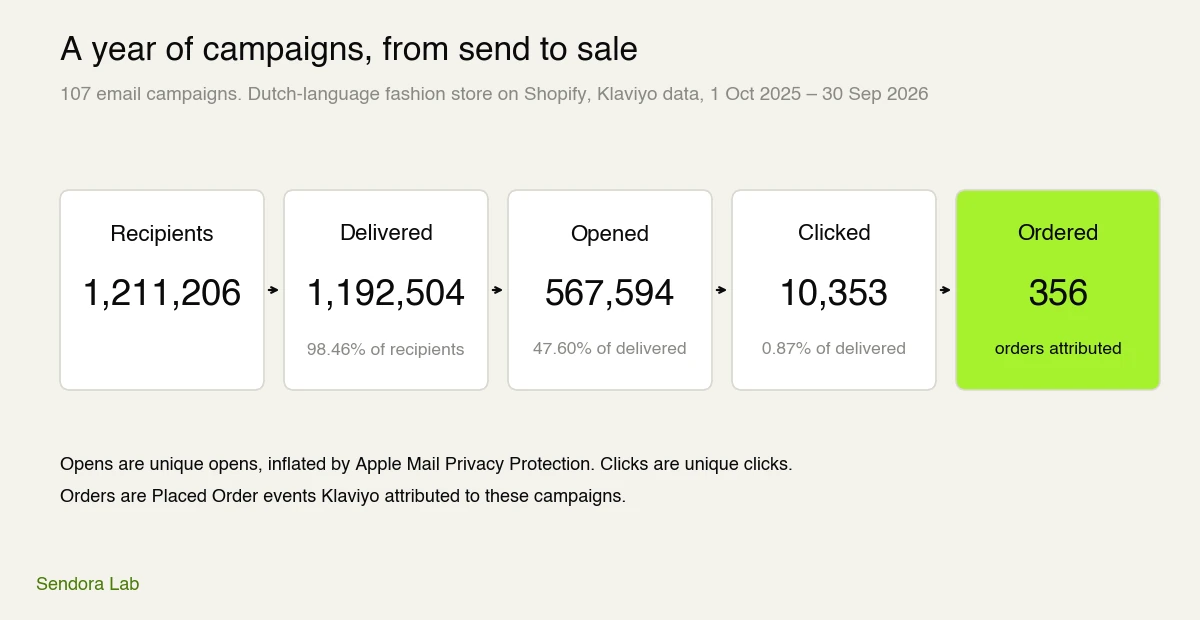
“Delivered” in Klaviyo only means the receiving server accepted the email, not that it reached the inbox. In Sendora Lab’s anonymised Klaviyo data from a Dutch-language fashion and lifestyle store on Shopify (107 email campaigns, 1 October 2025 to 30 September 2026), 1,192,504 of 1,211,206 recipients were delivered, or 98.46%. The same campaigns recorded 207 spam complaints, 0.017% of delivered emails, which is not the same measure as Gmail’s Postmaster rate but is a useful early warning.
How email campaigns work after the inbox: open, click, order
Each stage keeps only a fraction of the people from the stage before. Here is the full year of campaigns from the same store:
Open: sender name and subject line
People decide in a second, mostly on who the email is from and what the subject line promises. The store’s campaigns show an open rate of 47.60% of delivered emails, but treat that number with care: Apple Mail Privacy Protection loads emails automatically for Apple Mail users who switch it on, so a large share of “opens” are machines, not people. We explain how to read opens now in what open rates mean after Apple Mail Privacy Protection.
Click: one clear reason to visit
The email’s job is to earn the click, not to close the sale. Across the year, 10,353 people clicked, 0.87% of delivered. That is the first number in the chain you can trust as human behaviour, and it is the one to compare between campaigns.
Order: the store finishes the job
The landing page has to match the email. If the email shows a product and the link drops people on the homepage, most of them leave. In the store’s data, the 10,353 clicks were followed by 356 attributed orders worth €23,716.15, which is €0.0196 per recipient. Revenue per recipient is attributed revenue divided by the number of people who received the email, and it is the fairest way to compare one campaign with another.
How Klaviyo decides which sales a campaign gets credit for
Klaviyo credits an order to the email the shopper most recently opened or clicked, as long as the order happens inside the attribution window: the number of days after an open or click during which a purchase still counts. Klaviyo’s conversion tracking guide gives a default of five days for accounts created since October 2024, and you can change it in your account settings.
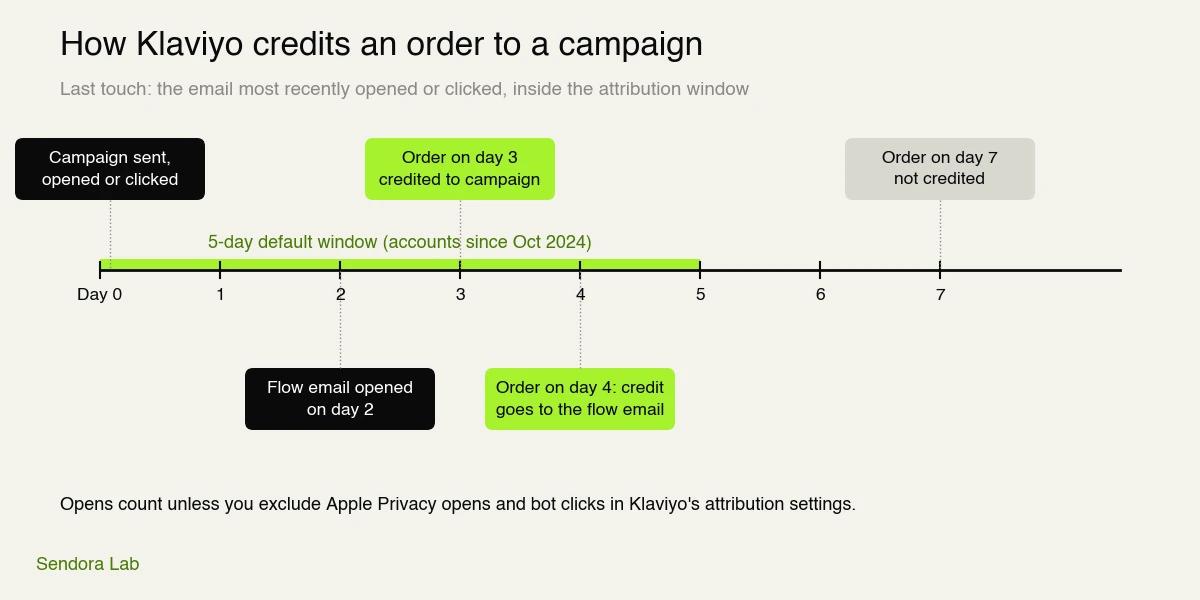
Three details change the numbers you report:
- Opens count, not just clicks. Someone who opened a campaign and later bought from a Google search is still credited to the campaign.
- Apple Privacy opens count by default. Klaviyo lets you remove bot clicks and Apple Privacy opens from attribution, which lowers reported revenue but makes it more honest.
- Last touch wins. If a shopper opens a campaign and then a flow email before buying, the flow email gets the order.
Attributed revenue is a useful signal, not proof that the email caused the sale. Our guide to attributed revenue, explained honestly shows how to read it next to your store’s total sales.
Where campaigns fit next to flows
Flows earn more per email because they arrive when a shopper has just shown intent; campaigns arrive when you are ready. Over the same twelve months, the same store’s 16 email flows, including its welcome, abandonment and shipping-confirmation emails, went to 585,363 recipients and earned €250,934.81 in attributed revenue, or €0.4287 per recipient. Its 107 campaigns went to 1,211,206 recipients and earned €23,716.15, or €0.0196 per recipient.
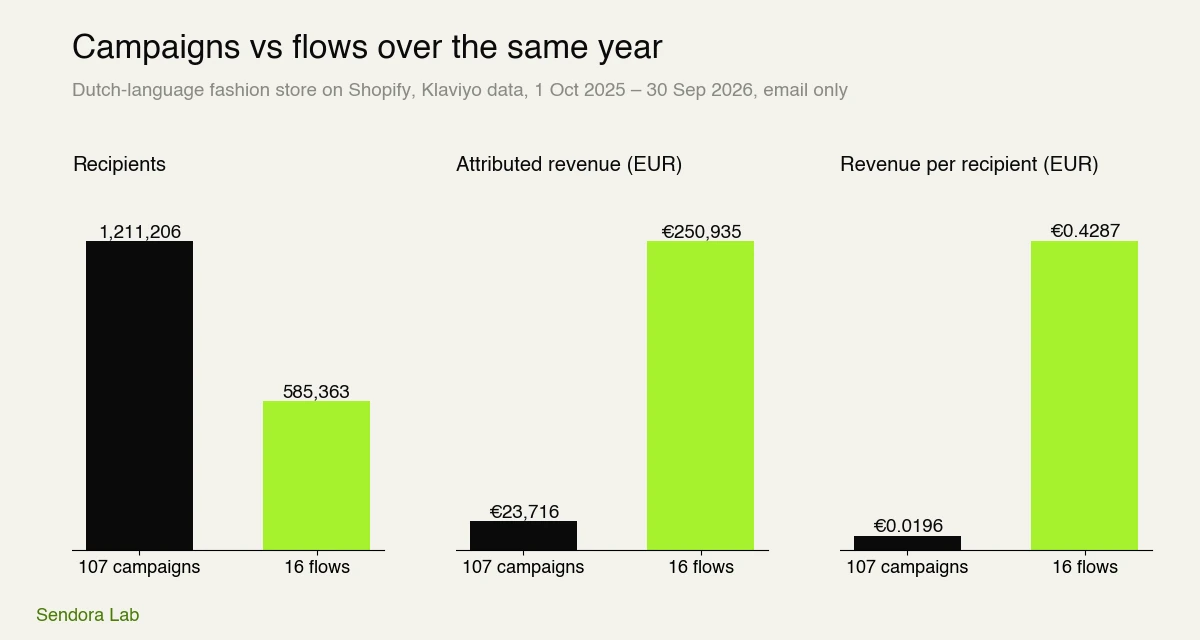
That gap does not make campaigns pointless. They do three jobs flows cannot:
- They start the journeys flows finish. A shopper who clicks a campaign, browses and leaves a cart enters your abandonment flows. Our guide to Klaviyo Smart Sending explains how to stop the campaign from blocking the flow email that follows.
- They carry news. New collections, restocks and events have no trigger, so only a campaign can announce them.
- They keep the list warm. People who never hear from you between purchases stop opening, which hurts your reputation for every email, flows included.
The order of work follows from the numbers: build the flows first, starting with a Klaviyo welcome series (in this store, its welcome flow earned €1.2548 per recipient over the same year), then run campaigns on top.
What a year of campaigns looks like
Campaign results are uneven, and a single send tells you little. The store sent between 7 and 11 campaigns every month. November 2025, the month of Black Friday (see our Black Friday email plan), earned €6,098.87 from 11 campaigns, while April 2026 earned €802.08 from 9. Over the year, 21 of the 107 campaigns recorded no attributed order at all.
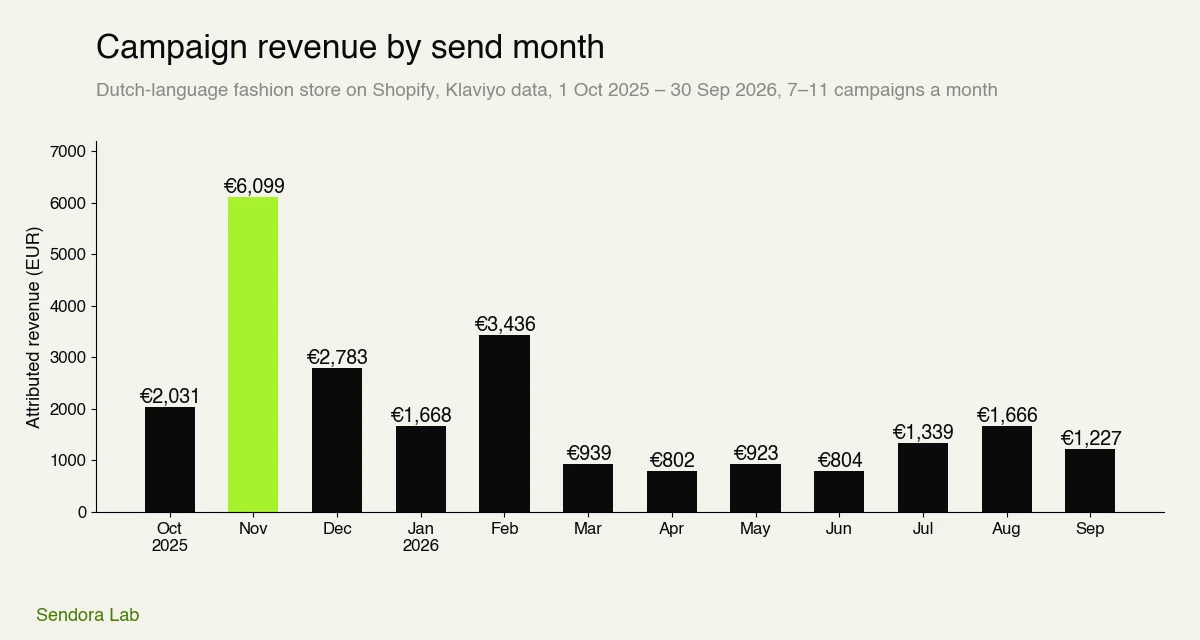
So judge campaigns in batches, by audience and by month, not one by one, and plan them a month ahead with an email campaign calendar. Watch the unsubscribe rate as closely as revenue (our guide to email campaign metrics shows why): the store’s campaigns recorded 15,661 unsubscribes over the year, 1.31% of delivered emails. Each one is someone your flows can no longer email, which is why email marketing frequency matters.
Conclusion
How email campaigns work comes down to a chain: reputation gets you into the inbox, the sender name earns the open, one clear message earns the click, and the landing page earns the order. Klaviyo then credits the sale to the last email opened or clicked within the window. In our data, campaigns delivered reach and news while flows delivered most of the revenue, so the best campaign plan sits on top of strong flows. If you want help with both, Sendora Lab plans and runs Klaviyo email marketing for Shopify brands, or you can book a free audit.
FAQ
What is the difference between an email campaign and a flow?
A campaign is a one-off email you send to a list or segment on a date you choose. A flow sends automatically to one person at a time when they do something, such as joining your list or abandoning a cart.
How does Klaviyo attribute revenue to a campaign?
It credits an order to the email the shopper most recently opened or clicked, if the order happens within the attribution window. The default window is five days for accounts created since October 2024.
Why do flows earn more than campaigns?
Flows reach people right after they show intent, such as leaving a cart. In our store data, flows earned €0.4287 per recipient over a year, against €0.0196 for campaigns.
Does “delivered” mean my email reached the inbox?
No. Delivered means the receiving mail server accepted the email. It can still land in a promotions tab or the spam folder.
Which campaign metric should I trust most?
Clicks and revenue per recipient. Open rates are inflated by Apple Mail Privacy Protection, so they are a weak guide to what people actually read.
Want this set up in your Klaviyo account?
A free 30-minute audit, your account open on screen.
Book a free audit